
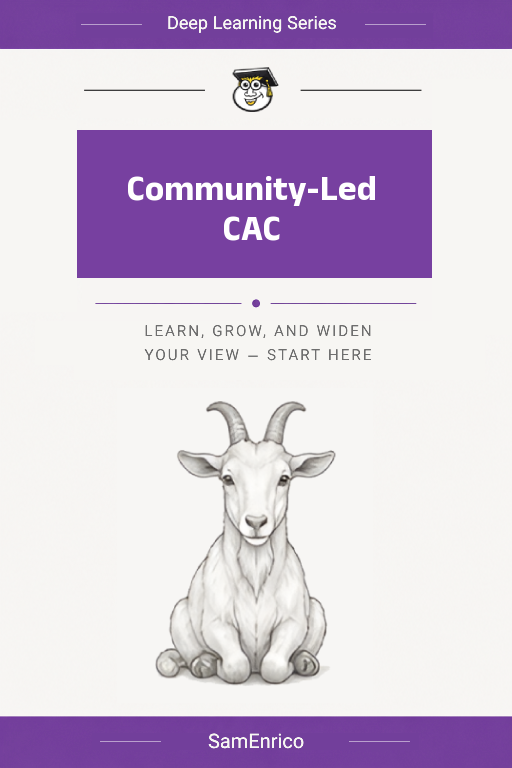
Community-Led CAC eBook
Build engaged communities that acquire new custome
Build engaged communities that acquire new customers through organic word-of-mouth.
Formats
Free sample
Chapter 1: The $47 Billion Lie...--The email arrived at 11:47 PM on a Tuesday. Sarah had been staring at her dashboard for fourteen hours. The number in red hadn't changed. Her company had exactly 47,312leftinthebank.Eighteenmonthsearlier,shehadraised47,312 left in the bank. Eighteen months earlier, she had raised 47,312leftinthebank.Eighteenmonthsearlier,shehadraised4 million on the strength of a simple promise: "We know how to acquire customers." She had been right.
She had acquired thousands of them. And every single one had cost her more money than they would ever return.The dashboard told the story no investor wanted to hear. Customer Acquisition Cost: 187.Average Lifetime Value:187. Average Lifetime Value: 187.Average Lifetime Value:142. She was losing $45 on every customer.
The more customers she acquired, the faster she went bankrupt. Her head of growth had just resigned. Her Facebook Ads account was suspended for the third time. Her Google Ads cost-per-click had doubled in six months. And her board was sending increasingly terse emails with subject lines like "Urgent: Path to Profitability."Sarah's story is not unique.
It is the story of thousands of founders who have been sold the same lie: that growth comes from spending, that customer acquisition is a math problem you can solve with enough budget, and that the funnel—that beautiful, linear, predictable funnel—is the only path to scale.This book exists because that lie has cost businesses over $47 billion in the last decade.The Funnel That Ate the World The traditional marketing funnel is one of the most seductive diagrams ever drawn. You have seen it a thousand times. At the top, a wide mouth: Awareness. Below it, a narrowing: Interest. Then Desire.
Then Action. At the bottom, a small spout: Sale. The metaphor is irresistible. Pour money into the top, and customers drip out the bottom. The wider the top, the more drips you get.
So you pour. And pour. And pour.This model worked reasonably well for about sixty years. From the 1950s through the early 2000s, media was scarce. There were three television networks, a handful of newspapers, and radio stations that played whatever the DJ chose.
If you wanted to reach a mass audience, you bought a mass ad. The funnel was efficient because attention was concentrated.Then everything changed.The internet decentralized attention. Then social media atomized it. Then the algorithm personalized it into oblivion. Today, there is no mass audience.
There are only millions of micro-audiences, each in their own algorithmic bubble. To reach them through paid channels, you do not buy one ad. You buy ten thousand hyper-targeted ads, each competing in a real-time auction against every other brand on earth.The result is a tragedy of the commons. Everyone bids up the same keywords. Everyone chases the same audiences.
Everyone pays more for less. And the platforms—Google, Meta, Amazon, Tik Tok—collect the rent. In 2023 alone, businesses spent over 600billionondigitaladvertising.Theplatformskeptroughly600 billion on digital advertising. The platforms kept roughly 600billionondigitaladvertising.Theplatformskeptroughly400 billion of that as profit. The other $200 billion bought attention that, for most companies, generated negative returns.Sarah learned this the hard way.
Her first million dollars in ad spend generated a positive return. Her second million broke even. Her third million lost money. Diminishing returns are not a bug of the funnel. They are a feature.
The more you pour into the top, the more the funnel resists. Because the funnel is not a physics problem. It is an auction. And auctions always favor the house.The $47 Billion Lie Let me be precise about the lie I am naming.The lie is not that advertising never works. It works beautifully for a small number of companies with massive lifetime values, repeat purchase cycles, and category-defining brands.
Nike can spend millions on ads and generate positive returns because Nike sells shoes to almost everyone forever. If you are not Nike—and you are not—the math looks very different.The lie is that paid acquisition is the default growth strategy for every company. Venture capitalists repeat it. Growth consultants sell it. Ad platforms depend on it.
The underlying assumption is that you will eventually figure out the unit economics—that your LTV will outrun your CAC if you just optimize enough, test enough, or scale enough.But the data tells a different story. A comprehensive study of over 2,000 direct-to-consumer brands found that only 13 percent had LTV-to-CAC ratios above 3:1, the industry standard for healthy growth. Forty-two percent had ratios below 1:1, meaning they lost money on every customer. The rest were treading water, acquiring customers at break-even and praying that retention would save them.This is the $47 billion lie. It is the accumulated losses of companies that burned through venture capital on paid acquisition, only to discover that the funnel is a drug.
The first hit feels great. You see immediate results. Revenue goes up. The board applauds. So you increase the dose.
And then you need more. And more. And then one day, you wake up and you cannot stop. Your entire business depends on the daily methadone of ad spend. When you try to cut back, revenue collapses.
When you try to increase, margins disappear.There is another way. And it begins with a single, subversive insight: The only sustainable customer acquisition cost is zero.The Zero-Cost Alternative I do not mean zero literally, though some companies have achieved it. I mean asymptotically zero—approaching zero as a limit. I mean a growth model where the marginal cost of acquiring the next customer is so low that it does not appear as a line item on your profit and loss statement. I mean a model where your customers acquire your next customers, for free, because they want to.This is not a fantasy.
It is the hidden growth story behind some of the most valuable companies in the world.Let me give you three examples.Atlassian grew to a billion-dollar valuation with zero salespeople. Zero. Not one person whose job title included the word "sales." How? Their community of users became their sales force. Developers told other developers about Jira and Confluence.
They answered questions in forums. They wrote blog posts. They created templates. They did all of this not because Atlassian paid them, but because Atlassian gave them something more valuable: a sense of belonging to a community of builders.Git Hub grew to a billion-dollar valuation with almost no traditional marketing. The product was the marketing.
The community was the sales team. Every time a developer pushed code to a public repository, they were implicitly advertising Git Hub to every other developer who saw that repository. The network effect was so powerful that Git Hub became the default, not because they outspent competitors, but because their users would not shut up about them.Hub Spot grew its first fifty thousand customers through user groups, not ad campaigns. In city after city, Hub Spot users organized local meetups. They invited colleagues.
They shared tips. They celebrated wins. Hub Spot provided the framework and the swag. The users provided the evangelism. The result was a grassroots movement that no amount of paid advertising could have purchased.These companies did not have better products or smarter founders or luckier timing.
They had a different theory of growth. They understood that customers are not endpoints of a funnel. They are the…
This is the end of the free sample. Get the eBook to keep going. Buy now
About this book
Details
- Author
- Braxton Candy
- Publisher
- SamEnrico
- Language
- English
- Genre
- Non-Fiction, Startup Guide
- Released
- 2026-05-29
- Pages (approx.)
- 118
- Available as
- eBook, Audiobook

Read better in the ZLOADR app
Your eBooks on your phone or tablet. Sign in with your SamEnrico account and start reading.
More by Braxton Candy
 Meeting Invite Defaults GuideBraxton Candy$11.99
 Recovery From Burnout WorkbookBraxton Candy$11.99
 Difficult Conversations For CouplesBraxton Candy$11.99
 Sleep Walking Safety GuideBraxton Candy$11.99
 The Outpatient Detox GuideBraxton Candy$11.99
 Blood and Roses: The Wars That Shaped England's ThroneBraxton Candy$11.99
 Daily User Testing RoutineBraxton Candy$12.99
 Hunter Biden: The Gun and Tax TrialsBraxton Candy$11.99
 Understanding X Fragile Site Folic ACID TypeBraxton Candy$17.99
 How to Start a Blinds (soft Furnishings) Business (Beginners Guide)Braxton Candy$11.99
You may also like
 Hong Kong Handover 1997Dunn Johnnie$11.99
 Zumba For Postnatal Recovery CourseNeal Christian$11.99
 Zumba for BeginnersLadner Nikia$11.99
 YouTube Comment Mining GuideHumes Pandora$12.99
 Worry Box MeditationCarlin Rudy$11.99
 Workplace Stress MeditationNguyen Lynn$11.99
 Workplace Stress and Sleep RepairHawley Ivory$11.99
 Workplace Perfectionism CureDelaney Jeffry$11.99
 Workplace Injustice Anger GuideWallen Isabelle$11.99
 Work Addiction and Burnout LinkGreenwood Ester$11.99
 Women in Yoga and WellnessBeattie Galina$11.99
 Women in Stand Up ComedyChun Evangeline$11.99