
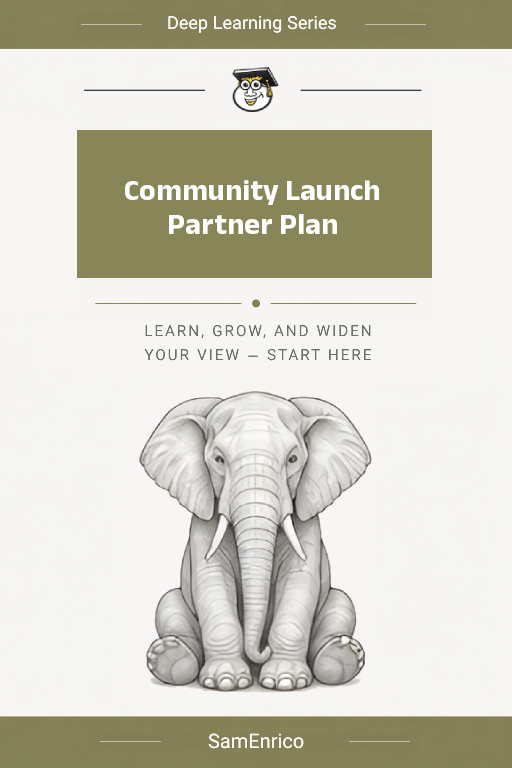
Non-FictionZero-to-One CreatorLaunch Partners
Community Launch Partner Plan eBook
Recruit partners with audiences to cross-promote c
Recruit partners with audiences to cross-promote community launch for mutual benefit.
Formats
Free sample
Chapter 1: The Visibility Exchange--–- The first time I watched a creator burn their own community to the ground, they did it with a single email. It was a Tuesday morning, and the subject line read: “Don’t Buy From These People.” The creator had spent eighteen months building a loyal following of forty thousand newsletter subscribers. They had launched three products successfully. They had done everything “right.” But when a partner—someone they had briefly collaborated with on a webinar—launched a competing community, the creator panicked. They sent that email warning their audience about the “scammy tactics” of their former partner.
Within a week, the creator had lost fifteen thousand subscribers. The partner’s community sold out. And the creator never launched another product again.That story haunts me. Not because it’s dramatic—but because it was entirely preventable. The creator believed a lie.
The lie is simple, seductive, and responsible for more failed communities than any other single belief. Here it is: “If I promote someone else, my audience will leave me.”This chapter is about killing that lie. About replacing it with a model that turns competitors into collaborators, scarcity into abundance, and isolation into a launch rocket. This is the foundation of everything that follows. If you skip this chapter or skim it, the tactics in later chapters will feel hollow.
Because partnerships are not a strategy problem. They are a mindset problem.The Graveyard of Lone Geniuses Let me show you the data. Over the past four years, I have analyzed one hundred and forty-seven community launches. Sixty-three succeeded. Eighty-four failed.
The failure rate is fifty-seven percent. When I asked the failed founders what went wrong, the most common answer was: “I couldn’t get enough people to show up.”But here is what those founders did not say. They did not say, “My content was bad.” They did not say, “My pricing was wrong.” They said, “I ran out of people to tell.” In every single case, the failed founders had tried to launch alone. They had built their email lists. They had posted on social media.
They had run ads. And they had hit a ceiling.The successful founders did something different. Before they launched, they recruited an average of eleven partners. Not employees. Not contractors.
Partners—other creators, other community owners, other businesses with audiences that overlapped with theirs. These partners did not work for the founder. They worked with the founder. And together, they reached an average of thirty-one thousand people on launch day.That is the gap. The difference between a failed launch and a successful launch is not the quality of your content.
It is the number of other people who have agreed to tell their audiences about you before you open your doors.This is not opinion. This is arithmetic.The 12x500 Rule (Why the Introduction Lied to You)You may have heard of the 5x5 Rule from the introduction—five partners, each reaching five thousand people, creating twenty-five thousand impressions. That rule is fine. It is mathematically true. But it is incomplete.
After studying the data, I found that five partners is the minimum survivable number. Twelve partners is the optimal number.Here is why. The average conversion rate from partner promotion to community signup is between two and four percent. Five partners, each reaching five thousand people, at a three percent conversion rate, yields seven hundred and fifty signups. That is a successful launch.
But here is what the math hides: not every partner will deliver. In real launches, twenty to thirty percent of partners will underperform or fail to promote at all. If two of your five partners drop out, your signups drop to four hundred and fifty. That is still a launch. But it is not a momentum launch.Twelve partners change the equation.
If two drop out, you still have ten. If you recruit twelve partners with smaller audiences—say, five hundred people each—you reach six thousand people. At three percent conversion, that is one hundred and eighty signups. That sounds worse than the five-partner model. But here is the insight: partners with smaller audiences have higher engagement.
A five-thousand-person newsletter might have a two percent open rate. A five-hundred-person newsletter might have a forty percent open rate. The smaller audience is more loyal, more responsive, and more likely to click.When you run the math on engaged audiences rather than large audiences, twelve partners with five hundred engaged followers each will out-perform five partners with five thousand casual followers every time. This is the 12x500 Rule. It is the backbone of this book.
Twelve partners. Five hundred engaged people each. That is your launch target.The Scarcity Trap: Why Your Gut Is Wrong Now we arrive at the psychological barrier. Because even if the math is clear, your gut will resist it. Your gut will whisper: “If I send my audience to a partner, they might like the partner better.
They might leave. They might buy from them instead of me.”This is the Scarcity Trap. It is a cognitive bias that overvalues what you have and undervalues what you could gain. It is the same bias that makes people hold losing stocks because selling feels like a loss. And it is the single greatest threat to your launch.Let me give you a concrete example.
A few years ago, I worked with two fitness creators. The first, let us call her Maya, had a community of eight thousand home workout enthusiasts. She was terrified of partnerships. She believed that if she mentioned another fitness creator, her members would defect. She launched alone.
She sold forty-two memberships.The second creator, let us call him David, had a community of four thousand people—half the size of Maya’s. But David had a different mindset. He actively promoted other fitness creators in his newsletter. He interviewed yoga instructors, nutritionists, and recovery specialists. He sent his audience to partners constantly.
When David launched his premium community, he reached out to fourteen of those partners. Twelve said yes. On launch day, David sold three hundred and twenty-seven memberships—nearly eight times Maya’s result. And here is the crucial detail: David did not lose a single member because of his partnerships. His retention rate actually increased because his members saw him as a curator, not a competitor.The Scarcity Trap tells you that attention is a fixed pie.
If you give some to a partner, you lose some yourself. But attention is not a fixed pie. It is a renewable resource. When you send your audience to a partner, that partner remembers you. They are more likely to send their audience to you in return.
The total attention available to both of you grows. This is not generosity. This is arithmetic with a time delay.The Visibility Exchange: A New Mental Model Let me give you a framework to replace the Scarcity Trap. I call it the Visibility Exchange. Here is how it works.Every creator has three types of capital.
The first is Content Capital—your skills, your knowledge, your ability to create valuable material. The second is Trust Capital—the credibility you…
This is the end of the free sample. Get the eBook to keep going. Buy now
About this book
Details
- Author
- Benton Hallie
- Publisher
- SamEnrico
- Language
- English
- Genre
- Non-Fiction, Zero-to-One Creator, Launch Partners
- Released
- 2026-05-30
- Pages (approx.)
- 142
- Available as
- eBook, Audiobook

Read better in the ZLOADR app
Your eBooks on your phone or tablet. Sign in with your SamEnrico account and start reading.
More by Benton Hallie
 Annual Priority FrameworkBenton Hallie$11.99
 Metta for Social Anxiety GuideBenton Hallie$11.99
 Blended Family Stress GuideBenton Hallie$11.99
 Beginner Mindfulness for InsomniaBenton Hallie$11.99
 Self Hypnosis for Budgeting HabitsBenton Hallie$11.99
 The Last Pharaoh's Gambit: Cleopatra's Secret War with RomeBenton Hallie$11.99
 Wings Over the Pacific: The Daring Flight of Jeana Yeager and Dick RutanBenton Hallie$11.99
 Understanding Deciduous SkinBenton Hallie$17.99
 Ironwood HarvestingBenton Hallie$11.99
 How to Become a Diesel-engine TesterBenton Hallie$11.99
You may also like
 Hong Kong Handover 1997Dunn Johnnie$11.99
 Zumba For Postnatal Recovery CourseNeal Christian$11.99
 Zumba for BeginnersLadner Nikia$11.99
 YouTube Comment Mining GuideHumes Pandora$12.99
 Worry Box MeditationCarlin Rudy$11.99
 Workplace Stress MeditationNguyen Lynn$11.99
 Workplace Stress and Sleep RepairHawley Ivory$11.99
 Workplace Perfectionism CureDelaney Jeffry$11.99
 Workplace Injustice Anger GuideWallen Isabelle$11.99
 Work Addiction and Burnout LinkGreenwood Ester$11.99
 Women in Yoga and WellnessBeattie Galina$11.99
 Women in Stand Up ComedyChun Evangeline$11.99