
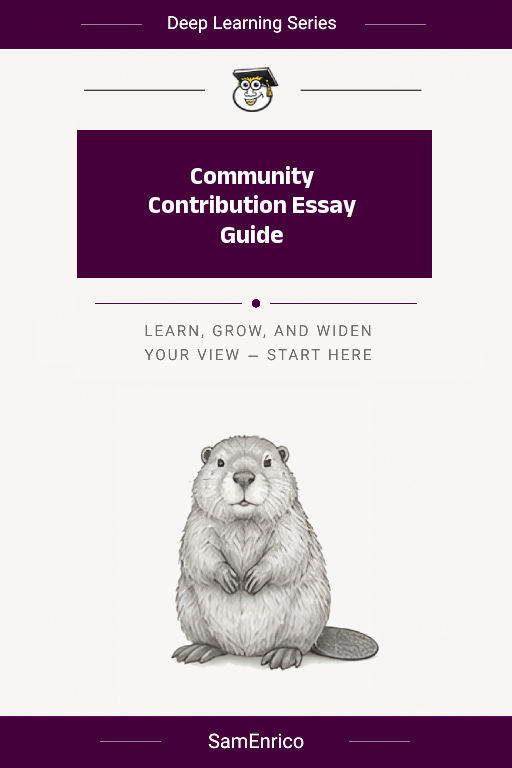
Community Contribution Essay Guide eBook
Show tangible impact on family school or neighborh
Show tangible impact on family school or neighborhood through specific before and after metrics.
Formats
Free sample
Chapter 1: The Fluff Epidemic--Every year, over one million students sit down to write a community contribution essay. They open their laptops, stare at the blinking cursor, and type some version of the same six words: “I am passionate about helping others.”Then they delete it.Then they type: “Volunteering has changed my life.”Then they delete that too.By the time they finish, they have produced what admissions officers and award judges have learned to dread: the Fluff Essay. It is grammatically correct. It is sincere. It is utterly forgettable.
And worst of all, it contains not a single piece of evidence that anything actually changed because the student showed up.This chapter is an intervention.The $10 Million Mistake Let me tell you about a student named Maya. She was a senior applying to a competitive university program that received twelve thousand applications for two hundred spots. Maya had spent three years tutoring elementary school students in reading at a local community center. She had logged over four hundred hours. She wrote in her essay: “I am committed to literacy equity.
I tutored young students who were struggling, and I watched them grow more confident. It was deeply rewarding.”Maya was rejected.Another student, let’s call him David, had also tutored. He logged only sixty hours—less than one-sixth of Maya’s time. But David wrote this: *“When I started, my three tutees were reading an average of one year below grade level. After eight weeks of twice-weekly sessions using a phonics intervention I designed, all three reached grade-level benchmarks.
One student moved from the 12th to the 41st percentile in reading fluency.”*David was accepted.What happened? Did the admissions committee hate literacy? Did they have something against Maya’s community center? No. The difference was not in the activity.
The difference was in the evidence.Maya wrote about effort. David wrote about impact.This is the $10 million mistake—the cumulative value of scholarships, admissions slots, and awards lost every year to students who did meaningful work but failed to prove it. Admissions committees and award judges do not reward effort. They reward outcomes. They are not heartless; they are overwhelmed.
The average admissions officer reads fifty to seventy essays per day. They have developed what insiders call a “fluff detector”—a mental shortcut that flags vague verbs like helped, supported, assisted, volunteered, and participated in as empty calories.When they see those words without numbers attached, they move on.The Two Types of Metrics That Everyone Confuses To understand why Maya failed and David succeeded, you need to understand a distinction that will appear in every chapter of this book. It is simple but profound.Activity Metrics measure what you did. They answer the question: “How much time did you spend?” Examples include:Hours logged Number of sessions Miles traveled People “served” (without specifying how)Impact Metrics measure what changed because of what you did. They answer the question: “What was different after you left than before you arrived?” Examples include:Grade point increase (e.g., from 65% to 82%)Conflict reduction (e.g., from 45 minutes of morning arguments to 12)Attendance rise (e.g., from 70% to 95%)Skill acquisition (e.g., “Student progressed from decoding CVC words to reading simple sentences”)Here is the hard truth that most students never hear: Activity Metrics are worthless in a community contribution essay.
Not “less valuable.” Not “less impressive.” Worthless. They communicate effort, and effort is assumed. The fact that you showed up is the minimum requirement, not the achievement.Impact Metrics, on the other hand, are rare. They are so rare that when admissions officers encounter one, they flag the essay as “high interest.” David’s essay—with its percentiles and grade levels—probably received three reads instead of one.Let me give you a diagnostic that will serve as the backbone of this book. It comes from a former Gates Scholarship reader who shared it anonymously.
She called it the 30-Day Test.“If you removed your contribution from the community, would anyone notice a quantitative difference thirty days later? If the answer is no, you have an activity, not an impact.”Apply this to Maya: If she stopped tutoring, would her students still be reading below grade level? Possibly. But she didn’t measure their reading levels at the start, so she couldn’t prove that anything changed during her time there. She had no baseline.
She had no endline. She had no delta.Apply it to David: If he stopped tutoring, would his students revert? Possibly. But he could prove that during his intervention, three students crossed a critical threshold. That is a measurable change.Why Small, Measurable Changes Beat Large, Unmeasurable Ones There is a common objection at this point.
Students say: “But the change I created was too small to measure.” Or: “My contribution was emotional, not numerical.” Or: “The problem I worked on was too big for one person to fix.”These objections reveal a misunderstanding of what admissions readers actually want. They do not expect you to solve homelessness, end food insecurity, or close the achievement gap single-handedly. They know you are seventeen. What they want is evidence that you understand the difference between effort and outcome, and that you are capable of observing the world with enough rigor to notice whether your actions had any effect at all.A 5% improvement that you can prove is infinitely more valuable than a 50% improvement you can only claim.Let me repeat that: A 5% improvement that you can prove is infinitely more valuable than a 50% improvement you can only claim.Here is why. Educational psychology research—specifically John Hattie’s 2012 meta-analysis Visible Learning, which synthesized over eight hundred studies involving millions of students—found that measurable changes in a student’s immediate environment are statistically significant predictors of long-term success.
Hattie calculated something called “effect sizes.” An effect size of 0.4 is considered the “hinge point” where an intervention moves from trivial to meaningful. Family engagement strategies (tracking homework completion, reducing conflict, increasing shared meals) have effect sizes between 0.5 and 0.7. That is equivalent to moving a student from the 50th to the 70th percentile.Generic volunteering—without measurement, without targeted intervention, without baseline data—has no measurable effect size at all. Not a small one. Zero.The research is clear: small, specific, measured changes in a student’s environment produce outsized outcomes.
Large, vague, unmeasured efforts produce nothing that can be documented.The Four Fatal Flaws of the Fluff Essay Before we move to solutions, let me name the enemy. The Fluff Essay has four fatal flaws. If your essay contains even one of these, you are at risk of being categorized as “generic” by a tired admissions reader.Flaw #1: The List of Activities“I tutored, volunteered at a food bank, coached younger students, and helped with a community garden.”This is not an essay. It is a resume bullet point in paragraph form. Lists communicate breadth but not depth.
They tell the reader that you did many things but cannot prove that any of them worked. A reader’s internal response: “So you showed up to four places. Did anything happen at any of them?”Flaw #2: The Vague Verb Cluster“I…
This is the end of the free sample. Get the eBook to keep going. Buy now
About this book
Details
- Author
- Sherrod Jackson
- Publisher
- SamEnrico
- Language
- English
- Genre
- essays, Student's Shortcut
- Released
- 2026-06-01
- Pages (approx.)
- 137
- Available as
- eBook, Audiobook

Read better in the ZLOADR app
Your eBooks on your phone or tablet. Sign in with your SamEnrico account and start reading.
More by Sherrod Jackson
 Benzo Protracted Withdrawal SupportSherrod Jackson$11.99
 Dental Chronic Pain GuideSherrod Jackson$11.99
 Relationship Building on LinkedinSherrod Jackson$11.99
 Peak Flow State Hypnosis GuideSherrod Jackson$11.99
 Press Release For AwardsSherrod Jackson$11.99
 Circadian Rhythm Research UpdateSherrod Jackson$11.99
 Cuban Family Reunification StorySherrod Jackson$11.99
 Calming Bodily FormationSherrod Jackson$11.99
 Breath Counting for PanicSherrod Jackson$11.99
 The Frozen Frontlines: Stalin’s Opium War on the Eastern FrontSherrod Jackson$11.99
 Ravana's Last Stand: The Asura King's DefianceSherrod Jackson$11.99
 How to Produce Bathroom SetsSherrod Jackson$11.99
You may also like
 YouTube Video Essay DepthLeon Lala$11.99
 TOEFL Independent Essay GuideMintz Alex$11.99
 Music Theory Essay GuideWilkinson Maisha$11.99
 Expository Essay AI PromptsApplegate Dalia$11.99
 Exam Essay MemorizationMcgovern Johna$11.99
 Compare Contrast Essay PromptsOntiveros Marx$11.99
 College Application Essay GuideSisson Aimee$11.99College Application Essay GuideSisson Aimee$11.99
 The 100 Word Essay ChallengeAli Luciana$11.99
 Journalism Essay PromptsThatcher Williemae$11.99
 Finance Essay PromptsShrader Lamont$11.99
 Cause Effect Essay GPT GuideBland Jacelyn$11.99