
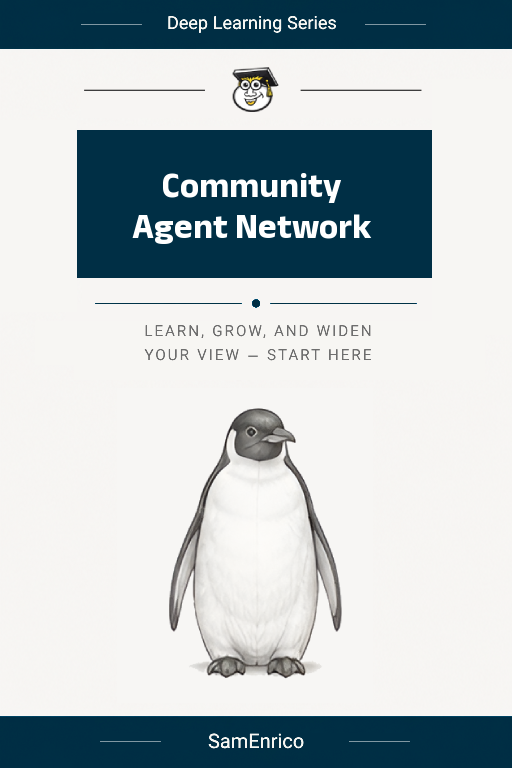
Non-FictionStartup GuideDistributionAgent Model
Community Agent Network eBook
Recruit local shopkeepers as agents who earn commi
Recruit local shopkeepers as agents who earn commission on each sale.
Formats
Free sample
Chapter 1: The 10-Foot Trust Advantage--–- The corner of 7th and Main in any American town holds a secret that Silicon Valley cannot buy. It is not a piece of code, a proprietary algorithm, or a data set of thirty million users. It is a person—a shopkeeper named Maria, or Ahmed, or Mrs. Chen—who has watched children grow up, knows which customers lost their jobs, and remembers who prefers their coffee with two sugars. Maria does not have a marketing budget.
She does not have a customer acquisition team. What she has is something far more valuable: a ten-foot radius of absolute trust.Every time a customer walks into Maria’s shop, they enter a space where the normal rules of commerce reverse. On the internet, trust is earned after the sale—reviews are checked, refund policies are scrutinized, and social proof is algorithmically manufactured. In Maria’s shop, trust comes before the transaction. It has been built over years of small interactions: remembering a name, holding a product behind the counter, asking about a sick parent.
When Maria recommends a product, the customer does not reach for their phone to check Amazon reviews. They reach for their wallet.This chapter reveals why that ten-foot radius is the most underutilized asset in modern commerce, how to measure its value, and—most importantly—how to identify the specific shopkeepers who will become your most profitable agents. We will dismantle the myth that digital marketing is the only scalable channel, quantify the dwell time advantage that local shops possess, and provide a systematic framework for spotting high-potential agents before your competitors do.The 10-Foot Trust Advantage is not a metaphor. It is a measurable economic reality. And by the end of this chapter, you will never walk past a corner shop without seeing the goldmine hidden behind the counter.The Collapse of Digital Certainty Let us begin with a brutal truth that most marketing consultants will not tell you.
The digital advertising ecosystem—the trillion-dollar engine that powers Google, Meta, Amazon, and every direct-to-consumer brand—is slowly dying. Not because the technology is failing, but because the fundamental assumption upon which it was built has been proven false.That assumption was simple: more data leads to better targeting leads to higher conversion rates. For a brief window between 2010 and 2018, the assumption held. Facebook knew your relationship status, your shopping habits, your political affiliations, and even your predicted income. Google knew what you were searching for before you finished typing.
Amazon knew what you wanted before you knew yourself. The result was an advertising efficiency that had never existed before. Return on ad spend (ROAS) of 5x, 10x, even 20x was common.Then three things happened simultaneously.First, privacy regulations—GDPR in Europe, CCPA in California, and a cascade of similar laws worldwide—cut the data pipelines at their source. Apple's App Tracking Transparency framework alone cost Facebook an estimated ten billion dollars in lost ad revenue in 2022, according to the company's own earnings reports. The era of surveillance capitalism is not over, but it is under siege from regulators and consumers alike.Second, ad saturation reached a breaking point.
The average American sees between six thousand and ten thousand digital advertisements every single day, according to a 2021 study by the University of Southern California. That is up from approximately five hundred per day in the 1970s. The human brain has responded by developing what neuroscientists call "ad blindness"—the ability to look directly at an advertisement without consciously registering it. Your expensive Facebook campaign is not being ignored out of spite. It is being filtered out by an ancient neurological defense mechanism designed to prevent cognitive overload.Third, the platforms changed their incentives.
In the early days of Facebook advertising, the company wanted you to succeed so you would spend more. Today, Facebook has more advertisers than it knows what to do with. The platform's goal is no longer your success; it is extracting the maximum possible bid from you while delivering the minimum acceptable result. This is not malice. It is the logical endpoint of a publicly traded company optimizing for shareholder value.
The result is that customer acquisition costs (CAC) have risen every year for the past decade, with no reversal in sight.Consider the data. According to a 2023 analysis by Digital Commerce 360, the average cost to acquire a new e-commerce customer through paid social media increased 42% between 2020 and 2023. During the same period, conversion rates on paid search fell by 18%. The math is becoming impossible for all but the highest-margin, highest-repeat-purchase products. If you sell a twenty-dollar item with a 50% gross margin, you have approximately ten dollars to spend on customer acquisition.
On many platforms, that will not even buy a single click, let alone a conversion.The digital advertising industry has responded to this crisis with a series of half-measures: artificial intelligence optimization, lookalike audiences, dynamic creative testing. These tools help around the edges, but they do not solve the fundamental problem. The problem is not that your ads are poorly optimized. The problem is that ads, by their very nature, are interruptions. And human beings have evolved to ignore interruptions.What humans do not ignore is a trusted voice speaking from a familiar face.
This is not a nostalgic preference for "the way things used to be." It is a hardwired biological reality. Your brain processes a verbal recommendation from a known person differently than it processes a digital advertisement. The difference is not subtle. It is structural.The Neuroscience of Trust-Based Selling To understand why local shopkeepers are the most valuable sales channel you are not using, you must first understand how the human brain evaluates information from different sources. This is not marketing theory.
It is cognitive neuroscience, and the findings are unambiguous.The brain has two distinct systems for evaluating the credibility of incoming information. Psychologists Daniel Kahneman and Amos Tversky famously labeled these System 1 (fast, automatic, emotional) and System 2 (slow, deliberate, analytical). What is less commonly understood is that the brain decides which system to use based largely on the perceived source of the information.When you see a digital advertisement, your brain automatically flags it as external, commercial, and potentially manipulative. The prefrontal cortex—the seat of skeptical reasoning—activates before you have even consciously registered the ad's content. You are, in a very real sense, on guard.
This is why banner blindness exists. Your brain has learned that most digital advertisements are irrelevant at best and deceptive at worst. It has developed a rapid filtering mechanism to protect you.When you receive a verbal recommendation from a familiar person—someone you have seen face-to-face multiple times—your brain processes the information through a completely different pathway. The amygdala, which processes emotional significance, activates positively. The mirror neuron system, which enables empathy and social bonding, creates a sense of shared experience.
The result is that the information is absorbed not as a sales pitch, but as social knowledge.This is not a subtle difference. Functional magnetic resonance imaging (f MRI) studies conducted at UCLA in 2016 showed that the same product information, presented as a digital ad versus a verbal recommendation from…
This is the end of the free sample. Get the eBook to keep going. Buy now
About this book
Details
- Author
- Aquino Domenica
- Publisher
- SamEnrico
- Language
- English
- Genre
- Non-Fiction, Startup Guide, Distribution, Agent Model
- Released
- 2026-06-01
- Pages (approx.)
- 155
- Available as
- eBook, Audiobook

Read better in the ZLOADR app
Your eBooks on your phone or tablet. Sign in with your SamEnrico account and start reading.
More by Aquino Domenica
 Single Monitor ProductivityAquino Domenica$11.99
 Networking Mindset TransformationAquino Domenica$11.99
 Emotion Regulation Techniques CourseAquino Domenica$11.99
 Obama HopeAquino Domenica$11.99
 Loneliness Fishing Group GuideAquino Domenica$11.99
 Hypnosis Podcast GuideAquino Domenica$11.99
 Asking for a Deadline ExtensionAquino Domenica$11.99
 Thyroid Cancer JourneyAquino Domenica$11.99
 The Prevention Pause MethodAquino Domenica$11.99
 The Forgotten Warriors: How African Women Pioneered Early Football (1700s)Aquino Domenica$11.99
 The Whispering Lanterns of Obon: Japan's Floating SoulsAquino Domenica$11.99
 Neon Shadows: The Birth of Rave Culture in the 90sAquino Domenica$11.99
You may also like
 Hong Kong Handover 1997Dunn Johnnie$11.99
 Zumba For Postnatal Recovery CourseNeal Christian$11.99
 Zumba for BeginnersLadner Nikia$11.99
 YouTube Comment Mining GuideHumes Pandora$12.99
 Worry Box MeditationCarlin Rudy$11.99
 Workplace Stress MeditationNguyen Lynn$11.99
 Workplace Stress and Sleep RepairHawley Ivory$11.99
 Workplace Perfectionism CureDelaney Jeffry$11.99
 Workplace Injustice Anger GuideWallen Isabelle$11.99
 Work Addiction and Burnout LinkGreenwood Ester$11.99
 Women in Yoga and WellnessBeattie Galina$11.99
 Women in Stand Up ComedyChun Evangeline$11.99