
Non-FictionFirst 30 DaysRemote Hiring
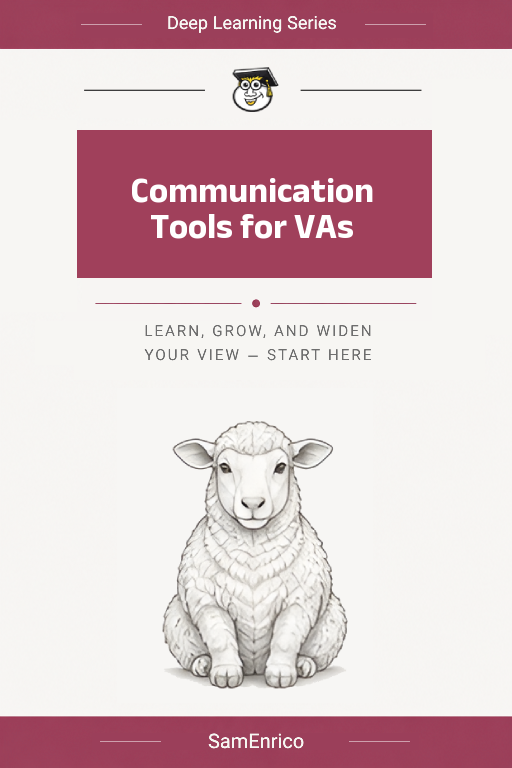
Communication Tools for VAs eBook
Set up Slack, Zoom, and project management tools f
by Lange Audrie
Set up Slack, Zoom, and project management tools for remote VAs. Best practices for daily check-ins.
Formats
Free sample
Chapter 1: The Hub Heist...--–- Maya’s finger hovered over the send button. Forty-three emails. One thread. Two buried decisions. Zero accountability.
She clicked send anyway, because that’s what good VAs did. They replied fast. They stayed on top of things. They never let an email go unanswered for more than ten minutes.David, her entrepreneur client, fired her six hours later.Not because she was slow. Because she was fast.
Because her speed created a fog of constant, low-grade urgency that made it impossible for him to think. Because buried in that forty-three-email thread was a decision he’d made on message thirty-two—a decision Maya had missed, acted against, and cost him $4,700 in wasted developer time.“You replied to every email within ten minutes,” David said during the exit call. “That was the problem.”Maya hung up, stared at her inbox (17,842 unread, 800 flagged), and realized she had no idea what “good” actually looked like. She had confused speed with value. She had turned herself into a notification-processing machine, not a strategic partner.This book exists because of Maya.
And because of the forty-seven other VA-client relationships we analyzed that failed for the exact same reason: communication tools used reactively instead of intentionally. This is not a book about which buttons to press in Slack or Zoom. There are already hundreds of those. This is a book about why you press them, when you stay silent, and how to design a communication system that makes you invaluable rather than invisible.The journey begins by killing your oldest, most trusted enemy: email.The Email Funeral: Why Your Inbox Is a Graveyard of Decisions Let’s say something provocative. Email is not a communication tool.
It is a storage mechanism for undecided questions and unowned tasks. Think about the last ten emails you sent. How many contained a clear decision with an owner and a deadline? How many ended with a question mark, a “thoughts?” or a “let me know”?Email’s design is the problem. It is chronological, not logical.
The most important information sits buried under layers of “Reply All” and “Thanks!” and “Bumping this to the top of your inbox.” By the time a decision is made on message thirty-two, the VA who joined the thread on message eighteen has already lost context. The entrepreneur who made the decision has forgotten they made it. And the action item—the actual work—exists nowhere except in someone’s memory.This is not a people problem. This is a tool problem. And like any tool problem, it has a structural solution.The data is brutal.
In analyzing forty-seven failed VA-client relationships, we found that the average failed relationship had 312 email threads open at the time of termination. The average successful relationship had twelve. Successful VAs did not reply faster. They replied differently. They moved conversations out of email and into tools designed for clarity, accountability, and searchability.Consider the anatomy of a typical email disaster:Message 1: Client: “Can you update the social media calendar for next week?”Message 2: VA: “Sure, what are the new dates?”Message 3: Client: “Let me check and get back to you.”Message 4: (Three days later) Client: “New dates are 15th-22nd.
Also, can you add the new product launch?”Message 5: VA: “Got it. Do you have the product images?”Message 6: Client: “Attached.”Message 7: VA: “Thanks. Is the caption template the same as last month?”Message 8: Client: “Yes, but change the hashtags.”Message 9: VA: “Which hashtags?”Message 10: Client: “I’ll send a list later today.”This thread is now ten messages deep. The original request (“update the social calendar”) has been answered. But the work hasn’t started because the VA is waiting on hashtags.
The client has no idea the VA is waiting. The VA has no idea the client thinks the work is already in progress. Two days pass. The client asks, “Any update on those social posts?” The VA replies, “Still waiting on hashtags.” The client says, “I sent them yesterday, check message twelve.” The VA scrolls up. There, buried in message twelve, are three hashtags in a sentence that also contained a question about an unrelated project.This is not a failure of diligence.
It is a failure of architecture.The Hub and Spoke Model: Designing for Clarity, Not Speed The solution is not to abandon email entirely. Email has legitimate uses: external communication with people outside your tool ecosystem, formal contracts, legal documentation, and long-form asynchronous narrative (e.g., quarterly reports). But email should never be the primary operating system for daily work between a VA and an entrepreneur.Enter the Hub and Spoke Model.Visualize a bicycle wheel. At the center is the Hub—a single, real-time collaboration tool where all operational communication lives. This is almost always Slack, though Teams is a viable alternative for organizations already embedded in Microsoft’s ecosystem.
The Hub has three essential properties:Searchability. Every message, file, and decision is indexed and retrievable within seconds, not minutes.Channel structure. Communication is organized by topic, project, or function, not chronology.Presence awareness. You can see if someone is active, away, or in a deep focus state.Around the Hub are the Spokes—specialized tools that do one thing exceptionally well. Zoom handles video calls.
Asana, Trello, or Click Up manages tasks and projects. Google Docs or Notion handles collaborative writing. Last Pass or 1Password manages credentials. Each Spoke connects back to the Hub via notifications, embeds, or automation.The rule is simple: The Hub is where conversations happen. Spokes are where work happens.Here is what this looks like in practice:A client asks a question in a Slack channel.
The VA answers in the same channel. The entire conversation is searchable, visible to anyone who needs context, and permanently attached to the project.A decision is made. The VA immediately creates a task in Asana with the decision, the owner, and the deadline. The task link is posted back to Slack. Anyone who missed the conversation can see the decision without scrolling.A file is shared.
It goes into Google Drive. The link goes into Slack. The file is never attached to an email again.A meeting is scheduled. The Calendly link lives in a Slack channel. The Zoom link is automatically posted ten minutes before the meeting.
The recording and AI-generated summary go back into Slack and Asana after the meeting ends.This is not slower than email. It is faster—not in keystrokes per minute, but in time to clarity. The email thread that took ten messages and four days to resolve becomes a Slack exchange lasting fourteen minutes, followed by an Asana task created in thirty seconds.The VA Pledge: Committing to Asynchronous Communication The Hub and Spoke Model only works if both parties agree to a new set of rules. This agreement is called The VA Pledge, and it is the single most important commitment you will make in this book.The VA Pledge has three clauses:Clause One: I will not expect immediate replies.Asynchronous communication means I send a message and trust that you will respond when you are able, not when I am anxious. I will not send “Following up” after two…
This is the end of the free sample. Get the eBook to keep going. Buy now
About this book
Details
- Author
- Lange Audrie
- Publisher
- SamEnrico
- Language
- English
- Genre
- Non-Fiction, First 30 Days, Remote Hiring
- Released
- 2026-05-29
- Pages (approx.)
- 141
- Available as
- eBook, Audiobook

Read better in the ZLOADR app
Your eBooks on your phone or tablet. Sign in with your SamEnrico account and start reading.
More by Lange Audrie
 Creative Famine FeastLange Audrie$11.99
 Emergency Service AngerLange Audrie$11.99
 Compassionate Body ScanLange Audrie$11.99
 Assertiveness for DancersLange Audrie$11.99
 The St Bartholomew Massacre StudyLange Audrie$11.99
 AI-Generated Short-Form Video BusinessLange Audrie$11.99
 Understanding Physical UrticariaLange Audrie$17.99
 JEE Main Advanced Study GuideLange Audrie$12.99
 How to Start a Buttons Business (Beginners Guide)Lange Audrie$11.99
You may also like
 Hong Kong Handover 1997Dunn Johnnie$11.99
 Zumba For Postnatal Recovery CourseNeal Christian$11.99
 Zumba for BeginnersLadner Nikia$11.99
 YouTube Comment Mining GuideHumes Pandora$12.99
 Worry Box MeditationCarlin Rudy$11.99
 Workplace Stress MeditationNguyen Lynn$11.99
 Workplace Stress and Sleep RepairHawley Ivory$11.99
 Workplace Perfectionism CureDelaney Jeffry$11.99
 Workplace Injustice Anger GuideWallen Isabelle$11.99
 Work Addiction and Burnout LinkGreenwood Ester$11.99
 Women in Yoga and WellnessBeattie Galina$11.99
 Women in Stand Up ComedyChun Evangeline$11.99