
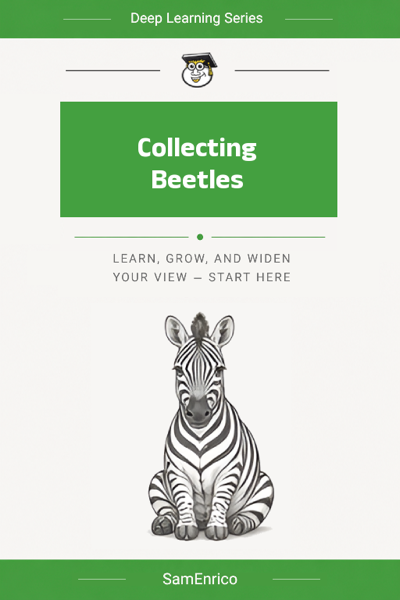
Non-FictionInformativeEducational
Collecting Beetles eBook
A Coursebook on Collecting Beetles
A Coursebook on Collecting Beetles
Formats
Free sample
Chapter 1: An Inordinate Fondness--The first beetle I ever killed was a mistake.I was seven years old, barefoot in my grandmother’s garden in rural Ohio, when a metallic green creature landed on my forearm. It shimmered like a drop of gasoline on wet pavement. I slapped it out of reflex. When I opened my hand, the beetle lay on its back, six legs twitching, its emerald shell cracked down the middle. I felt something I had no words for yet—a mixture of awe and guilt and hunger.
I wanted to know what I had just destroyed. I wanted to see it alive again. I wanted to understand why something so small could be so beautiful.That was my first collection. One dead beetle, flattened in a child’s palm, no label, no data, no purpose except wonder.Thirty years later, that beetle is long gone, ground into dust somewhere in a landfill. But the questions it left behind have never left me.
What makes a beetle a beetle? Why are there so many of them? How do you look at a six-legged speck the size of a grain of rice and know its name, its habits, its place in the world? And perhaps most urgently: in an age of extinction, when insects are disappearing from the planet at alarming rates, is it still ethical to collect them at all?This book is the answer to the questions that seven-year-old could not yet ask.Why Beetles Deserve Your Attention Let me begin with a number that will either thrill you or terrify you: 400,000.That is the approximate number of described beetle species on Earth. Coleoptera—the order of beetles—accounts for roughly one out of every four named species on the planet.
If aliens landed tomorrow and asked to see Earth’s biodiversity report, we would have to explain that beetles are the dominant land animals by almost any measure. There are more species of weevils (one beetle family alone) than there are species of fish, amphibians, reptiles, birds, and mammals combined.But here is the number that matters more: 1,000,000.That is the estimated number of beetle species that probably exist, waiting to be discovered, named, and understood. Most of them live in tropical canopies, leaf litter, and rotting logs. Most of them have never been seen by human eyes. A significant percentage may go extinct before we ever know they existed.The British geneticist J.B.S.
Haldane, when asked what his studies of nature revealed about the Creator, reportedly said: “An inordinate fondness for beetles.” The joke works because it is true. Something about the beetle body plan—that armored shell, those folding wings, that compact and efficient design—has proven spectacularly successful. Beetles have survived every mass extinction. They have colonized every continent except Antarctica (and even there, a few hardy species cling to the edges). They live in deserts, ponds, tree canopies, animal burrows, caves, and the spray zone of waterfalls.
One species lives inside the digestive tracts of certain mammals. Another spends its entire life cycle in the bodies of dead fish.Beetles are not merely numerous. They are essential.Dung beetles (family Scarabaeidae) remove and recycle animal waste, burying it underground where it fertilizes plants and reduces parasite populations. In Australia, where native dung beetles could not process cattle manure, ranchers imported African species to prevent the landscape from being buried in cow patties. The beetles saved the pasturelands.Carrion beetles (family Silphidae) do the same work with dead animals, returning their nutrients to the soil.
Without them, carcasses would persist for years, and disease would flourish.Lady beetles (family Coccinellidae) are voracious predators of aphids. A single lady beetle can consume 5,000 aphids in its lifetime. Farmers who understand this do not reach for pesticides; they release lady beetles.Longhorn beetles (family Cerambycidae) chew tunnels through dead and dying trees, accelerating decomposition and creating habitat for birds, bats, and other insects. A forest without wood-boring beetles is a forest choked with fallen timber that cannot rot.Beetles are the unsung engineers of every terrestrial ecosystem. They till soil, cycle nutrients, control pests, pollinate flowers, and feed countless larger animals.
When we lose beetles, we lose the infrastructure of life on land.And yet, most people cannot name a single beetle beyond the ladybug or the firefly (which is actually a beetle—more on that later). Most people, when they see a beetle, reach for a shoe or a can of poison.This book exists to change that response from fear to curiosity, from destruction to documentation, from passive ignorance to active engagement.What This Book Is (And What It Is Not)Let me be clear about what you are holding.This is not a field guide. You will not find thousands of species accounts with range maps and identification plates. Other books do that job well—Evans’ Beetles of Eastern North America, for instance, or Marshall’s Beetles: The Natural History and Diversity of Coleoptera. I will point you toward those resources when you need them.This is not a coffee-table picture book, though it contains photographs that I hope will make you stop and stare.
Other books showcase beetle beauty—The Book of Beetles, An Anthology of Remarkable Bugs. They are wonderful. They will sit on your coffee table and impress your guests. But they will not teach you how to pin a specimen, relax a dried corpse, or key out an unknown weevil.This is not an academic monograph. I will not drown you in jargon or assume you have a Ph D in entomology.
When I use a technical term—elytra, tarsus, aedeagus—I will define it. I will show you photographs. I will walk you through the anatomy like a patient teacher standing at your shoulder.What this book is: a coursebook. A structured, chapter-by-chapter curriculum that takes you from absolute beginner to competent citizen scientist. It is designed to be read in order.
Each chapter builds on the last. You can skip around if you must, but you will miss the scaffolding.In these pages, you will learn:How to see beetles. Not just spot them, but truly see them—their anatomy, their behavior, their microhabitats.How to collect ethically. When to kill, when to photograph, when to walk away. How to obtain permits.
How to avoid harming rare species.How to preserve specimens. From the killing jar to the spreading board to the museum drawer. Techniques that have been refined over two centuries of entomology.How to identify your finds. Using dichotomous keys, microscopes, and comparative anatomy. Moving beyond “some kind of brown beetle” to Carabus nemoralis or Tenebrio molitor.How to rear beetles from eggs or larvae.
Watching the complete metamorphosis in your own home.How to photograph beetles like a professional. Macro photography, focus stacking, lighting for iridescent shells.How to contribute to science. Depositing specimens in museums, digitizing labels, publishing observations. Turning your hobby into genuine research.By the end of this book, you will not merely be someone who likes beetles. You will be a coleopterist—an amateur, perhaps, but a serious one.
You will have a collection that matters, photographs that document, and data that contributes to our understanding of these extraordinary…
This is the end of the free sample. Get the eBook to keep going. Buy now
About this book
Details
- Author
- Gilliam Winnifred
- Publisher
- SamEnrico
- Language
- English
- Genre
- Non-Fiction, Informative, Educational
- Released
- 2026-05-11
- Pages (approx.)
- 136
- Available as
- eBook, Audiobook

Read better in the ZLOADR app
Your eBooks on your phone or tablet. Sign in with your SamEnrico account and start reading.
More by Gilliam Winnifred
 Philippines Liberation ReturnGilliam Winnifred$11.99
 Walmart Canada Failure TurnaroundGilliam Winnifred$11.99
 Nat Turner Rebellion VirginiaGilliam Winnifred$11.99
 Metta for Bullies PastGilliam Winnifred$11.99
 The Hong Kong Impeachment: The Murder That Shook Colonial Justice (1891)Gilliam Winnifred$11.99
 How to Produce Bowling ToysGilliam Winnifred$11.99
 Franchise Non Compete GuideGilliam Winnifred$12.99
 How to Become a Pasting InspectorGilliam Winnifred$11.99
You may also like
 Hong Kong Handover 1997Dunn Johnnie$11.99
 Zumba For Postnatal Recovery CourseNeal Christian$11.99
 Zumba for BeginnersLadner Nikia$11.99
 YouTube Comment Mining GuideHumes Pandora$12.99
 Worry Box MeditationCarlin Rudy$11.99
 Workplace Stress MeditationNguyen Lynn$11.99
 Workplace Stress and Sleep RepairHawley Ivory$11.99
 Workplace Perfectionism CureDelaney Jeffry$11.99
 Workplace Injustice Anger GuideWallen Isabelle$11.99
 Work Addiction and Burnout LinkGreenwood Ester$11.99
 Women in Yoga and WellnessBeattie Galina$11.99
 Women in Stand Up ComedyChun Evangeline$11.99