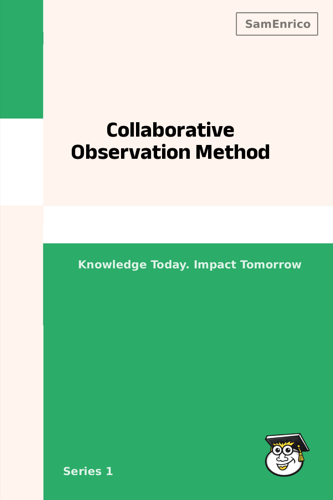
Collaborative Observation Method Audiobook
Teams watch users or processes together to inspire
Teams watch users or processes together to inspire creative solutions.
Formats
Free sample
Chapter 1: Two Beats One--–- In a crowded emergency room in Dallas, Texas, on a Tuesday night in March 2018, a forty-seven-year-old man named Robert arrived with what he described as "the worst headache of my life." The attending physician, Dr. Sarika Patel, had sixteen years of experience. She had seen hundreds of headaches. She ordered a CT scan, reviewed the images alone in her reading room, and diagnosed a severe migraine. Robert was sent home with painkillers.
Three days later, he suffered a ruptured cerebral aneurysm and nearly died. A subsequent review revealed that the aneurysm had been visible on the original CT scan—a tiny, almost imperceptible bulge that Dr. Patel had simply missed. She was not incompetent. She was not careless.
She was alone.This single sentence—she was alone—is the most damning indictment of solo observation ever written. It is also the reason you are holding this book.Robert survived, but he spent six weeks in neurological intensive care. The hospital changed its protocol after the incident. The new protocol was simple, almost embarrassingly so: every CT scan would be reviewed by two radiologists, not one. Within eighteen months, the hospital saw a forty-three percent reduction in missed findings.
No new technology. No expensive AI. No additional training. Just two pairs of eyes instead of one.This is the power of collaborative observation. And it is the single most underutilized tool in modern problem-solving.The Hidden Epidemic of Solo Observation Every day, in every industry, people watch alone and miss what is right in front of them.
The software developer watches a user struggle with a checkout flow and diagnoses "impatience" instead of noticing the confusing button placement. The manufacturing supervisor watches a machine operator perform the same motion repeatedly and sees "efficiency" instead of noticing the subtle flinch that indicates an impending repetitive stress injury. The teacher watches a student fail a math problem and sees "lack of understanding" instead of noticing the specific step where the student's pencil hesitates.We watch alone. We interpret alone. We fail alone.The problem is not a lack of talent or effort.
The problem is a fundamental misconception about how human perception actually works. We believe that seeing is a passive process—that if something is there, we will see it. This is false. Seeing is an active process of selection, filtering, and interpretation. Your brain does not show…
This is the end of the free sample. Get the Audiobook to keep going. Buy now
About this book
Details
- Author
- Mosher Fidelia
- Publisher
- SamEnrico
- Language
- English
- Genre
- Non-Fiction, Self-Help, Observation
- Released
- 2026-06-09
- Pages (approx.)
- 153
- Available as
- eBook, Audiobook

Listen in the VoxFlicks app
Audiobooks and audio dramas wherever you go. Sign in with your SamEnrico account and press play.
More by Mosher Fidelia
 Minimum Viable Product TestingMosher Fidelia$11.99
 Legal Professional Stress GuideMosher Fidelia$11.99
 Intermittent Fasting Success StoriesMosher Fidelia$11.99
 The Bully Proof TeenMosher Fidelia$11.99
 Mitch McConnell GridlockMosher Fidelia$11.99
 TM for TradersMosher Fidelia$11.99
 Nicotine Replacement Adherence PlanMosher Fidelia$11.99
 HGH And BodybuildingMosher Fidelia$11.99
 The Silk Road in the Sky: The Forgotten Flight of the Kashgari AviatorsMosher Fidelia$11.99
 The Manchurian Candidate: The Untold CIA ExperimentsMosher Fidelia$11.99
 Orpheus and the Lyre That Moved the GodsMosher Fidelia$11.99
 Chain-of-Thought Prompt StrategiesMosher Fidelia$11.99