
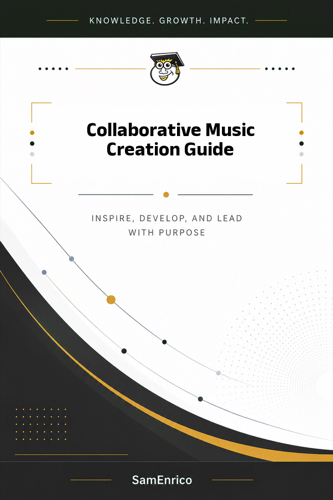
Non-FictionSelf-HelpMusic Inspiration
Collaborative Music Creation Guide eBook
Applies jazz and ensemble principles to team brain
Applies jazz and ensemble principles to team brainstorming and improvisation.
Formats
Free sample
Chapter 1: Brainstorming Is Broken--The most dangerous phrase in modern business is not “we’ve always done it this way.” It is not “that’s not in the budget.” It is not even “I’ll circle back.” The most dangerous phrase in modern business is spoken every day in thousands of conference rooms around the world, often with genuine enthusiasm and good intentions. That phrase is: “Let’s brainstorm.”For nearly eighty years, brainstorming has been the default method for generating ideas in teams. Alex Osborn, a advertising executive and the “O” in the firm BBDO, invented the technique in 1942. His book Your Creative Power promised that groups following four simple rules—defer judgment, go for quantity, build on others’ ideas, encourage wild ideas—would produce more and better ideas than individuals working alone. The rules spread like gospel through corporate America, then through schools, nonprofits, and governments.
Today, brainstorming is so deeply embedded in organizational culture that questioning it feels like questioning democracy or indoor plumbing.There is only one problem. Brainstorming does not work.Not in the way Osborn claimed. Not in the way most managers believe. And certainly not for the complex, adaptive, creative challenges that teams face in the twenty-first century. The evidence has been accumulating for decades, quietly sitting in peer-reviewed journals while facilitators continue to draw circles on whiteboards and ask people to shout out ideas.
This chapter dismantles the brainstorming myth not to make you feel bad about your past meetings, but to free you from a method that has been secretly sabotaging your team’s creative potential. And then it offers an alternative—not another technique to add to your toolkit, but a fundamentally different way of understanding how groups create together.The Invention of a Myth Alex Osborn was not a scientist. He was a charismatic advertising man with a plausible hypothesis and a bestselling book. His four rules of brainstorming emerged from his own observations of creative teams at BBDO, not from controlled experiments. In his 1953 book Applied Imagination, Osborn claimed that brainstorming could double the creative output of a group.
He offered anecdotes, not data. But the anecdotes were compelling, and the method was easy to teach, and so it spread.The first serious challenge to Osborn’s claims came in 1958, just fifteen years after his original book. Yale psychologist Donald Taylor conducted a landmark study comparing real brainstorming groups with “nominal groups”—the same number of individuals working alone whose ideas were later pooled. The results were devastating. Nominal groups consistently produced more ideas, and more original ideas, than interactive brainstorming groups.
Taylor’s finding has been replicated more than twenty times over the following decades. The meta-analyses are unanimous: individuals working separately generate more ideas than groups brainstorming together.Let that sink in. The very activity that organizations use to generate collective creativity is, on average, less creative than having people sit alone in a room and then combine their lists.Why does brainstorming fail so consistently? The answer lies in four cognitive and social phenomena that Osborn never anticipated. Understanding these phenomena is the first step toward replacing brainstorming with something that actually works.The Four Killers of Brainstorming The first killer is production blocking.
This is the simple but devastating reality that only one person can speak at a time in a typical brainstorming session. While one person shares an idea, everyone else must wait. In that waiting period, several things happen. People forget ideas they were about to share. They get distracted by the speaker’s idea.
They get anxious about whether their own idea is good enough. They start mentally rehearsing their contribution instead of listening. And crucially, they cannot generate new ideas while also holding an old idea in working memory and listening to someone else. The cognitive load is simply too high. Research by psychologist Michael Diehl and economist Wolfgang Stroebe found that production blocking alone reduces idea generation by forty to sixty percent compared to individuals working alone.The second killer is evaluation apprehension.
Osborn’s first rule—“defer judgment”—is almost impossible for humans to follow. We are social animals evolved to monitor our status within groups. When someone proposes an idea in front of colleagues, especially in the presence of a manager or senior executive, the brain’s threat detection systems activate. Will they think I’m stupid? Will someone laugh?
Will this idea get me fired? Even in the most psychologically safe environments, evaluation apprehension does not disappear; it merely decreases. The result is self-censorship. People offer safe ideas, obvious ideas, ideas that have worked before. The wild ideas that Osborn championed are the first to die under the glare of social evaluation.The third killer is social loafing.
In any group activity, some individuals will coast on the efforts of others. This is not laziness; it is rational behavior in a system that does not track individual contributions. If ten people are shouting out ideas and a facilitator is writing them on a whiteboard, who is to say which ideas came from which person? The high-contributors work harder; the low-contributors disappear into the crowd. Over time, this pattern becomes entrenched.
The people with the best ideas learn to keep them to themselves until a smaller, safer forum. The people with the weakest ideas learn that they can remain silent without consequence. The group’s creative potential collapses toward the lowest common denominator.The fourth killer is downward norm setting. This is the most subtle and perhaps the most destructive phenomenon. When a group generates ideas together, members unconsciously calibrate their contributions to the average quality of the group’s ideas.
If the first few ideas are mediocre, the bar is set low. People think: “If that’s what we’re going for, my average idea is fine.” They do not reach for their best ideas because the social signal suggests that best ideas are unnecessary or even unwelcome. Conversely, if the first few ideas are highly original, some group members will feel intimidated and withdraw. The group’s output clusters around the initial contributions, for better or worse. There is no mechanism in traditional brainstorming to raise the bar over time.Together, these four killers explain why brainstorming fails.
But the problem is worse than mere failure. Brainstorming does not just produce fewer ideas than individual work; it produces different ideas. The ideas that survive the gauntlet of production blocking, evaluation apprehension, social loafing, and downward norm setting are systematically less novel, less risky, and less diverse than the ideas that individuals generate alone. Brainstorming does not just fail to help. It actively hurts.Classical vs.
Jazz: Two Models of Group Work The failure of brainstorming points to a deeper question. If taking turns listing ideas is ineffective, how do groups actually create together? How do ensembles produce work that exceeds the capacity of any individual member? To answer this question, we need to understand two fundamentally different models of group work: the classical model and the jazz model.The classical model is what most organizations use, even when they think they are being creative. In the classical model, there is a score—a plan, a project charter, a…
This is the end of the free sample. Get the eBook to keep going. Buy now
About this book
Details
- Author
- Vanwinkle Eric
- Publisher
- SamEnrico
- Language
- English
- Genre
- Non-Fiction, Self-Help, Music Inspiration
- Released
- 2026-06-09
- Pages (approx.)
- 138
- Available as
- eBook, Audiobook

Read better in the ZLOADR app
Your eBooks on your phone or tablet. Sign in with your SamEnrico account and start reading.
More by Vanwinkle Eric
 Marathon Hypnosis TrainingVanwinkle Eric$11.99
 Nap for Teachers GuideVanwinkle Eric$11.99
 Student Sports DubaiVanwinkle Eric$11.99
 OKR For Evening RoutineVanwinkle Eric$11.99
 Self Hypnosis for Change AnxietyVanwinkle Eric$11.99
 Acupuncture for ArthritisVanwinkle Eric$11.99
 Massage Business BasicsVanwinkle Eric$11.99
 The Midnight Code: Harriet Tubman’s Secret SignalsVanwinkle Eric$11.99
 The Healers of Nubia: The Forgotten Medical Marvels of Ancient KushVanwinkle Eric$11.99
 Skunks: Striped MammalVanwinkle Eric$11.99
 How to Produce a Demo ModeVanwinkle Eric$11.99
 A Collector's Handbook to the Volvo 240 Saloon SeriesVanwinkle Eric$11.99
You may also like
 Hong Kong Handover 1997Dunn Johnnie$11.99
 Zumba For Postnatal Recovery CourseNeal Christian$11.99
 Zumba for BeginnersLadner Nikia$11.99
 YouTube Comment Mining GuideHumes Pandora$12.99
 Worry Box MeditationCarlin Rudy$11.99
 Workplace Stress MeditationNguyen Lynn$11.99
 Workplace Stress and Sleep RepairHawley Ivory$11.99
 Workplace Perfectionism CureDelaney Jeffry$11.99
 Workplace Injustice Anger GuideWallen Isabelle$11.99
 Work Addiction and Burnout LinkGreenwood Ester$11.99
 Women in Yoga and WellnessBeattie Galina$11.99
 Women in Stand Up ComedyChun Evangeline$11.99