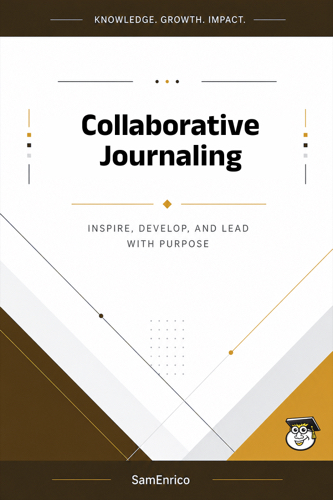
Collaborative Journaling eBook
Uses shared digital documents for asynchronous ide
by Farrar Hye
Uses shared digital documents for asynchronous idea development across time zones.
Formats
Free sample
Chapter 1: The Meeting That Killed Innovation--–- The conference room (or Zoom grid) looks productive. There are eleven people on the call. Three are in San Francisco, two in London, one in Tokyo, and the rest scattered across four other cities. The agenda says “Brainstorming Session – Q3 Strategy.” The facilitator opens with, “No bad ideas. Let’s go around the room.”What happens next is not brainstorming.
It is a ritual of wasted potential.The first person to speak is the most senior—not because she has the best idea, but because her title gives her the first turn. Her suggestion is reasonable, safe, and immediately anchors the entire conversation. The second person, a junior designer two time zones away, has a genuinely novel concept but hesitates. By the time she unmutes, three others have already said, “Building on what Jen said…” The junior designer’s idea never surfaces. The meeting ends with a list of action items that look suspiciously like Jen’s original suggestion, slightly modified by the three people who spoke second, third, and fourth.
The quietest six people on the call said nothing at all.This is the tyranny of the real-time brainstorm. It is the single most destructive force in collaborative work today—and it has become so normalized that most teams do not even recognize it as a problem.The Hidden Epidemic of Wasted Genius Let us name what just happened in that meeting. It was not collaboration. It was a performance of collaboration—a ritual that prioritizes speed over depth, confidence over quality, and hierarchy over insight. And it is happening millions of times per day across every industry, in every time zone, on every video conferencing platform.The cost is staggering.
According to research from the Harvard Business Review, the average knowledge worker spends 85% of their workweek in meetings—and 67% of those meetings are considered failures by the people attending them. But those numbers only scratch the surface. The real damage is invisible: the ideas never shared, the connections never made, the junior employee’s breakthrough thought that died in her throat because she couldn’t find a two-second gap in the conversation.This chapter is not another complaint about meetings. There are already enough books that tell you meetings are broken. The question is: broken compared to what?The answer is the shared journal.
Specifically, an asynchronous, structured, persistent digital document where ideas are written, refined, and decided upon without the pressure of real-time judgment. This is not a small tweak to existing workflows. It is a fundamental reorientation of how human beings collaborate across space and time.But before we can embrace the solution, we must fully understand the disease. The real-time brainstorm is not merely inefficient. It is actively anti-innovative.
And the deeper we dig into its mechanics, the more we realize that the problem is not bad facilitators or talkative colleagues. The problem is the format itself.The Three Fatal Flaws of Live Brainstorming To understand why live meetings kill innovation, we must examine their three structural flaws: anchoring bias, fragmentation cost, and the paradox of turn-taking.Fatal Flaw #1: Anchoring Bias and the First-Speaker Curse Decades of cognitive psychology research have demonstrated a robust phenomenon called anchoring bias: the human brain’s tendency to rely too heavily on the first piece of information it receives. In a live brainstorm, this means the first person to speak effectively sets the boundaries of possibility for everyone else.Consider a classic study by Stasser and Titus (1985) on group decision-making. When groups were tasked with selecting the best candidate for a job, the first person to voice a preference shifted the entire group’s evaluation criteria. Even when later speakers had objectively better information, they unconsciously framed their contributions in relation to the initial anchor rather than from first principles.In a shared journal, anchoring bias is neutralized because all ideas are presented simultaneously.
No single voice gets to define the starting line. The first idea written is visually equal to the forty-first idea written. The playing field is flat.But in a live meeting, the anchor is not only inevitable—it is amplified by status. The most senior person in the room speaks first not because of any rule, but because of social gravity. And once they have spoken, everyone else is unconsciously playing a game of “agree, tweak, or remain silent.” The third option is the most common.Fatal Flaw #2: The Fragmentation of Deep Work There is a second cost of live meetings that is more insidious than anchoring: the destruction of what author Cal Newport calls deep work—the ability to focus without distraction on a cognitively demanding task.Every time a meeting begins, it does not merely consume the hour on the calendar.
It fragments the hours before and after. The cost of context-switching is not linear; it is exponential. Research from the University of California, Irvine found that after a single interruption, it takes an average of 23 minutes to return to the original level of focus. Now consider a day with four meetings. The math is devastating: four hours of meetings can destroy eight hours of deep work.This is particularly brutal for distributed teams spanning time zones.
A developer in Berlin who has a meeting at 10 AM with colleagues in San Francisco has effectively lost not only the meeting hour but also the two hours before (preparation and anticipatory anxiety) and the two hours after (recovery and re-orientation). That is five hours for a one-hour meeting.The shared journal inverts this equation. Rather than forcing everyone into the same fragile moment of real-time attention, it allows each person to engage when their cognitive energy is highest. The morning person writes at 6 AM. The night owl writes at midnight.
The parent with childcare constraints writes during naptime. The journal waits. It is patient. It does not demand that everyone be broken at the same time.Fatal Flaw #3: The Paradox of Turn-Taking The third fatal flaw is the most counterintuitive: turn-taking in meetings actually reduces the diversity of ideas, even when everyone gets a turn.This seems paradoxical. Surely if everyone gets to speak, all ideas are heard?
The research says otherwise. A landmark study by Woolley, Chabris, et al. (2010) on collective intelligence found that groups with equal turn-taking did indeed perform better than groups dominated by one or two voices. But they still underperformed compared to asynchronous written collaboration. Why?Because turn-taking in real-time forces a linear sequence.
Idea A must be spoken before Idea B, which must be spoken before Idea C. This sequence introduces a hidden bias: each subsequent speaker is not generating ideas from scratch but responding to the cumulative weight of everything said before. By the time the tenth person speaks, they are not brainstorming—they are commenting.In contrast, written asynchronous collaboration allows for what creativity researchers call parallel ideation. All ideas coexist in the same space at the same time. They can be combined, remixed, and built upon without the artificial constraint of sequence.
The result is not just more ideas but more novel ideas—because novelty thrives in simultaneity, not linearity.The Anatomy of a Shared Journal If live meetings are the…
This is the end of the free sample. Get the eBook to keep going. Buy now
About this book
Details
- Author
- Farrar Hye
- Publisher
- SamEnrico
- Language
- English
- Genre
- Non-Fiction, Self-Help, Asynchronous Work
- Released
- 2026-06-12
- Pages (approx.)
- 154
- Available as
- eBook, Audiobook

Read better in the ZLOADR app
Your eBooks on your phone or tablet. Sign in with your SamEnrico account and start reading.
More by Farrar Hye
 Luxury Auto by GenerationFarrar Hye$11.99
 Workplace Evening Wind DownFarrar Hye$11.99
 Vegan Dining Out GuideFarrar Hye$11.99
 SAD And Circadian RhythmFarrar Hye$11.99
 Future Self GuidanceFarrar Hye$11.99
 Anger De escalation with ElderlyFarrar Hye$11.99
 Networking for DoctorsFarrar Hye$11.99
 Turtle Ships and Samurai: Korea's Desperate Stand Against JapanFarrar Hye$11.99
 The Golden Tables of Axum: Where Wisdom and Empire ConvergedFarrar Hye$11.99
 A Collector's Handbook to the Mazda Rx3Farrar Hye$11.99
 How to Produce Leaf CleanerFarrar Hye$11.99
 How to Become a Rug InspectorFarrar Hye$11.99