
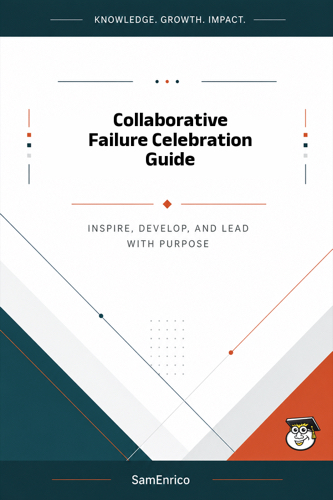
Non-FictionSelf-HelpFailure Recovery
Collaborative Failure Celebration Guide eBook
Turns team mistakes into learning and future creat
by Fair Leonie
Turns team mistakes into learning and future creative fuel.
Formats
Free sample
Chapter 1: The Performance Paradox--–- In a brightly lit conference room on the 37th floor of a Manhattan skyscraper, a team of fourteen product managers, engineers, and designers received the highest possible performance rating. Their quarterly review was flawless. Every project had shipped on time. Every metric was green. The senior vice president praised their "culture of excellence" and held them up as a model for the entire organization.
That night, three members of the team stayed late to quietly delete a folder of unopened error logs, rewrite two performance reviews to remove mentions of a near-miss that could have cost half a million dollars, and draft a memo blaming a vendor for a bug that was entirely their own fault.This is not a story of bad people. It is a story of a system that rewards the appearance of perfection so aggressively that hiding mistakes becomes the most rational career move available. And it happens every single day, in every industry, on every continent, in teams that genuinely believe they are doing the right thing.The team in Manhattan did not set out to lie. They set out to survive. And in doing so, they fell victim to what this book calls the Performance Paradox: the counterintuitive reality that the teams with the best reported performance are often the most skilled at hiding their errors, while teams with slightly messier track records often have a more accurate picture of their own weaknesses and therefore a greater capacity for improvement.The Unspoken Truth About High-Performing Teams Let us begin with an uncomfortable confession.
Most books about teamwork start with a heroic story of transformation. This one starts with a scandal. Because the scandal is the truth, and the truth is that your team is almost certainly hiding more mistakes than you think. Not because anyone is malicious. Because hiding is what humans do when they are punished for revealing their vulnerabilities.Consider the research from Harvard Business School professor Amy Edmondson, who studied medication error reporting in hospitals.
She found that the hospitals with the best safety records actually reported more errors. At first glance, this seems backwards. Shouldn't the safest hospitals have the fewest mistakes? What Edmondson discovered was that the hospitals with genuine safety cultures encouraged nurses to report every error, no matter how small, while hospitals with punitive cultures discouraged reporting so effectively that most errors simply disappeared from the records. The "best" hospitals on paper were often the most dangerous in reality.The Performance Paradox works exactly the same way in product teams, engineering departments, marketing agencies, and executive suites.
When leaders demand perfection, they do not get perfection. They get silence, cover-ups, and strategic underperformance—teams aiming lower just to avoid the risk of visible failure.Smart Failures Versus Basic Failures Before we go any further, we need to draw a distinction that will run throughout this entire book. Not all failures are created equal. Some failures are teachers. Some are just waste.
And confusing the two is the fastest way to turn a learning culture into a permission slip for laziness.Smart failures are necessary for growth. They share three characteristics:First, they are novel. The team attempted something that had not been tried before, or tried an existing process in a new context where the outcome was genuinely uncertain. A smart failure is not a repeat of a known mistake. If you already knew that skipping user research leads to bad products, and you skipped it anyway, that is not a smart failure.
That is negligence.Second, they are hypothesis-driven. The team acted on a clear, testable assumption. They said, "We believe that if we do X, then Y will happen." The failure disproved the hypothesis, which means the team learned something specific about what does not work. Without a hypothesis, failure teaches nothing because there was nothing to disprove.Third, they are effort-aligned. The team invested appropriate resources.
Half-hearted dabbling that fails is not educational. It is wasteful. Smart failures require genuine effort, thoughtful planning, and a real attempt to succeed. The failure comes from uncertainty, not from apathy.Basic failures are the opposite. They involve repeating known mistakes, acting without a hypothesis, cutting corners, violating established safety protocols, or failing due to laziness or ego.
Basic failures do not deserve celebration. They do not belong in the Failure Library. They are not discussed in collaborative retrospectives. They are handled privately, through standard performance management, just like any other form of substandard work.The entire framework of this book applies exclusively to smart failures. If your team is celebrating basic failures, you have not created a learning culture.
You have created an excuse factory.How Accountability Became a Dirty Word The second critical distinction in this chapter is between accountability and blame. These two words are often used interchangeably, but they are opposites in almost every meaningful way.Blame is backward-looking, punitive, and focused on assigning fault to a specific person. Blame asks: "Who did this?" Blame assumes that mistakes are caused by bad individuals rather than bad systems. Blame produces shame, silence, and cover-ups. Blame feels satisfying in the moment because it offers a target for frustration, but it makes teams less safe and less innovative over time.Accountability is forward-looking, constructive, and focused on understanding causes so they can be changed.
Accountability asks: "What in our system allowed this to happen?" Accountability assumes that most mistakes are caused by broken processes, unclear incentives, or inadequate resources rather than malicious individuals. Accountability produces learning, transparency, and better systems.Here is the paradox that most organizations refuse to acknowledge: the more you punish people for mistakes, the fewer mistakes you will see in your reports—and the more mistakes will actually happen. Punishment drives errors underground, where they fester, multiply, and eventually cause catastrophic failures that no one saw coming.The Manhattan team understood this intuitively. They knew that if they reported the error logs, the vendor issue, and the near-miss, they would face hours of painful meetings, damage to their reputations, and perhaps even layoffs. They also knew that if they quietly hid the problems, they would receive their bonuses and be praised as heroes.
The system did not accidentally reward concealment. It was designed to reward concealment.The Cost of Strategic Underperformance When teams hide their mistakes, they do not just conceal the past. They sabotage the future. This phenomenon is called strategic underperformance, and it is one of the most expensive hidden costs in modern organizations.Strategic underperformance happens when teams deliberately aim lower than their true capability to avoid the risk of visible failure. Consider how this plays out in real time.
A product manager has an idea that could double revenue but requires a risky technical approach. She knows that if the risky approach fails, she will be blamed for the failure. She also knows that if she proposes a safe, incremental improvement, she will be praised for delivering reliably. She chooses the safe path. The company loses the potential revenue.
No one ever knows what was lost because the better idea never left her head.This happens thousands of times every day in every large organization.…
This is the end of the free sample. Get the eBook to keep going. Buy now
About this book
Details
- Author
- Fair Leonie
- Publisher
- SamEnrico
- Language
- English
- Genre
- Non-Fiction, Self-Help, Failure Recovery
- Released
- 2026-06-09
- Pages (approx.)
- 148
- Available as
- eBook, Audiobook

Read better in the ZLOADR app
Your eBooks on your phone or tablet. Sign in with your SamEnrico account and start reading.
More by Fair Leonie
 Skier Mental PerformanceFair Leonie$11.99
 Acupuncture for Hot FlashesFair Leonie$11.99
 Weekly Review HabitFair Leonie$11.99
 Student Tech Setup DubaiFair Leonie$11.99
 Self Hypnosis for NeuropathyFair Leonie$11.99
 International Dental IDFair Leonie$11.99
 Async Communication Best PracticesFair Leonie$11.99
 The Hollow Crown Conspiracy: Camelot's Shadow WarFair Leonie$11.99
 The Architects of Al-Andalus: Black Genius in Islamic SpainFair Leonie$11.99
 A Collector's Handbook to the Wartburg 311Fair Leonie$11.99
 How to Produce Denture AdhesiveFair Leonie$11.99
 How to Become a Mental-retardation AideFair Leonie$11.99
You may also like
 Hong Kong Handover 1997Dunn Johnnie$11.99
 Zumba For Postnatal Recovery CourseNeal Christian$11.99
 Zumba for BeginnersLadner Nikia$11.99
 YouTube Comment Mining GuideHumes Pandora$12.99
 Worry Box MeditationCarlin Rudy$11.99
 Workplace Stress MeditationNguyen Lynn$11.99
 Workplace Stress and Sleep RepairHawley Ivory$11.99
 Workplace Perfectionism CureDelaney Jeffry$11.99
 Workplace Injustice Anger GuideWallen Isabelle$11.99
 Work Addiction and Burnout LinkGreenwood Ester$11.99
 Women in Yoga and WellnessBeattie Galina$11.99
 Women in Stand Up ComedyChun Evangeline$11.99