
Non-FictionSelf-HelpAmplification
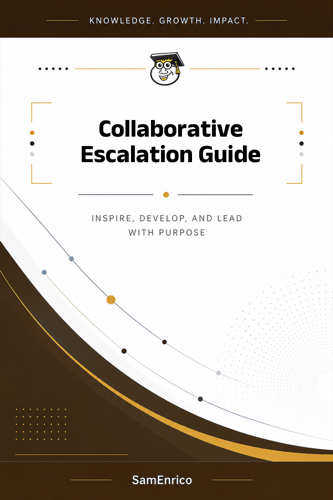
Collaborative Escalation Guide eBook
Turns small ideas into bigger, bolder concepts thr
by Penn James
Turns small ideas into bigger, bolder concepts through team amplification.
Formats
Free sample
Chapter 1: The Genius Trap...--In the winter of 2001, a brilliant engineer named Doug stood before his executive team and unveiled a machine that he believed would reinvent urban transportation. It was self-balancing, electric, intuitive—controlled simply by leaning forward or back. Doug had spent years in solitude perfecting this vision, convinced that his singular genius had produced something the world had never seen. The machine was called the Segway. Its inventor, Dean Kamen, famously believed it would be as transformative as the personal computer.
Journalists who received early previews wrote breathless articles predicting that cities would be redesigned around it.The Segway launched with enormous fanfare. And then, largely, it failed.Not because the technology was flawed. Not because the idea lacked merit. The Segway failed because one brilliant man in a metaphorical cave could not see what a thousand ordinary users would have told him in an afternoon: it was too expensive, too heavy, too conspicuous, and solved a problem most people didn't know they had. Kamen's ego attachment to his "baby" meant that critical feedback arrived too late, after millions had already been sunk into production.
The lone genius, it turned out, had blind spots the size of city blocks.This story is not an outlier. It is the rule.For the past fifty years, Western culture has been enchanted by a seductive myth: the lone genius who retreats from the world, communes with their own brilliance, and emerges with a fully formed, world-changing idea. We tell stories of Einstein in the patent office, of Steve Jobs in his garage, of J.K. Rowling in an Edinburgh café. These narratives are emotionally satisfying—they suggest that greatness is accessible to anyone willing to lock themselves in a room and think hard enough.
But they are also, for the most part, dangerously wrong.The truth, revealed by decades of organizational psychology, innovation research, and network science, is that breakthrough ideas almost never emerge from solitary cognition. They emerge from collision, amplification, and collective extension. A small spark becomes a firestorm not because one person fans it, but because many people do—each adding a log, each seeing a different angle, each catching what the previous person missed.This is the Genius Trap: the reflexive belief that good ideas are born, not built; that originators own their concepts; that collaboration is a threat to purity rather than a path to power. Teams trapped in this mindset do not escalate. They defend, hoard, and ultimately watch their small ideas remain small.This book exists to free you from that trap.
The Collaborative Escalation Guide is not a book about brainstorming. It is not a collection of warm feelings about teamwork. It is a hard engineering discipline for turning the smallest flicker of insight into a roaring, scalable, battle-tested concept—using the only machine powerful enough to do it: a team of human beings who know how to build on each other's minds.Before we can teach you the mechanics of escalation, we must first dismantle the myth that prevents it from happening. That is the work of this opening chapter. We will examine the three failures of the lone genius, introduce the concept of Shared Ownership, provide practical tools for surrendering ego, and lay the foundation for everything that follows.
By the time you finish these pages, you will never look at a "brilliant solo idea" the same way again.The Three Failures of Solitary Ideation Imagine a single brain as a flashlight in a vast, dark warehouse. No matter how powerful the beam, it illuminates only what it points at. The rest of the warehouse—the corners, the ceiling, the floor beneath your feet—remains invisible. Now imagine ten flashlights, each held by a different person standing in a different location, each pointing in a different direction. The illuminated area is not ten times larger.
It is exponentially larger, because each beam reveals what the others cannot see.This metaphor captures the first and most damaging failure of solitary ideation: blind spots.When an individual develops an idea alone, they are necessarily limited by their own cognitive biases, expertise, and life experience. Psychologists call this the Einstellung effect—the tendency for familiar solutions to block the discovery of better ones. If you are an engineer, you will see engineering solutions. If you are a marketer, you will see messaging problems. If you are a pessimist, you will see risks.
If you are an optimist, you will see opportunities. None of these perspectives is wrong. But each is incomplete.The Segway's blind spots were catastrophic. Kamen, a brilliant mechanical engineer, saw the technological miracle. He did not see the social awkwardness of riding a scooter at walking speed among pedestrians.
He did not see the logistical nightmare of parking, storing, and charging the device. He did not see the cultural resistance to looking like a "nerd on wheels." These were not failures of intelligence. They were failures of perspective—and perspective is something no single brain can manufacture on demand.Research on innovation networks bears this out. A landmark study by sociologist Brian Uzzi at Northwestern University analyzed hundreds of Broadway musicals produced between 1945 and 1989. He found that the most successful shows were not created by solitary geniuses or by loose collections of strangers.
They were created by teams with "small-world" networks—people who had worked together before in different combinations, bringing diverse expertise and trust. The worst-performing musicals, interestingly, were those written by a single person. Even the greats—Sondheim, Lloyd Webber—produced their best work when forced to collaborate with lyricists, directors, and choreographers who challenged and extended their ideas.The second failure of solitary ideation is brittleness. An idea developed in isolation has never been tested. It has never been poked, prodded, stretched, or asked to defend itself.
Like a sword that has never seen battle, it looks beautiful on the wall but shatters on first impact. This is because challenge is not the enemy of a good idea; it is the essential forging process. A concept that cannot survive scrutiny does not deserve to exist.Consider the story of the Post-it Note. In 1968, a 3M scientist named Spencer Silver developed a low-tack adhesive that stuck to surfaces but could be repositioned. By his own admission, it was a "failed" invention—too weak for permanent bonding, too strong for temporary labels.
Silver spent five years trying to find a use for his adhesive, working largely alone. He had a small idea, but it remained small because he could not see past his own framing: an adhesive needs to stick permanently.The breakthrough came not from Silver but from a colleague named Art Fry. Fry was singing in his church choir and grew frustrated that his paper bookmarks kept falling out of his hymnal. He remembered Silver's adhesive and asked: "What if I put this on the back of a bookmark?" That small addition—moving from "permanent adhesive" to "repositionable paper"—unlocked everything. But note what happened: Fry built on Silver's idea.
He did not dismiss it because it was "weak." He asked what it could do, not what it failed to do. And then other colleagues added more…
This is the end of the free sample. Get the eBook to keep going. Buy now
About this book
Details
- Author
- Penn James
- Publisher
- SamEnrico
- Language
- English
- Genre
- Non-Fiction, Self-Help, Amplification
- Released
- 2026-06-09
- Pages (approx.)
- 156
- Available as
- eBook, Audiobook

Read better in the ZLOADR app
Your eBooks on your phone or tablet. Sign in with your SamEnrico account and start reading.
More by Penn James
 Digital Dental ForensicsPenn James$11.99
 Digital Communication for ManagersPenn James$11.99
 Acupuncture for Radiation RecoveryPenn James$11.99
 Student Plagiarism RulesPenn James$11.99
 Snowboarder Hypnosis GuidePenn James$11.99
 Pre Evening Nap GuidePenn James$11.99
 Self Hypnosis for Joint PainPenn James$11.99
 The Phantom Thieves: Europe's Greatest Art HeistsPenn James$11.99
 Imhotep's Triumph: The Architect Who Built the Step Pyramid of DjoserPenn James$11.99
 Spadefoot Toads: Unique BurrowerPenn James$11.99
 How to Produce Dental Water JetsPenn James$11.99
 Polish Language for Managers GuidePenn James$12.99
You may also like
 Hong Kong Handover 1997Dunn Johnnie$11.99
 Zumba For Postnatal Recovery CourseNeal Christian$11.99
 Zumba for BeginnersLadner Nikia$11.99
 YouTube Comment Mining GuideHumes Pandora$12.99
 Worry Box MeditationCarlin Rudy$11.99
 Workplace Stress MeditationNguyen Lynn$11.99
 Workplace Stress and Sleep RepairHawley Ivory$11.99
 Workplace Perfectionism CureDelaney Jeffry$11.99
 Workplace Injustice Anger GuideWallen Isabelle$11.99
 Work Addiction and Burnout LinkGreenwood Ester$11.99
 Women in Yoga and WellnessBeattie Galina$11.99
 Women in Stand Up ComedyChun Evangeline$11.99