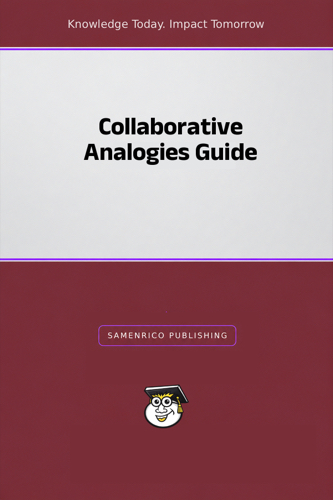
Collaborative Analogies Guide eBook
Draws parallels from nature, sports, and art to so
by Kay Ozie
Draws parallels from nature, sports, and art to solve business challenges.
Formats
Free sample
Chapter 1: The Lens Effect--–- Every business failure I have ever studied—and I have studied hundreds—begins the same way. Not with a bad strategy, not with incompetent people, not with insufficient funding. It begins with a leader who owns one hammer and treats every problem as a nail.The marketing director who spent twenty years in the military sees every product launch as a territorial invasion. The engineer-turned-CEO sees every employee issue as a logic puzzle with one correct answer. The finance veteran sees every creative proposal as a spreadsheet error waiting to happen.
These are not stupid people. They are trapped people—trapped inside a single mental model that worked beautifully for one type of problem and now applies to every type of problem with diminishing returns.This is the single most expensive cognitive bias in the business world, and almost no one talks about it. We talk about data. We talk about execution. We talk about culture.
But we almost never talk about the lens through which we see all of those things. And yet, changing the lens changes everything.Consider two leaders facing identical data. A retail chain has lost fifteen percent of its market share over eighteen months. Competitors have entered the space with lower prices and faster delivery. The board is anxious.
The team is exhausted. Leader A, who came up through operations, sees a logistics problem: the supply chain is too slow, inventory is in the wrong places, and delivery times need to be cut by forty percent. Leader B, who came up through marketing, sees a brand problem: customers no longer trust the company, the value proposition has become muddled, and the messaging needs a complete overhaul.Both are partially right. Both are partially wrong. And neither will solve the problem by staying inside their default lens.Now imagine a third leader—one who has been trained in what I call metaphorical fluency.
This leader looks at the same data and asks a different set of questions. Is this a systems problem, like a forest recovering from fire? Is this an execution problem, like a soccer team responding to a sudden counterattack? Or is this a creativity problem, like a sculptor revealing the form hidden inside the marble?The answer, almost always, is all of the above. But the order matters.
The emphasis matters. And the ability to switch between lenses—to see the same problem through nature, then sports, then art—is the single most underrated leadership skill of the twenty-first century.This book exists to teach you that skill.The Anatomy of a Cognitive Trap Before we can learn to see differently, we must understand why we see so narrowly in the first place. The answer lies in how the human brain handles expertise.When you learn a new domain—whether it is accounting, software engineering, sales, or law—your brain builds neural pathways that make you faster and more efficient at solving problems within that domain. This is called automaticity, and it is the foundation of expertise. A radiologist can look at a scan for three seconds and see what a medical student would miss in three hours.
A master electrician can hear a buzzing sound and name the exact circuit breaker that is failing. This is beautiful, powerful, and essential.But automaticity has a dark side. The same neural pathways that make you fast inside your domain make you blind outside of it. The radiologist sees everything as a potential tumor. The electrician hears every buzz as a wiring problem.
The marketing expert sees every challenge as a positioning issue. The finance expert sees every decision as a trade-off between risk and return.This is not a character flaw. It is a neurological fact. And it becomes dangerous when leaders rise through the ranks because of their expertise, only to discover that the problems at the top require the opposite of expertise—they require fluidity.I call this the One-Hammer Epidemic, and I have watched it destroy companies, teams, and careers in every industry on every continent. A brilliant product designer becomes a CEO and tries to design the company as if it were a product—forgetting that people are not features.
A brilliant sales leader becomes a division head and tries to sell every internal initiative—forgetting that persuasion is not the same as alignment. A brilliant litigator becomes a general counsel and treats every business decision as a liability to be avoided—forgetting that risk is the price of reward.The One-Hammer Epidemic is not a problem of intelligence. It is a problem of repertoire. And the solution is not more data, more training, or more experience inside your existing domain. The solution is the deliberate, systematic expansion of your metaphorical lens library.The Isomorphism Discovery In the 1980s, a handful of interdisciplinary scientists began noticing something strange.
The mathematical patterns that described how a forest recovers from fire were almost identical to the patterns that described how a city recovers from an economic crash. The rules that governed how a flock of birds changes direction were almost identical to the rules that governed how a crowd of shoppers changes their buying behavior. The principles that made a jazz quartet sound cohesive were almost identical to the principles that made a software development team productive.This phenomenon has a name: isomorphism. It comes from the Greek words isos (equal) and morphe (form). Two systems are isomorphic when they have different surface details but identical underlying structures.
A tree and a lung both branch. A river delta and a supply chain both distribute resources. A basketball team and a wolf pack both hunt.Isomorphism is the scientific foundation of this entire book. It explains why a CEO can learn from a flock of geese, why a product manager can learn from a Formula 1 pit crew, and why a team facilitator can learn from a jazz drummer. Not because geese have quarterly reports or pit crews have user personas, but because the pattern of adaptation, communication, and execution is the same across nature, sports, and art.Here is the radical implication: if isomorphism is real, then you do not need to become an expert in biology, athletics, and aesthetics to benefit from them.
You only need to become fluent in recognizing the patterns. You do not need to know the name of every mushroom to understand mycelial networks. You do not need to know the history of every jazz musician to understand rhythmic rests. You need only the ability to see the shape of a solution in one domain and translate it to another.This book is a translation engine. Each chapter takes a pattern from nature, sports, or art, isolates its isomorphic core, and provides a workshop-ready protocol for applying that pattern to your specific business challenge.The Three Domains: Why These Three?You might wonder why this book draws exclusively from nature, sports, and art rather than from, say, military history, religious traditions, or ancient philosophy.
The answer is both practical and theoretical.Theoretically, these three domains map perfectly to three fundamental categories of business problems. Nature provides the best analogies for systems problems: scaling, resilience…
This is the end of the free sample. Get the eBook to keep going. Buy now
About this book
Details
- Author
- Kay Ozie
- Publisher
- SamEnrico
- Language
- English
- Genre
- Non-Fiction, Self-Help, Analogical Thinking
- Released
- 2026-06-11
- Pages (approx.)
- 140
- Available as
- eBook, Audiobook

Read better in the ZLOADR app
Your eBooks on your phone or tablet. Sign in with your SamEnrico account and start reading.
More by Kay Ozie
 Teeth in Aircraft AccidentsKay Ozie$11.99
 Student Evacuation PlansKay Ozie$11.99
 Meditation Flow State BridgeKay Ozie$11.99
 Learning Before ScrollingKay Ozie$11.99
 Digital Body Language GuideKay Ozie$11.99
 Acupuncture for Low LibidoKay Ozie$11.99
 Self Hypnosis for EndometriosisKay Ozie$11.99
 The Silent Witness: The DNA Breakthrough That Solved a 30-Year-Old MurderKay Ozie$11.99
 The Golden Voice of Shanghai: Li Xianglan’s Secret War of SongKay Ozie$11.99
 A Collector's Handbook to the Wartburg TouristKay Ozie$11.99
 How to Produce Pillow FormsKay Ozie$11.99
 Startup Launch Cheat SheetKay Ozie$12.99