
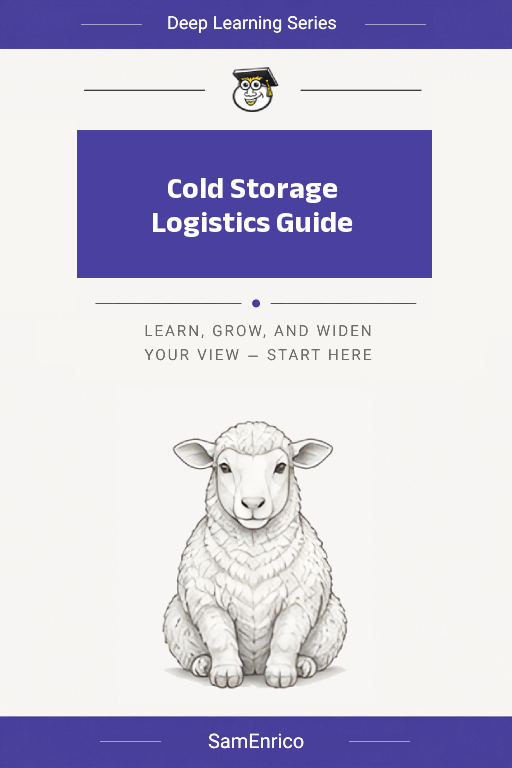
Non-FictionForecast & OutlookCold Chain
Cold Storage Logistics Guide eBook
Project refrigerated warehouse investment, pharma
by Weeks Elnora
Project refrigerated warehouse investment, pharma logistics, and temperature-controlled trucking.
Formats
Free sample
Chapter 1: The Texas Freeze...-- On February 14, 2021, at 3:47 AM, a facility manager named Diana Reyes received the first alert that would change her life. She was asleep in a hotel room forty miles from her warehouse, having been unable to reach her building through ice-covered roads for the past nine hours. The alert on her phone was not a text message or a phone call. It was a silent push notification from her building management system, a piece of software she had personally configured three years earlier. It read: “Zone 4 Temperature: -68.2°C.
Setpoint: -70°C. Variance: +1.8°C. Alarm threshold exceeded.”She stared at the number for five seconds, waiting for it to self-correct. Sensors sometimes drifted, especially during power fluctuations. She refreshed the screen.
Zone 4 now read -67.1°C. Zone 3, the adjacent ultra-cold room, had dropped from -70°C to -69.4°C—not because it was failing, but because the entire facility was losing electrical capacity as the Texas grid buckled under a once-in-a-century winter storm. Diana did not yet know that the Electric Reliability Council of Texas had begun rolling blackouts at 1:25 AM. She did not know that her backup generators, which she had tested dutifully every thirty days, would fail to start because their diesel fuel had gelled in the unprecedented cold. She did not know that by sunrise, she would be watching $200 million worth of COVID-19 vaccines, cancer biologics, and gene therapies approach their thermal limits with no way to stop it.What Diana knew, at 3:47 AM, was that she had approximately four hours to prevent a catastrophe.
She also knew that she was forty miles away, that the roads were impassable, and that the only person on-site was a night security guard who had never touched a refrigeration control panel in his life.This is a book about cold storage. But it is not a book about freezers and trucks. It is a book about risk, money, and the invisible infrastructure that keeps modern medicine alive. It is a book about why most cold storage investors lose money, why most logistics professionals underestimate their liability, and why a handful of operators build fortresses that generate reliable returns for decades while their competitors crumble. And it begins, as all stories about infrastructure should begin, not with a diagram or a spreadsheet, but with the sound of an alarm at 3:47 AM on a night when everything went wrong.The Three Cold Truths Before we dive into the technical details of insulation, refrigeration cycles, and temperature mapping protocols, you need to understand three fundamental truths about cold storage logistics.
These truths contradict nearly everything you have probably heard about warehousing and transportation. They are not opinions. They are the distilled lessons of hundreds of facility failures, billions of dollars in destroyed product, and a handful of remarkable successes.Truth Number One: Cold is not a feature of your warehouse. It is the product you are selling.When you operate a dry storage warehouse, you are selling space. Your customer pays for square footage, pallet positions, and labor.
The building itself is a container. When you operate a refrigerated warehouse, you are selling thermal reliability. Your customer does not care about your square footage. They care about whether their product arrives at the correct temperature, every time, without exception. A dry storage warehouse that fails—a leaky roof, a broken dock leveler—creates inconvenience and a repair bill.
A cold storage warehouse that fails destroys product, kills patient trust, and invites lawsuits that can exceed the value of the building itself.This distinction changes every financial calculation. In dry storage, you optimize for cost per square foot. In cold storage, you optimize for risk per pallet. The cheapest insulation, the most basic refrigeration system, the single-source power feed—these decisions save money on the construction budget but create catastrophic exposure over the life of the asset. Smart investors understand that cold storage is not real estate with some refrigeration equipment attached.
It is a thermal machine that happens to occupy a building. The building is secondary. The thermal machine is primary.Truth Number Two: Pharma and food logistics share nothing but a thermostat.To an outsider, a refrigerated warehouse is a refrigerated warehouse. The temperature might be set to +4°C for produce or +4°C for insulin. The trucks look the same.
The boxes look the same. But the regulatory frameworks, liability structures, and operational protocols are as different as those of a restaurant and a hospital.Food logistics operates under HACCP—Hazard Analysis Critical Control Point. The goal is to prevent spoilage and foodborne illness. The standard of proof is reasonable care. The cost of failure is measured in waste, recall expenses, and reputational damage.
Pharma logistics operates under GDP—Good Distribution Practice. The goal is to preserve product efficacy. The standard of proof is documented evidence. The cost of failure is measured in patient harm, criminal liability, and corporate extinction.Consider a single pallet of frozen french fries. If that pallet experiences a temperature excursion—say, it warms to -10°C instead of the required -18°C—the fries might be ugly.
They might have freezer burn. But they are still french fries. You can sell them at a discount or process them into a different product. The loss is measured in hundreds of dollars. Now consider a single pallet of gene therapy for a rare pediatric disorder.
That pallet contains vials, each vial representing months of personalized manufacturing for a specific patient. If that pallet experiences a temperature excursion—if it warms from -70°C to -50°C for even four hours—the biologic denatures. It becomes medically useless. There is no discount. There is no alternative use.
There is only incineration and a letter to the patient’s family explaining why their treatment will be delayed by another six months, if it can be remanufactured at all.That pallet is worth 2million.Butthetruecostofitslossisnot2 million. But the true cost of its loss is not 2million.Butthetruecostofitslossisnot2 million. It is the lawsuit from the patient’s family, the termination of the supply contract, the regulatory investigation, and the reputational damage that follows a logistics provider for years. This is the difference between food and pharma. It is not a difference of degree.
It is a difference of kind.Truth Number Three: Most cold storage investors lose money because they buy buildings, not risk models.Walk into any commercial real estate investment committee, and you will hear the same language: cap rates, net operating income, lease escalators, tenant creditworthiness. These are the tools of dry storage. Apply them directly to cold storage, and you will almost certainly overpay for assets that will underperform.Cold storage has three characteristics that make traditional real estate analysis dangerously misleading. First, the operating expenses are volatile and catastrophic. A dry storage warehouse’s largest Op Ex line item is labor.
A cold storage warehouse’s largest Op Ex line item is electricity, which can fluctuate dramatically with energy prices, weather, and grid reliability. A single power outage can destroy months of revenue in hours. Second, the tenant base is concentrated and demanding. Pharma tenants require validation, redundancy, and continuous monitoring. They will pay premium…
This is the end of the free sample. Get the eBook to keep going. Buy now
About this book
Details
- Author
- Weeks Elnora
- Publisher
- SamEnrico
- Language
- English
- Genre
- Non-Fiction, Forecast & Outlook, Cold Chain
- Released
- 2026-06-01
- Pages (approx.)
- 160
- Available as
- eBook, Audiobook

Read better in the ZLOADR app
Your eBooks on your phone or tablet. Sign in with your SamEnrico account and start reading.
More by Weeks Elnora
 PTSD Flashback Suicide Attempt MemoirWeeks Elnora$11.99
 Wasabi Phobia Spice Ladder PlanWeeks Elnora$11.99
 Essay Scoring with AI ModelsWeeks Elnora$11.99
 Norwegian Sami Resistance GuidesWeeks Elnora$11.99
 Stress and Psoriasis Flare ManagementWeeks Elnora$11.99
 The Star-Gazing Scholars of Timbuktu: Africa's Ancient AstronomersWeeks Elnora$11.99
 How to Become a Knitting-machine OperatorWeeks Elnora$11.99
 Remote Review For Night Shift WorkersWeeks Elnora$12.99
 Understanding Marsden SyndromeWeeks Elnora$17.99
You may also like
 Hong Kong Handover 1997Dunn Johnnie$11.99
 Zumba For Postnatal Recovery CourseNeal Christian$11.99
 Zumba for BeginnersLadner Nikia$11.99
 YouTube Comment Mining GuideHumes Pandora$12.99
 Worry Box MeditationCarlin Rudy$11.99
 Workplace Stress MeditationNguyen Lynn$11.99
 Workplace Stress and Sleep RepairHawley Ivory$11.99
 Workplace Perfectionism CureDelaney Jeffry$11.99
 Workplace Injustice Anger GuideWallen Isabelle$11.99
 Work Addiction and Burnout LinkGreenwood Ester$11.99
 Women in Yoga and WellnessBeattie Galina$11.99
 Women in Stand Up ComedyChun Evangeline$11.99