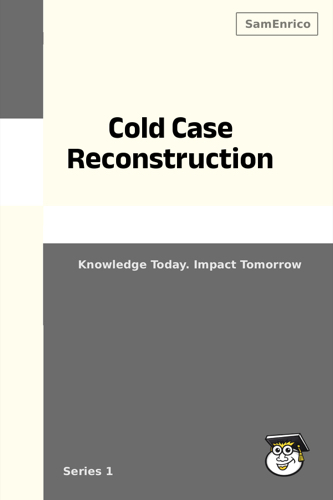
Cold Case Reconstruction Audiobook
undefined
by Shumate Adam
undefined
Formats
Free sample
Chapter 1: The Frozen Hour...–- The patrol officer’s flashlight cut a weak arc through the November fog. It was 2:47 a.m. when he found her. She lay in the drainage ditch behind the abandoned textile mill, half-covered by wet leaves and the kind of silence that follows violence. He checked for a pulse out of protocol, not hope.
There was none. Her eyes were open, fixed on a sky she could no longer see. He radioed it in as a homicide, then stepped back to wait for the detectives. That was 1995. The case file landed on a desk, then another desk, then a shelf, then a box, then a storage unit.
Twenty-eight years later, that same box was carried into a fluorescent-lit room where I sat waiting. The patrol officer had long since retired. The original detectives were dead or had forgotten her name. The textile mill had been demolished, replaced by a parking lot. The leaves had rotted and been replaced by new leaves, season after season.
But the file remained. And somewhere in that file, buried under decades of assumptions and dead ends and questions never asked, was the answer to who killed her. The case wasn't closed. It was frozen. And frozen things can thaw.This is what a cold case actually is.
Not a mystery to be marveled at from the comfort of an armchair, not a puzzle to be solved over a weekend with a true crime podcast and a notebook. A cold case is a failure. It is a failure of investigation, a failure of resources, a failure of time, and sometimes a failure of will. But more than any of those, it is a failure of imagination—the inability of the original investigators to see what was hidden in plain sight, not because they were stupid or lazy, but because they were human. And humans, even the best detectives, suffer from a predictable set of cognitive traps, procedural blind spots, and resource limitations that turn solvable cases into unsolved ones.The purpose of this chapter is to give you a diagnostic framework for understanding why cases go cold in the first place.
Before you can solve a cold case, you must understand the anatomy of its failure. You must learn to distinguish between different types of cold cases, because a case that was never properly investigated requires a different approach than a…
This is the end of the free sample. Get the Audiobook to keep going. Buy now
About this book
Details
- Author
- Shumate Adam
- Publisher
- SamEnrico
- Language
- English
- Genre
- Non-Fiction, True Crime / Cold Cases
- Released
- 2026-06-06
- Pages (approx.)
- 148
- Available as
- eBook, Audiobook

Listen in the VoxFlicks app
Audiobooks and audio dramas wherever you go. Sign in with your SamEnrico account and press play.
More by Shumate Adam
 Palliative Care Anticipatory GuideShumate Adam$11.99
 Dental Anatomy ForensicsShumate Adam$11.99
 Buffer Time Between BlocksShumate Adam$11.99
 Shopping Addiction Flea MarketsShumate Adam$11.99
 The Postpartum and ThyroidShumate Adam$11.99
 Self Hypnosis for Morning SnoozeShumate Adam$11.99
 Body Language for Retail StaffShumate Adam$11.99
 The Healers of Color: Latin America's Impressionist Revolution (1950-1980)Shumate Adam$11.99
 The Kepler Conspiracy: Unlocking the Secrets of the CosmosShumate Adam$11.99
 How to Produce Curling IronsShumate Adam$11.99
 How to Produce Pest Control TrapsShumate Adam$11.99
 A Collector's Handbook to the Vauxhall Viva Ha 90Shumate Adam$11.99