
Non-FictionSelf-HelpResentment
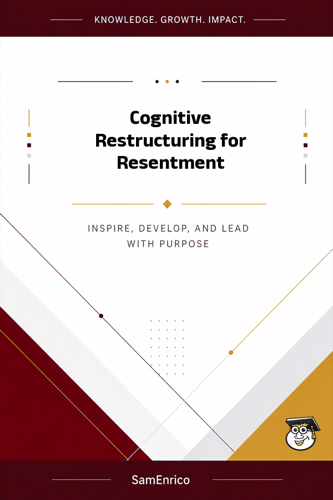
Cognitive Restructuring for Resentment eBook
Let go of long-held grudges by changing your inter
by Gaddy Laure
Let go of long-held grudges by changing your interpretation of past events.
Formats
Free sample
Chapter 1: The Secret Payoff--–- Let me begin with a confession that most self-help books avoid: you probably don’t actually want to let go of your resentment. Not fully. Not yet. And that is not a moral failure. It is not evidence that you are weak, petty, or broken.
It is evidence that your resentment is doing something for you—something useful enough that your brain has decided, unconsciously, that the cost of keeping it is worth the benefit. This chapter is not going to shame you for holding on. It is going to help you see what you have been holding on for. Because until you name the secret payoff, any attempt to “just let it go” will fail. You cannot release what you have not admitted you are holding.This is the first and most overlooked truth about resentment: it persists not because the event was so terrible, but because the story you tell yourself about the event has become useful.
We are taught that resentment is a burden, a poison, a weight. And it is. But it is also a shield, an identity, a source of moral certainty, and sometimes even a strange form of companionship. If you have been carrying a grudge for years—decades, even—it is not because you lack willpower. It is because somewhere along the way, that grudge started paying you back in currency you had not learned to earn any other way.Think about the last time you really leaned into your resentment.
Perhaps you were lying in bed replaying an old argument. Perhaps you were explaining to a friend why you no longer speak to a family member. Perhaps you were silently rehearsing what you would say if you ever ran into the person who hurt you. In that moment, did you feel something other than pain? Did you feel a flicker of righteousness?
A sense of clarity? A strange, grim comfort in knowing exactly who was wrong and who was right? That feeling is the secret payoff. And it is the reason your brain keeps replaying the tape.The Graduated Model of Release Before we go any further, I need to tell you something important. This book operates on a Graduated Model of Release, and understanding where you fall on this spectrum will determine how you measure success.
There are two tiers.Tier One applies to moderate resentments. These are the everyday betrayals, slights, disappointments, and injustices that have accumulated over time. A friend who ghosted you. A colleague who took credit for your work. A partner who was habitually dismissive.
A parent who played favorites. These events hurt. They matter. But they are not cataclysmic. For Tier One, full release is possible.
You can reach a place where the memory still exists but no longer carries emotional charge—like an old scar that you notice but no longer feel.Tier Two applies to severe events. These are profound betrayals, abuse, trauma, or violations that fundamentally reshaped your life. These are the events that therapists call “big T trauma.” For Tier Two, full release may not be possible—and pretending otherwise is cruel and unhelpful. The goal is not to erase the memory or to feel nothing. The goal is reduced suffering.
It is moving from a ten out of ten on the pain scale to a five, then a three, then accepting that a one or a zero might never come. That is still success. That is still healing.Most readers will find themselves in Tier One. Some will recognize themselves in Tier Two. A few will straddle both—severe events from one domain of life, moderate resentments from another.
Throughout this chapter and the rest of the book, I will signal when the advice applies differently to each tier. For now, simply notice which tier resonates with you. There is no prize for being in one category over the other. There is only the honesty of knowing where you are starting from.What Secondary Gains Are (And Why They Matter)The concept of secondary gains comes from psychology, specifically from psychodynamic and cognitive-behavioral traditions. A secondary gain is a hidden benefit you receive from a symptom or behavior that appears, on the surface, to be purely negative.
In other words, your resentment looks like pure suffering—but underneath, it is quietly paying you in ways you may not have acknowledged.Let me give you a non-resentment example so the mechanism is clear. Imagine someone with chronic back pain that prevents them from working. On the surface, the pain is awful. But the secondary gains might include: not having to face a job they hate, receiving care and attention from family members, avoiding social obligations they find draining, and having a clear, unquestionable reason to say no. The person is not faking the pain.
The pain is real. But the pain is also useful. And that usefulness makes it harder to heal.Resentment works exactly the same way. Your anger is real. The injustice you experienced is real.
But somewhere underneath, your resentment has become useful. And as long as it remains useful, a part of you will resist letting it go—not because you are bad, but because you are strategic. Your brain has done a cost-benefit analysis, and for now, the benefits have been winning.The Four Most Common Secondary Gains of Resentment Through years of clinical work and research synthesis from best-selling books on anger, forgiveness, and cognitive behavioral therapy—including Robert Nay’s Taking Charge of Anger, Harriet Lerner’s The Dance of Anger, and Meg Josephson’s Are You Mad at Me?—I have identified four secondary gains that appear again and again. Read through each one slowly. Notice if your body responds.
Notice if you feel a flash of recognition or a wave of defensiveness. That defensiveness is data. It means we are getting close to something true.Secondary Gain One: Protection from Vulnerability Anger is a hot emotion. It moves outward. It feels strong, active, and righteous.
Sadness, fear, grief, and shame are cold emotions. They move inward. They feel weak, passive, and humiliating. Resentment allows you to stay in the hot zone. As long as you are angry, you do not have to feel the more vulnerable feelings underneath.
You do not have to admit how much you were hurt. You do not have to face how scared you were. You do not have to grieve what you lost.I have sat with hundreds of clients who said some version of this: “If I stop being angry, I’m just going to be sad. And sad feels worse.” That is a secondary gain. The resentment is protecting you from the soft underbelly of your own emotional experience.
It is a suit of armor. And armor is heavy, but it is better than being defenseless.For Tier Two readers especially, this protection is not trivial. When the event was severe, the vulnerability underneath may feel life-threatening. Your resentment may be the only thing standing between you and an abyss of despair. If that is the case, you are not going to drop the armor because a book told you to.
You are going to need to build new forms of safety first. That is fine. That is the work. But…
This is the end of the free sample. Get the eBook to keep going. Buy now
About this book
Details
- Author
- Gaddy Laure
- Publisher
- SamEnrico
- Language
- English
- Genre
- Non-Fiction, Self-Help, Resentment
- Released
- 2026-06-06
- Pages (approx.)
- 131
- Available as
- eBook, Audiobook

Read better in the ZLOADR app
Your eBooks on your phone or tablet. Sign in with your SamEnrico account and start reading.
More by Gaddy Laure
 Walking Meditation For Therapists HandbookGaddy Laure$11.99
 Sandwich Generation Self CareGaddy Laure$11.99
 Trying to Conceive Nutrition GuideGaddy Laure$11.99
 The Annexation Doctrine of LapseGaddy Laure$11.99
 The Secret Games of the Celts: Hurling's Underground Resistance in Ancient RomeGaddy Laure$11.99
 Chinese Student Visa HandbookGaddy Laure$12.99
 Engineer to Order Production SequencingGaddy Laure$12.99
 Understanding Oculo Facio Cardio Dental SyndromeGaddy Laure$17.99
 Visual ArtistGaddy Laure$11.99
 How to Start a Performing Arts Support Business (Beginners Guide)Gaddy Laure$11.99
You may also like
 Hong Kong Handover 1997Dunn Johnnie$11.99
 Zumba For Postnatal Recovery CourseNeal Christian$11.99
 Zumba for BeginnersLadner Nikia$11.99
 YouTube Comment Mining GuideHumes Pandora$12.99
 Worry Box MeditationCarlin Rudy$11.99
 Workplace Stress MeditationNguyen Lynn$11.99
 Workplace Stress and Sleep RepairHawley Ivory$11.99
 Workplace Perfectionism CureDelaney Jeffry$11.99
 Workplace Injustice Anger GuideWallen Isabelle$11.99
 Work Addiction and Burnout LinkGreenwood Ester$11.99
 Women in Yoga and WellnessBeattie Galina$11.99
 Women in Stand Up ComedyChun Evangeline$11.99