
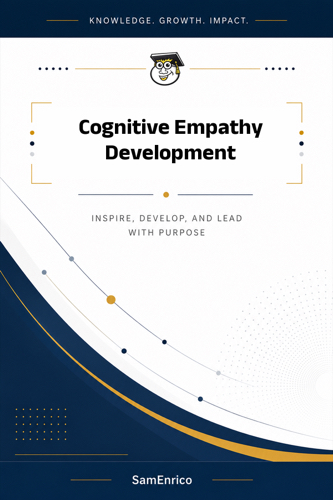
Cognitive Empathy Development eBook
Understand others' perspectives without absorbing
Understand others' perspectives without absorbing their emotions.
Formats
Free sample
Chapter 1: The Feeling Fallacy--–- Every day, millions of well-intentioned people do the same thing. They walk into a room where someone is suffering—a grieving friend, a frustrated colleague, a frightened child—and they try to feel their way to a solution. They lean in. They mirror the furrowed brow. They let the heaviness settle into their own chest.
They believe, with absolute conviction, that this is what caring looks like.They are wrong.Not partly wrong. Not wrong in a few edge cases. Fundamentally, structurally, and dangerously wrong. The belief that emotional resonance is the path to understanding has created a generation of burned-out helpers, biased decision-makers, and ineffective caregivers. It has confused suffering with virtue.
It has elevated feeling over thinking. And it has left millions of people exhausted, guilty, and no more helpful than when they started.The woman who cries with every client and collapses into bed each night is not a hero. She is a cautionary tale. The manager who feels his team’s stress so deeply that he cannot make tough calls is not compassionate. He is paralyzed.
The parent who dissolves into tears when their child is upset is not attuned. They are dysregulated.This chapter will show you why everything you learned about empathy is backward. It will give you the conceptual foundation you need to rebuild your understanding from the ground up. And it will introduce you to a distinction that will change how you listen, help, and care for the rest of your life.The distinction is simple. The implications are profound.The Day I Realized I Had Been Lied To My own awakening to this problem came in a windowless conference room in Chicago.
I was thirty-two years old, three years into a doctoral program in clinical psychology, and thoroughly miserable. I had been trained to be empathetic. I had been told that my ability to feel clients’ pain was my greatest asset. I had been praised for my “emotional availability” and “deep attunement.”And I was burning out so fast I could feel my bones smolder.I sat across from a woman who had survived a house fire. She had lost everything.
Her voice was flat. Her eyes were dry. She described the smell of smoke, the sound of glass shattering, the moment she realized her cat was still inside. I listened. I felt my throat tighten.
I imagined the heat, the panic, the loss. By the end of the session, I could barely speak. I wanted to cry for her. I wanted to hold her. I wanted to fix something I could not fix.That night, I could not sleep.
I replayed every detail. I felt the fire again and again. The next morning, I called in sick. I was not sick. I was hollow.My supervisor, a woman in her sixties who had been doing this work for thirty-five years, pulled me aside when I returned.
She did not offer comfort. She offered a question I have never forgotten.“Why are you feeling her pain?” she asked.I stared at her. “Because I’m empathetic.”“No,” she said. “You’re confused. Empathy is not feeling someone’s pain.
Empathy is understanding someone’s pain. What you’re doing is emotional contagion. And it’s going to destroy you.”That conversation saved my career. It also revealed a gap in my education that should embarrass every psychology program in the country. No one had ever taught me the difference between cognitive empathy and affective empathy.
No one had ever explained that feeling someone’s pain is optional. No one had ever told me that the best helpers are not the ones who feel the most but the ones who see the most clearly.This chapter closes that gap for you.The False God of Emotional Resonance Before we can build something better, we have to tear down something false. The falsehood is this: that emotional resonance—feeling what another person feels—is the gold standard of human connection. Call this the Resonance Fallacy.The Resonance Fallacy appears everywhere. It is in movies, where the hero cries with the victim before saving them.
It is in self-help books, where empathy is defined as “feeling into another’s heart.” It is in corporate training videos, where managers are told to “connect emotionally” with their teams. It is in parenting advice, where mothers and fathers are encouraged to “validate feelings” by mirroring them.The Resonance Fallacy sounds beautiful. It feels true. And it is catastrophically wrong for three reasons.Reason One: Emotional Resonance Is Inaccurate When you feel what someone else feels, you are not actually feeling their emotion. You are feeling your brain’s simulation of their emotion.
That simulation is filtered through your own history, your own personality, your own nervous system. Two people cannot feel the same emotion in the same way. The simulation is always a projection.This means that emotional resonance often leads you away from accurate understanding. A 2014 study by researchers at the University of California, Berkeley, asked participants to watch videos of people describing emotional experiences. Half the participants were instructed to “feel what the person is feeling.” Half were instructed to “understand what the person is feeling without getting emotionally involved.”The results were stark.
The “feel” group was significantly less accurate in identifying the specific emotions the speakers described. They confused sadness with anxiety. They mistook frustration for anger. They projected their own emotional states onto the speakers. The “understand” group, by contrast, was significantly more accurate.
They correctly identified the emotions because they were not busy drowning in them.Your feelings are not a window into someone else’s soul. They are a window into your own. If you want to see someone else, put the window down.Reason Two: Emotional Resonance Depletes You The second problem with the Resonance Fallacy is that it is unsustainable. Feeling is metabolically expensive. Your brain consumes glucose when it simulates emotion.
Your heart rate changes. Your cortisol rises. Your immune system suppresses. These are not metaphors. They are measurable biological events.When you repeatedly expose yourself to others’ suffering through emotional resonance, you accumulate what researchers call allostatic load—the wear and tear on your body from chronic stress.
This is not burnout in the vague, self-help sense. This is measurable organ damage. High allostatic load predicts cardiovascular disease, diabetes, depression, and early death.The therapists, nurses, and social workers who use cognitive empathy have allostatic loads within normal ranges. The therapists, nurses, and social workers who use affective empathy have allostatic loads that look like chronic trauma survivors. They are not more caring.
They are more damaged.You cannot help anyone if you are dead. And emotional resonance, practiced without regulation, is a slow suicide.Reason Three: Emotional Resonance Distorts Moral Judgment The third problem is the most disturbing. Emotional resonance does not just drain you and mislead you. It makes you a worse person.Consider the famous “trolley problem” in moral philosophy. A runaway trolley is heading toward five people tied to the track.
You can pull a lever to divert the trolley onto a side track, killing one person instead of five. Most…
This is the end of the free sample. Get the eBook to keep going. Buy now
About this book
Details
- Author
- Freitas Dayna
- Publisher
- SamEnrico
- Language
- English
- Genre
- Non-Fiction, Self-Help, Cognitive Empathy
- Released
- 2026-06-07
- Pages (approx.)
- 143
- Available as
- eBook, Audiobook

Read better in the ZLOADR app
Your eBooks on your phone or tablet. Sign in with your SamEnrico account and start reading.
More by Freitas Dayna
 Recurring Dreams of DrowningFreitas Dayna$11.99
 MBSR For ExecutivesFreitas Dayna$11.99
 Stress Omega 3 Supplement GuideFreitas Dayna$11.99
 Chiropractic Safety GuideFreitas Dayna$11.99
 Inner Child HypnosisFreitas Dayna$11.99
 Trump ApprenticeFreitas Dayna$11.99
 The Twelve Step Recovery WorkbookFreitas Dayna$11.99
 Self Hypnosis For FocusFreitas Dayna$11.99
 The Last Waltz: How a Single Performance Changed Music ForeverFreitas Dayna$11.99
 Quetzalcoatl's Broken Promise: The Feathered Serpent's Last WarningFreitas Dayna$11.99
 The Quantum Titans: Black Industrialists Who Shaped the Modern WorldFreitas Dayna$11.99
 How to Become a Cracking-and-fanning-machine OperatorFreitas Dayna$11.99