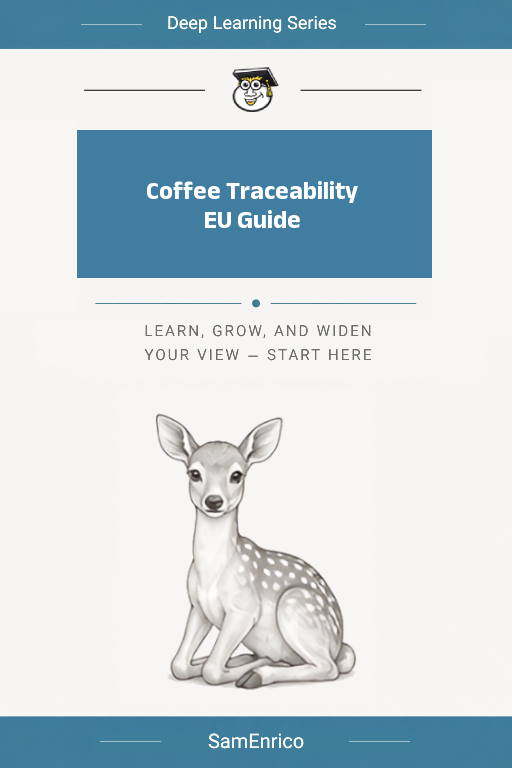
Coffee Traceability EU Guide Audiobook
Implement blockchain traceability for coffee expor
Implement blockchain traceability for coffee exports to meet EU deforestation regulations. Provide geolocation of farms to prove product not from deforested land.
Formats
Free sample
Chapter 1: The Rotterdam Seizure--The shipping container arrived at Rotterdam on a Tuesday morning in September 2024. It had traveled 7,200 kilometers from the highlands of Honduras, crossing the Atlantic Ocean over eighteen days. The coffee inside—forty thousand kilograms of washed arabica, certified organic, fair trade, and shade-grown—was worth €380,000 at market prices. The importer, a medium-sized German roaster with a reputation for sustainability, had paid a fifteen percent premium for these beans. The farmer, a smallholder named Elena who tended 2.3 hectares of land her grandfather had cleared in 1978, expected to receive her share of the payment within ninety days.The container never reached the roaster.At 10:47 AM, a customs officer scanned the shipment's entry documents into the European Union's new Information System.
The system flagged an immediate violation: no geolocation data for the farms where the coffee was grown. No polygons. No deforestation-free declaration. No Due Diligence Statement. The officer stamped a red "NON-COMPLIANT" notice on the electronic file.
The container was moved to a holding yard, where it would sit for six weeks while the importer appealed. The appeal was denied. On a cold November morning, the coffee was incinerated. The importer lost €380,000. The roaster lost a product line.
And Elena, the farmer who grew the beans, never received payment.This scenario is not hypothetical. It is the new reality of coffee trading under the European Union Deforestation Regulation, known as EUDR. And it will happen thousands of times before the end of this decade.The New Gatekeeper The European Union is the world's largest importer of coffee. European roasters purchase approximately 2.7 million metric tons of green coffee annually, accounting for roughly forty-five percent of global coffee trade. Germany alone imports more coffee than the entire continent of North America.
Italy, France, Belgium, and Spain round out a market that consumes over three billion cups of coffee every single day.This market is now closed to any coffee that cannot prove, with documented, verifiable evidence, that it was grown on land free from deforestation after December 31, 2020.Regulation (EU) 2023/1115, which took effect in June 2023 with enforcement beginning December 30, 2024, and later delayed to December 30, 2025, and finally settled on December 30, 2026 for most operators, represents the most significant transformation in agricultural commodity trade since the creation of the World Trade Organization. It applies to seven commodities: cattle, cocoa, coffee, oil palm, rubber, soya, and wood. For…
This is the end of the free sample. Get the Audiobook to keep going. Buy now
About this book
Details
- Author
- Conroy Lourdes
- Publisher
- SamEnrico
- Language
- English
- Genre
- Non-Fiction, Business Brief, Traceability
- Released
- 2026-06-01
- Pages (approx.)
- 152
- Available as
- eBook, Audiobook

Listen in the VoxFlicks app
Audiobooks and audio dramas wherever you go. Sign in with your SamEnrico account and press play.
More by Conroy Lourdes
 Memory for JournalismConroy Lourdes$11.99
 Floating in Space GuideConroy Lourdes$11.99
 Cocaine Community Support GuideConroy Lourdes$11.99
 The Monk Mode MorningConroy Lourdes$11.99
 Commercial Property Financing OptionsConroy Lourdes$11.99
 Forgiveness for Body ImageConroy Lourdes$11.99
 Handling Coworker InterruptionsConroy Lourdes$11.99
 Household Management BlocksConroy Lourdes$11.99
 Afghanistan Green Beret MedicConroy Lourdes$11.99
 The Last Whisper of the Indus: Secrets of the Mohenjo-DaroConroy Lourdes$11.99
 The Bloomsbury Breakthrough: How Virginia Woolf and the Bloomsbury Group Redefined Modern LiteratureConroy Lourdes$11.99
 The Battle of Carrhae: Rome's Desert Disaster (53 BC)Conroy Lourdes$11.99