
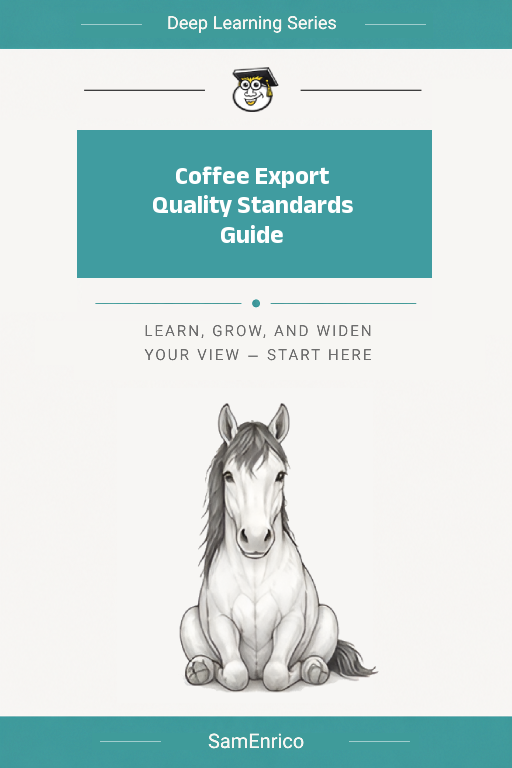
Non-FictionBusiness BriefCoffee Trade
Coffee Export Quality Standards Guide eBook
Meet EU coffee grading, moisture control, and cont
Meet EU coffee grading, moisture control, and contamination limits for specialty and commercial beans.
Formats
Free sample
Chapter 1: The €50,000 Mistake--–- The morning light had barely touched the wet cobblestones of Rotterdam when Maria Vasquez received the email that would unravel two years of work. Her family's cooperative in the mountains of Tolima, Colombia, had poured everything into that container – 275 bags of carefully sorted, shade-grown Caturra. The buyer, a well-regarded German roaster, had been enthusiastic about the samples. But the email was brief, cold, and devastating: "Rejected. OTA non-compliant on post-roast testing.
Container to be returned at seller's expense or destroyed. You have 14 days."–- Maria stared at the screen. She had tested for moisture. She had graded for defects. She had even paid for an export certificate.
But she had not understood that green coffee with no explicit legal limit for Ochratoxin A could still be rejected because the EU's General Food Law considers any food that would become unsafe after processing to be unsafe at entry. Her buyer's contract had no liability-shifting clause. The €48,000 shipment – plus freight, insurance, and storage – was now her loss. The cooperative would not survive.–- This book exists to ensure that story is not yours.The Wake-Up Call: Why Compliance Is Not Optional–- For the past decade, the European Union has been quietly but relentlessly tightening its grip on imported agricultural commodities. Coffee, once treated as a low-risk raw material, now sits squarely in the crosshairs of the most sophisticated food safety regime on earth.
Between 2020 and 2024, EU border rejections of green coffee increased by over 300 percent, according to RASFF data. The reasons range from mold toxins to pesticide residues to packaging failures. But the common thread is not malice from European regulators. It is a fundamental mismatch between how coffee has traditionally been exported and how the EU now expects it to be handled.–- The old way was simple: grow, dry, hull, bag, ship. The buyer accepted the risk.
If something went wrong in transit – moisture gain, mold growth, insect infestation – the importer filed a claim with their insurer and life moved on. That era is over. The EU's General Food Law Regulation (EC 178/2002) explicitly states that the "primary responsibility for ensuring compliance with food law rests with the food business operator" at every stage. For green coffee, that means the exporter is legally responsible for safety from the moment the cherry is picked until the bean leaves the ship. And crucially, liability extends to downstream processing: if your green coffee would produce roasted beans exceeding the EU limit for OTA (3.0 micrograms per kilogram), your green coffee is considered unsafe, even though no direct limit applies to it.–- This is the trap that caught Maria.
No EU official tested her green beans. They tested the roasted beans produced from them. But because her contract did not shift liability, she bore the cost. Understanding this distinction – between explicit limits and implicit safety requirements – is the single most important concept in this book.The Farm to Cup Philosophy: How EU Law Sees Your Coffee–- To export successfully to the EU, you must adopt the regulator's worldview. The EU does not see coffee as an agricultural commodity.
It sees coffee as a food. And under Regulation (EC) 178/2002, all foods entering the EU must be "safe" – defined as not injurious to human health and fit for human consumption. This definition applies regardless of whether the coffee will be roasted, ground, brewed, or turned into instant.–- The "Farm to Cup" philosophy means that liability attaches to every step. If mold grows in your storage silo three weeks before shipping, you are responsible. If condensation forms inside the container during ocean transit, you are responsible.
If the buyer roasts the coffee improperly, creating a toxin that was not present at shipment, the burden of proof shifts to you to show the contamination was not your fault. This is not theoretical. In a 2022 arbitration case between a Brazilian exporter and an Italian roaster, the exporter lost €120,000 because they could not prove that elevated OTA levels originated after loading.–- The legal mechanism is Article 14 of the General Food Law, which prohibits placing unsafe food on the market. While green coffee has no explicit OTA limit, any food that would be unsafe after "normal and reasonably foreseeable processing" is considered unsafe at entry. Roasting is normal and reasonably foreseeable.
Therefore, if your green coffee would produce roasted beans above 3.0 µg/kg OTA, your green coffee is non-compliant. The same logic applies to pesticides, heavy metals, and mycotoxins.Key Regulatory Documents: What You Must Know–- Navigating EU coffee regulation requires familiarity with three primary documents, each of which has been updated in the past 24 months.Regulation (EU) 2023/915 on Maximum Levels for Contaminants–- This regulation, which took full effect on May 25, 2024, replaced the previous framework (1881/2006) and consolidated contaminant limits across all food categories. For coffee, the key provisions are:OTA in roasted coffee beans and ground coffee: 3.0 µg/kg OTA in soluble coffee (instant): 5.0 µg/kg Lead and cadmium: Monitored but no specific limit for green coffee (though the general safety requirement applies)Polycyclic aromatic hydrocarbons (PAHs): Not currently limited for coffee, but under review–- Critically, 2023/915 introduced stricter enforcement provisions, including mandatory testing for shipments from origins with a history of non-compliance. If your country appears on the European Commission's list of "high-risk third countries" for a particular contaminant, you can expect a control rate of 20 to 50 percent – meaning one in five of your containers will be physically sampled at the border.Regulation (EU) 2023/2782 on Official Controls–- This regulation, effective since December 2024, governs how EU member states conduct border inspections. It increased the frequency of identity and physical checks on "food of non-animal origin" – including coffee – from specific origins.
Under the new rules:Identity checks (document review) must be completed within 24 hours Physical checks (sampling and laboratory analysis) can take up to 30 days Costs of sampling and analysis are borne by the importer, who will pass them to the exporter RASFF notifications (Rapid Alert System for Food and Feed) are now published within 48 hours of confirmation–- A RASFF notification is a commercial death sentence. Once your shipment is flagged, every EU member state is alerted. Future shipments from your cooperative or company will be subject to 100 percent inspection for up to 12 months. The notification is public, meaning your buyers and competitors can see it. Many importers will simply stop purchasing from you.Regulation (EC) 396/2005 on Pesticide MRLs–- While not coffee-specific, this regulation sets Maximum Residue Limits for over 1,100 pesticides across all foods.
For coffee, the default MRL for any pesticide not specifically listed is 0.01 mg/kg – effectively a ban. High-risk pesticides include:Chlorpyrifos: Banned in the EU, MRL of 0.01 mg/kg Endosulfan: Banned, MRL 0.01 mg/kg Glyphosate: MRL of 0.1 mg/kg for coffee (higher than the default, but still strict)Neonicotinoids (Imidacloprid, Thiamethoxam): MRLs ranging from 0.01 to 0.05 mg/kg–- The burden of proof is on the exporter. You must demonstrate compliance through accredited laboratory testing. A certificate from your local agricultural ministry is not sufficient unless it is backed by ISO/IEC 17025-accredited analysis.The Liability Trap: Green Coffee's Invisible Limits–- Let us return to the central paradox that confuses even experienced exporters: how can a product with no explicit…
This is the end of the free sample. Get the eBook to keep going. Buy now
About this book
Details
- Author
- Cranford Meggan
- Publisher
- SamEnrico
- Language
- English
- Genre
- Non-Fiction, Business Brief, Coffee Trade
- Released
- 2026-05-28
- Pages (approx.)
- 143
- Available as
- eBook, Audiobook

Read better in the ZLOADR app
Your eBooks on your phone or tablet. Sign in with your SamEnrico account and start reading.
More by Cranford Meggan
 Community Garden ParticipationCranford Meggan$11.99
 Observation Without Judgment SkillCranford Meggan$11.99
 Food Packaging Toxins GuideCranford Meggan$11.99
 Basketball Ankle PreventionCranford Meggan$11.99
 The Silent Crusade: The Knights Templar's Financial RevolutionCranford Meggan$11.99
 How to Start a Expansion Meter (non-electronic) Business (Beginners Guide)Cranford Meggan$11.99
 How to Produce Chiropractic TablesCranford Meggan$11.99
 Roadshow Sales RepresentativeCranford Meggan$11.99
You may also like
 Hong Kong Handover 1997Dunn Johnnie$11.99
 Zumba For Postnatal Recovery CourseNeal Christian$11.99
 Zumba for BeginnersLadner Nikia$11.99
 YouTube Comment Mining GuideHumes Pandora$12.99
 Worry Box MeditationCarlin Rudy$11.99
 Workplace Stress MeditationNguyen Lynn$11.99
 Workplace Stress and Sleep RepairHawley Ivory$11.99
 Workplace Perfectionism CureDelaney Jeffry$11.99
 Workplace Injustice Anger GuideWallen Isabelle$11.99
 Work Addiction and Burnout LinkGreenwood Ester$11.99
 Women in Yoga and WellnessBeattie Galina$11.99
 Women in Stand Up ComedyChun Evangeline$11.99