
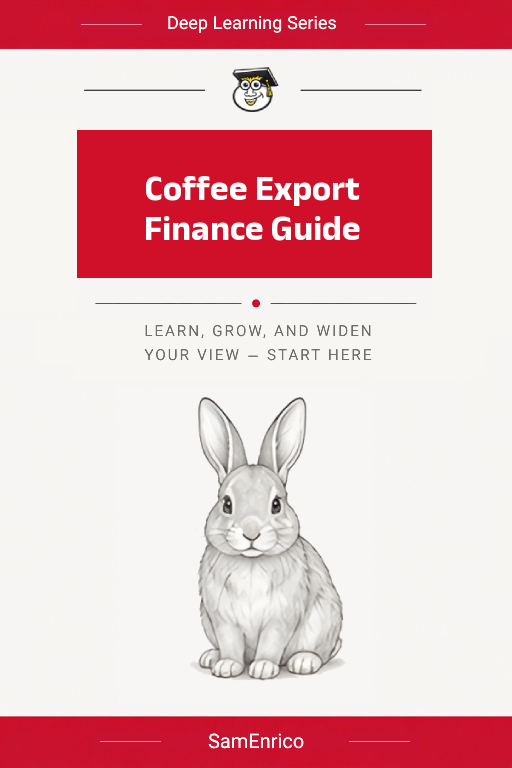
Non-FictionBusiness BriefAgricultural Trade
Coffee Export Finance Guide Audiobook
Access export finance for coffee shipments to Euro
Access export finance for coffee shipments to Europe. Warehouse receipts and trade finance.
Formats
Free sample
Chapter 1: The Cash Flow Trap--The moment your container of green coffee is loaded onto a vessel in Mombasa, Santos, or Ho Chi Minh City, the clock starts ticking—and not in your favour. For the next ninety to one hundred and twenty days, you will be expected to pay your farmers, your cooperatives, your labour force, your transport companies, and your port fees, all while waiting for a European roaster to settle an invoice that may not arrive until well after the next harvest has begun. This is not a cash flow problem. It is a cash flow trap. And for the majority of coffee exporters who fail to grow beyond small-scale operations, this trap is the single greatest barrier to accessing the European market.The purpose of this chapter is to lay bare the economic reality of coffee export finance.
We will examine why Europe remains the most attractive destination for green coffee, despite its payment terms. We will dissect the precise mechanics of the ninety-to-one-hundred-and-twenty-day gap between shipment and settlement. And we will explain why local banks in producing countries almost never fill that gap, leaving exporters stranded between a shipping container full of valuable beans and an empty working capital account. By the end of this chapter, you will understand that solving the finance gap is not merely a matter of operational convenience—it is the difference between surviving as a small exporter and scaling into a reliable, bankable partner for European roasters.The European Opportunity: Why Coffee Exporters Look West Europe is not merely a large market for green coffee; it is the most sophisticated, price-transparent, and legally predictable market in the world. The European Union and the United Kingdom together account for approximately sixty percent of global coffee imports by value, with traditional coffee powerhouses such as Germany, Italy, Belgium, and Scandinavia leading the way.
Unlike emerging markets where payment disputes can drag on for years, European buyers operate within well-defined commercial codes, standardised arbitration mechanisms, and banking systems that respect letters of credit and other trade finance instruments.Crucially, green coffee enters the European Union duty‑free. The Common Customs Tariff code for unroasted, decaffeinated or non-decaffeinated coffee is zero percent. This is not a temporary concession but a long-standing feature of European trade policy, designed to ensure that the continent’s roasting industry has access to affordable raw materials. For the exporter, zero duty means that…
This is the end of the free sample. Get the Audiobook to keep going. Buy now
About this book
Details
- Author
- Behrens Callie
- Publisher
- SamEnrico
- Language
- English
- Genre
- Non-Fiction, Business Brief, Agricultural Trade
- Released
- 2026-06-01
- Pages (approx.)
- 145
- Available as
- eBook, Audiobook

Listen in the VoxFlicks app
Audiobooks and audio dramas wherever you go. Sign in with your SamEnrico account and press play.
More by Behrens Callie
 Remote Company Retreats For Leadership TeamsBehrens Callie$11.99
 Burnout Prevention Spiritual PracticeBehrens Callie$11.99
 Google Pixel Photo ComparisonBehrens Callie$11.99
 Hip Replacement Recovery GuideBehrens Callie$11.99
 The Omega 3 Memory GuideBehrens Callie$11.99
 The Bloodhound of Buenos Aires: The Great 1920s Rum Heist That Went to the DogsBehrens Callie$11.99
 Understanding Shokeir SyndromeBehrens Callie$17.99
 How to Become a Political ScientistBehrens Callie$11.99
 Japanese Scholarship Rejection PrepBehrens Callie$12.99
 Self-aware Turing Machine OperatorBehrens Callie$11.99
You may also like
 Hong Kong Handover 1997Dunn Johnnie$11.99
 Zumba For Postnatal Recovery CourseNeal Christian$11.99
 Zumba for BeginnersLadner Nikia$11.99
 YouTube Comment Mining GuideHumes Pandora$12.99
 Worry Box MeditationCarlin Rudy$11.99
 Workplace Stress MeditationNguyen Lynn$11.99
 Workplace Stress and Sleep RepairHawley Ivory$11.99
 Workplace Perfectionism CureDelaney Jeffry$11.99
 Workplace Injustice Anger GuideWallen Isabelle$11.99
 Work Addiction and Burnout LinkGreenwood Ester$11.99
 Women in Yoga and WellnessBeattie Galina$11.99
 Women in Stand Up ComedyChun Evangeline$11.99