
Non-FictionStudent's ShortcutCareer Education
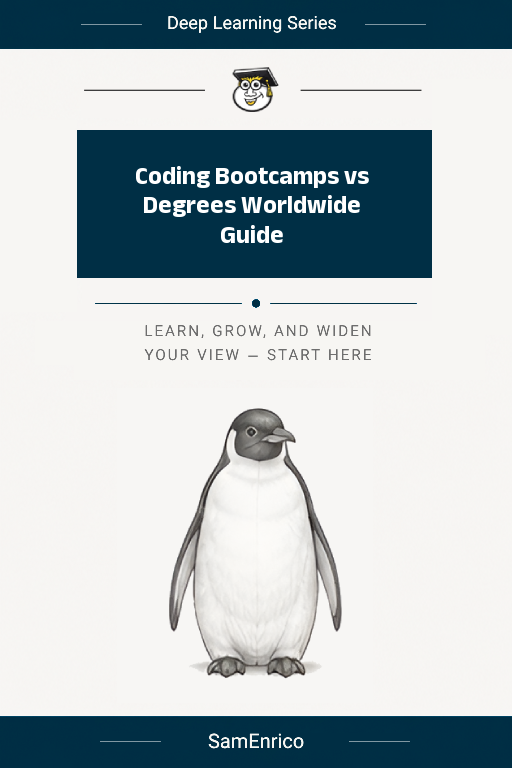
Coding Bootcamps vs Degrees Worldwide Guide eBook
Compare cost, duration, outcomes, and employer rec
Compare cost, duration, outcomes, and employer recognition across 100+ bootcamps and university CS programs globally.
Formats
Free sample
Chapter 1: The $410,000 Illusion--–- Sean was a 31-year-old marketing manager in Chicago when he first typed “how to become a programmer” into Google. He had a mortgage, a pregnant wife, and a growing sense that his current career had a glass ceiling painted in Excel spreadsheets. Over the next six months, he accumulated 47 browser tabs comparing bootcamps and universities, three conflicting opinions from well-meaning friends, and zero clarity. He almost enrolled in a $40,000 online master’s degree before a friend’s offhand comment—“Just do a bootcamp, it’s cheaper”—stopped him. Then he read a Reddit thread claiming bootcamp graduates couldn’t get past HR filters.
Then a Linked In post said degrees were “obsolete.” Then his uncle, who had been a mainframe programmer in the 1980s, told him he “needed a four-year degree or he’d never be taken seriously.”Sean is not real. But his paralysis is.Every single day, thousands of people around the world—from Bangalore to Berlin, from Toronto to Tokyo—face the same impossible question: Should I invest four years and a small fortune in a computer science degree, or should I bet fourteen weeks and a fraction of the cost on a coding bootcamp? The answer, as you will discover in this book, is not “bootcamp” or “degree.” The answer is “it depends on at least seven variables that most advice-givers have never even heard of.”But before we can answer that question for you personally, we have to destroy the most dangerous illusion in all of tech education: the illusion that the choice is simply about which program is “better.”The $410,000 Question Let us start with a number that will either terrify you or liberate you: $410,000.That is the total opportunity cost of a four-year computer science degree at a private American university. Let me show you the math, because this is the single most important calculation in this entire book, and I want you to understand it so deeply that no slick bootcamp salesperson or nostalgic degree-holder can ever confuse you again.Tuition, fees, room, and board at a private US university like Carnegie Mellon, MIT, or Stanford averages approximately $130,000 over four years. But that is only the money you write checks for.
The real cost is what economists call opportunity cost—the salary you do not earn because you are sitting in a lecture hall instead of working.The average entry-level software developer salary in the United States is approximately 70,000peryear.Multiplythatbyfouryears,andyouhave70,000 per year. Multiply that by four years, and you have 70,000peryear.Multiplythatbyfouryears,andyouhave280,000 in foregone earnings. Add the 130,000intuition,andyouarriveat130,000 in tuition, and you arrive at 130,000intuition,andyouarriveat410,000. That is what you sacrifice—in direct payments and lost income—to earn a four-year CS degree.Now compare that to a fourteen-week coding bootcamp. The average tuition for a reputable US bootcamp is 11,874.Duringthosefourteenweeks,youwillforegoapproximately11,874.
During those fourteen weeks, you will forego approximately 11,874.Duringthosefourteenweeks,youwillforegoapproximately18,000 in salary (assuming you could have been working at 70,000peryear).Thatbringsyourtotalopportunitycosttoroughly70,000 per year). That brings your total opportunity cost to roughly 70,000peryear).Thatbringsyourtotalopportunitycosttoroughly30,000.The difference between these two paths is $380,000.Let me say that again. The difference between a four-year degree and a fourteen-week bootcamp, in purely financial terms, is almost four hundred thousand dollars before you write a single line of code in your first job.You might be thinking: “But degree graduates earn more. So it evens out, right?”This is where most advice-givers stop. They say “degrees pay more” and call it a day.
But they never do the math across an entire career. So let us do it together.The Wealth Math That No One Else Does According to the data we will explore in Chapter 4, the average bootcamp graduate earns 70,698intheirfirstjob.Theaverage CSdegreegraduatefromanon−FAANGschoolearnsbetween70,698 in their first job. The average CS degree graduate from a non-FAANG school earns between 70,698intheirfirstjob.Theaverage CSdegreegraduatefromanon−FAANGschoolearnsbetween75,000 and 85,000.Andtheaverage FAANG−bounddegreegraduateearnsbetween85,000. And the average FAANG-bound degree graduate earns between 85,000.Andtheaverage FAANG−bounddegreegraduateearnsbetween110,000 and $130,000 including stock.But here is the catch: those degree graduates started earning two to four years later. A bootcamp graduate who starts at age 24 has a two-year head start on saving, investing, and career progression compared to a degree graduate who starts at age 26.
(I am using ages 24 and 26 to reflect the reality that most people do not graduate high school at 18, finish college at 22, and immediately land a job. Life happens.)Now let us run the numbers properly.Assume both graduates work until age 65. The bootcamp graduate earns 70,000foryears1−2,then70,000 for years 1-2, then 70,000foryears1−2,then99,000 for years 3-5 (after job-hopping), then 130,000foryears6−40.Thedegreegraduateearns130,000 for years 6-40. The degree graduate earns 130,000foryears6−40.Thedegreegraduateearns80,000 for years 1-2, 120,000foryears3−5,and120,000 for years 3-5, and 120,000foryears3−5,and180,000 for years 6-38 (remember, they started later).If you simply add up total lifetime earnings, the degree graduate comes out ahead by approximately $800,000. That is why so many people reflexively say “degrees are better.” They look at that number and stop.But they forget one thing: money earned earlier is worth more than money earned later because of compound interest.Assume both graduates save 10% of their pre-tax income and invest it in a diversified portfolio earning 7% annual returns.
The bootcamp graduate starts saving at age 24. The degree graduate starts saving at age 26. By age 65, the bootcamp graduate has accumulated approximately 2.1million.Thedegreegraduatehasaccumulatedapproximately2.1 million. The degree graduate has accumulated approximately 2.1million.Thedegreegraduatehasaccumulatedapproximately2.0 million.The bootcamp graduate has more wealth despite earning less over their lifetime because they started earlier.Now, before you close this book and enroll in the nearest bootcamp, let me add two crucial caveats.First, these numbers are averages. The top 10% of degree graduates (the ones who go to Stanford, get hired at Google, and make $300,000 by age 30) blow every bootcamp graduate out of the water financially.
If you are that person—if you have the grades, the test scores, the connections, and the ambition to attend an elite university—then get the degree. This book is not for you.Second, the bootcamp advantage disappears entirely for anyone who needs a work visa. If you are an international student hoping to work in the United States, Canada, the United Kingdom, or Australia, a bootcamp alone will not qualify you for a visa. You need the degree. We will cover this in brutal detail in Chapter 5.But for the vast majority of readers—career changers, self-taught programmers looking to formalize their skills, high school graduates without access to elite universities, and anyone who does not need visa sponsorship—the financial math is far closer than the conventional wisdom suggests.The Global Cost Divide Of course, not everyone reading this book lives in the United States.
And the financial math changes radically depending on where you live.In Germany, for example, public universities charge approximately €0 to €1,500 per semester for both domestic and international students. A four-year CS degree costs somewhere between €0 and €12,000 total. The opportunity cost remains—you still are not earning a salary for four years—but the tuition difference is staggering. In Germany, the degree path’s total opportunity cost might be 120,000insteadof120,000 instead of 120,000insteadof410,000. That changes the math entirely.
For a young German student, the degree becomes the obvious choice.In India, the calculation is different again. A degree from…
This is the end of the free sample. Get the eBook to keep going. Buy now
About this book
Details
- Author
- Reid Theodore
- Publisher
- SamEnrico
- Language
- English
- Genre
- Non-Fiction, Student's Shortcut, Career Education
- Released
- 2026-05-30
- Pages (approx.)
- 148
- Available as
- eBook, Audiobook

Read better in the ZLOADR app
Your eBooks on your phone or tablet. Sign in with your SamEnrico account and start reading.
More by Reid Theodore
 Recurring Dreams and Shadow IntegrationReid Theodore$11.99
 Overload Trance InductionReid Theodore$11.99
 MBSR Eight Week Course GuideReid Theodore$11.99
 Lower Back Pain ChiropracticReid Theodore$11.99
 Hypnosis Cheat SheetReid Theodore$11.99
 Desk Cleanliness ProtocolReid Theodore$11.99
 Wilson LeagueReid Theodore$11.99
 Motivation Emotional IntelligenceReid Theodore$11.99
 Preventing Engineering BurnoutReid Theodore$11.99
 The Sun King's Grandeur: Louis XIV and the Birth of VersaillesReid Theodore$11.99
 The Last Pharaoh's Secret: Cleopatra's Hidden LegacyReid Theodore$11.99
 Anansi Weaves the World: The Spider’s Song of WisdomReid Theodore$11.99
You may also like
 Hong Kong Handover 1997Dunn Johnnie$11.99
 Zumba For Postnatal Recovery CourseNeal Christian$11.99
 Zumba for BeginnersLadner Nikia$11.99
 YouTube Comment Mining GuideHumes Pandora$12.99
 Worry Box MeditationCarlin Rudy$11.99
 Workplace Stress MeditationNguyen Lynn$11.99
 Workplace Stress and Sleep RepairHawley Ivory$11.99
 Workplace Perfectionism CureDelaney Jeffry$11.99
 Workplace Injustice Anger GuideWallen Isabelle$11.99
 Work Addiction and Burnout LinkGreenwood Ester$11.99
 Women in Yoga and WellnessBeattie Galina$11.99
 Women in Stand Up ComedyChun Evangeline$11.99