
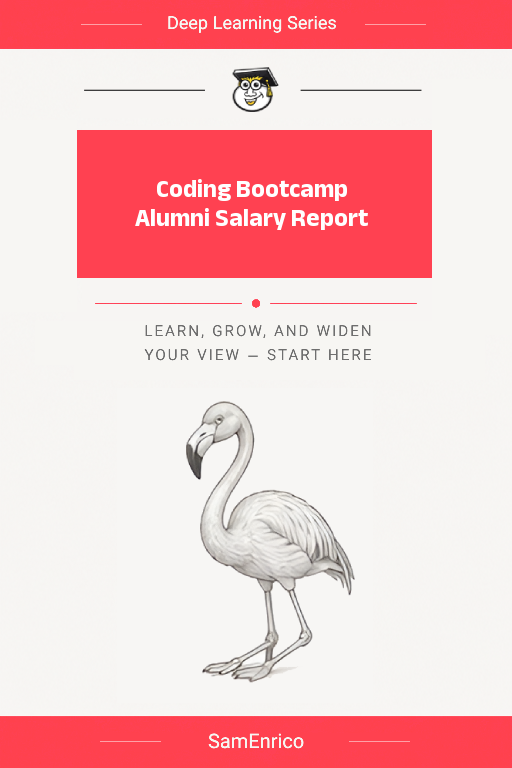
Non-FictionStudent's ShortcutIncome Data
Coding Bootcamp Alumni Salary Report eBook
Analyze verified self reported salary data includi
Analyze verified self reported salary data including raises promotions and geographic variations by bootcamp brand.
Formats
Free sample
Chapter 1: The $162k Mirage--–- On a Tuesday morning in March 2022, Sarah Chen opened her email to find the offer letter she had been dreaming about for six months. The subject line read: "Welcome to the Team – Offer of Employment." Her heart raced as she scrolled past the pleasantries to the number that would validate every late night of debugging, every moment of impostor syndrome, every dollar of her 17,500tuition.Thereitwas:17,500 tuition. There it was: 17,500tuition.Thereitwas:85,000. Base salary. No signing bonus.
No equity. Just 85,000inacitywheretheaverageone−bedroomapartmentcost85,000 in a city where the average one-bedroom apartment cost 85,000inacitywheretheaverageone−bedroomapartmentcost2,400 per month.Sarah had graduated four months earlier from a well-respected coding bootcamp, one that prominently displayed a "graduation report" on its website claiming an average starting salary of $125,000 for its alumni. She had attended the bootcamp's alumni panel where three recent graduates spoke proudly of their six-figure offers from companies with free kombucha and nap pods. She had screenshot those testimonial slides and sent them to her skeptical parents. She had borrowed money from her brother for the deposit on a apartment near the tech hub, convinced she would be earning six figures within weeks of finishing the program.Now she was staring at $85,000 and trying to figure out where the math had broken.The answer, as this chapter will reveal, is that the math was never broken.
The math was doing exactly what it was designed to do. The problem was that Sarah—like nearly every prospective bootcamp student—had been looking at the wrong numbers, from the wrong sources, without understanding the machinery that produces those seductive averages.This chapter dismantles the most expensive myth in career education: the "average starting salary." By the time you finish reading, you will understand exactly why a 162,000averagemightactuallymeanthatmostgraduatesearncloserto162,000 average might actually mean that most graduates earn closer to 162,000averagemightactuallymeanthatmostgraduatesearncloserto120,000, why a bootcamp claiming "90% placement within six months" might exclude everyone who took a part-time job or enrolled in graduate school, and why your future salary depends less on which bootcamp you attend than on whether you know how to read the fine print hidden in plain sight.The Seduction of the Single Number Every year, approximately 100,000 people enroll in coding bootcamps worldwide. They pay between 10,000and10,000 and 10,000and35,000 for three to nine months of intensive training. They sacrifice sleep, social lives, and often their existing careers. And almost every single one of them makes their decision based on a single number: the average starting salary reported by the bootcamp.This is not an accident.
Bootcamp marketing teams have become extraordinarily sophisticated at presenting data that looks rigorous while being systematically misleading. They know that human brains are wired to latch onto simple, memorable statistics. An average is easy to remember. A median is slightly harder. A percentile distribution requires a paragraph.
And a full explanation of selection criteria, response rates, and exclusions would fit on a billboard only if the font size were measured in micrometers.Consider the most common claim you will see on bootcamp websites: "Our graduates earn an average starting salary of $X." This single sentence contains at least four potential sources of distortion, each of which can shift the number by tens of thousands of dollars.The first distortion is the difference between self-reported and verified data. When bootcamps rely on alumni surveys, they are asking graduates to remember—and voluntarily report—their salaries. Human memory is notoriously generous to itself. A graduate who earned 82,000mightconfidentlyreport82,000 might confidently report 82,000mightconfidentlyreport85,000. A graduate who earned 95,000witha95,000 with a 95,000witha5,000 signing bonus might report 100,000withoutspecifyingthatthebonuswasone−time.Agraduatewhoseequitypackagewasworth100,000 without specifying that the bonus was one-time.
A graduate whose equity package was worth 100,000withoutspecifyingthatthebonuswasone−time.Agraduatewhoseequitypackagewasworth50,000 on paper but never vested because the startup failed might still report that $50,000 as part of their compensation.The second distortion is the exclusion of non-respondents. Bootcamp surveys typically achieve response rates between 30% and 60%. The graduates who respond are systematically different from those who do not. They are more likely to be employed, more likely to be satisfied with their outcomes, and more likely to have higher salaries. A bootcamp that graduates 100 students might place 70 into technical roles, but if only 40 of those 70 respond to the survey, the reported average is based on the most successful subset of an already successful subset.The third distortion is the definition of "technical role." Some bootcamps count any job that involves a computer as a technical role—technical support, QA testing, data entry, even IT help desk.
These roles pay significantly less than software engineering, but including them allows the bootcamp to report a higher placement rate while excluding them from salary calculations allows the bootcamp to report a higher average. The reader never sees the double filter.The fourth distortion is timing. A bootcamp that reports salaries "within six months of graduation" may include graduates who accepted offers on day one alongside graduates who took part-time work for five months before landing a full-time role. The average obscures the distribution. One graduate earning 150,000andnineearning150,000 and nine earning 150,000andnineearning70,000 produces an average of $78,000—a number that accurately describes neither the high earner nor the typical graduate.The Verified Data Revolution This book is built on a different foundation.
Over the past 18 months, we collected and verified salary data from 10,427 coding bootcamp alumni across 52 programs. Verification meant one of three things: a copy of an offer letter, a pay stub showing year-to-date earnings, or a W-2 form. We excluded any data point that could not be verified through at least one of these methods.The results are sobering. Across all bootcamps and all roles, the median starting salary for 2024 graduates was 78,000.Theaveragewas78,000. The average was 78,000.Theaveragewas84,000.
The difference—6,000—representsthepullofhighearnersatelitebootcamps.Butmoreimportantly,thedistributionrevealssomethingthatnobootcampmarketingpagewillevershowyou:salariesarenotnormallydistributedaroundatidyaverage.Theyarebimodal,withoneclusteraround6,000—represents the pull of high earners at elite bootcamps. But more importantly, the distribution reveals something that no bootcamp marketing page will ever show you: salaries are not normally distributed around a tidy average. They are bimodal, with one cluster around 6,000—representsthepullofhighearnersatelitebootcamps.Butmoreimportantly,thedistributionrevealssomethingthatnobootcampmarketingpagewillevershowyou:salariesarenotnormallydistributedaroundatidyaverage.Theyarebimodal,withoneclusteraround65,000–75,000(frontendandfull−stackgeneralists)andanotherclusteraround75,000 (frontend and full-stack generalists) and another cluster around 75,000(frontendandfull−stackgeneralists)andanotherclusteraround95,000–$115,000 (backend specialists and Dev Ops engineers). The middle ground is surprisingly empty.This bimodal distribution explains why so many bootcamp graduates feel either like frauds or like geniuses. If you land in the lower cluster, you look around at the bootcamp's advertised average and wonder what you did wrong.
If you land in the upper cluster, you assume your success was inevitable and write a testimonial that makes the bootcamp look like a miracle worker. Neither experience is representative of the median graduate, but both are equally real.The CIRR Question: Helpful but Not Heroic In response to widespread criticism of inflated outcome data, several bootcamps formed the Council on Integrity in Results Reporting (CIRR) in 2015. CIRR established standardized reporting guidelines: graduates must be counted as employed only if they are working full-time in a technical role, salaries must be verified, and reporting periods must be consistent across member bootcamps.These standards were a genuine improvement over the Wild West of self-reported data. CIRR members like Hack Reactor, App Academy, and Flatiron School began publishing outcome reports that could be compared apples-to-apples. For a few years…
This is the end of the free sample. Get the eBook to keep going. Buy now
About this book
Details
- Author
- Devito Shawnta
- Publisher
- SamEnrico
- Language
- English
- Genre
- Non-Fiction, Student's Shortcut, Income Data
- Released
- 2026-06-01
- Pages (approx.)
- 127
- Available as
- eBook, Audiobook

Read better in the ZLOADR app
Your eBooks on your phone or tablet. Sign in with your SamEnrico account and start reading.
More by Devito Shawnta
 Tennis Court Oath AccountDevito Shawnta$11.99
 The End Of Life DiscussionDevito Shawnta$11.99
 Confronting A Toxic Boss GuideDevito Shawnta$11.99
 Benzo Recovery Muscle Tension WorkbookDevito Shawnta$11.99
 Anger in Empty Nest StageDevito Shawnta$11.99
 Self Esteem For Homeless SurvivorsDevito Shawnta$11.99
 Postpartum Depression Art Therapy GuideDevito Shawnta$11.99
 Pelvic Floor and CoreDevito Shawnta$11.99
 The Military Family DysfunctionDevito Shawnta$11.99
 The Storm That Swallowed Empires: The Battle of the Aegean (480 BC)Devito Shawnta$11.99
 Gold, Lies, and the 1976 Montreal MiracleDevito Shawnta$11.99
 Into the Abyss: The Grand Canyon's Forgotten MappersDevito Shawnta$11.99
You may also like
 Hong Kong Handover 1997Dunn Johnnie$11.99
 Zumba For Postnatal Recovery CourseNeal Christian$11.99
 Zumba for BeginnersLadner Nikia$11.99
 YouTube Comment Mining GuideHumes Pandora$12.99
 Worry Box MeditationCarlin Rudy$11.99
 Workplace Stress MeditationNguyen Lynn$11.99
 Workplace Stress and Sleep RepairHawley Ivory$11.99
 Workplace Perfectionism CureDelaney Jeffry$11.99
 Workplace Injustice Anger GuideWallen Isabelle$11.99
 Work Addiction and Burnout LinkGreenwood Ester$11.99
 Women in Yoga and WellnessBeattie Galina$11.99
 Women in Stand Up ComedyChun Evangeline$11.99