
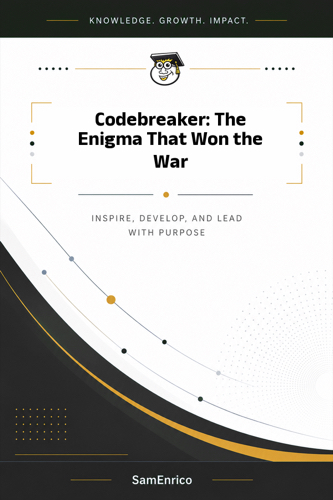
Codebreaker: The Enigma That Won the War
Uncover the untold story of Alan Turing’s groundbr
Uncover the untold story of Alan Turing’s groundbreaking work at Bletchley Park, where the birth of modern computing and cryptography turned the tide of World War II.
Formats
About this book
Free sample
Chapter 1: The Crib’s First Whisper...–- The machine sat on a polished oak table in a room that smelled of camphor and old paper. It looked harmless—like a typewriter in a wooden box, something a clerk might use to file requisition forms. But inside that box, three brass rotors turned with a precision that mocked the entire British Empire. Each time an operator pressed a key, an electrical signal raced through those rotors, bounced off a fixed reflector, and emerged as a different letter. A simple message—Wetterbericht (weather report)—became a cascade of seeming gibberish.
The Germans called it Enigma. The British called it the nightmare that was starving their island to death.This is not a story that begins with Alan Turing. It begins with a problem so vast that most mathematicians refused to touch it. The problem had a name, a shape, and an almost theological certainty behind it: the German High Command believed that Enigma was unbreakable. They were wrong.
But proving them wrong would require a war fought not with bullets but with probabilities, not with generals but with logicians, not with trenches but with ticking relays. And the first shots in that war were fired not by the British, not by the French, but by a thin, intense Polish mathematician named Marian Rejewski, who in 1932 did something that the Germans had declared impossible: he reverse-engineered an Enigma machine without ever seeing one.The Beast in the Box To understand what Rejewski achieved, and what Turing later perfected, you must first understand the machine itself. The Enigma was not a single device but a family of them, evolving throughout the 1920s and 1930s. The version that faced Britain in 1939 looked, to the untrained eye, like a slightly overweight portable typewriter. But beneath the keys lay a labyrinth of wires and rotors that embodied one of the most elegant encryption principles ever devised: polyalphabetic substitution with a twist.Here is how it worked.
When you pressed a key—say, the letter A—an electrical current flowed from the battery, through the key, and into the first…
This is the end of the free sample. Get the eBook to keep going. Buy now
Contents
- Chapter 1
- Chapter 2
- Chapter 3
- Chapter 4
- Chapter 5
- Chapter 6
- Chapter 7
- Chapter 8
- Chapter 9
- Chapter 10
- Chapter 11
- Chapter 12
Details
- Author
- Felder Ashlea
- Publisher
- SamEnrico
- Language
- English
- Genre
- Non-Fiction, Digital Revolution
- Released
- 2026-06-03
- Pages (approx.)
- 142
- Available as
- eBook, Audiobook

Read better in the ZLOADR app
Your eBooks on your phone or tablet. Sign in with your SamEnrico account and start reading.
More by Felder Ashlea
 LBO Goodwill ImpairmentFelder Ashlea$11.99
 Esports Spectator Addiction GuideFelder Ashlea$11.99
 Bariatric Surgery Childhood Obesity GuideFelder Ashlea$11.99
 Equity Waterfall Distribution DatabaseFelder Ashlea$11.99
 MBSR Eight Week Course ManualFelder Ashlea$11.99
 The Bone Whisperers of Borneo: Unlocking the Secrets of Ancient AnatomyFelder Ashlea$11.99
 Understanding Cataract Mental Retardation HypogonadismFelder Ashlea$17.99
 Retail Relationship BankerFelder Ashlea$11.99
 10 Ways to Use Chana Dal(split) (Recipe Book)Felder Ashlea$11.99
 Proposal Abstract Writing GuideFelder Ashlea$12.99
 AI Enhanced Excel for FinanceFelder Ashlea$12.99
You may also like
 Hong Kong Handover 1997Dunn Johnnie$11.99
 Zumba For Postnatal Recovery CourseNeal Christian$11.99
 Zumba for BeginnersLadner Nikia$11.99
 YouTube Comment Mining GuideHumes Pandora$12.99
 Worry Box MeditationCarlin Rudy$11.99
 Workplace Stress MeditationNguyen Lynn$11.99
 Workplace Stress and Sleep RepairHawley Ivory$11.99
 Workplace Perfectionism CureDelaney Jeffry$11.99
 Workplace Injustice Anger GuideWallen Isabelle$11.99
 Work Addiction and Burnout LinkGreenwood Ester$11.99
 Women in Yoga and WellnessBeattie Galina$11.99
 Women in Stand Up ComedyChun Evangeline$11.99