
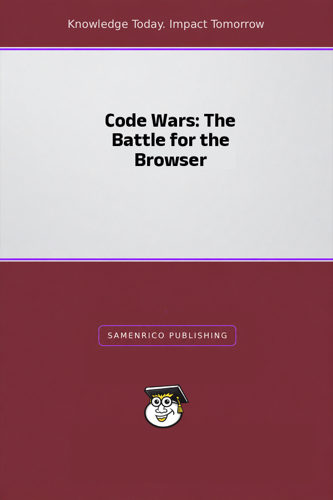
Code Wars: The Battle for the Browser eBook
Relive the high-stakes showdown between Netscape a
Relive the high-stakes showdown between Netscape and Microsoft as they fought for dominance in the 1990s browser wars, reshaping the internet forever.
Formats
Free sample
Chapter 1: The Accidental Bomb...--–- The internet, in 1992, was not a place you would ever describe as "friendly." It was not something you "surfed" or "browsed" or "shared." It was a command-line ghost town—a grey-on-black text wasteland where only the initiated dared to wander. To connect, you typed arcane instructions like telnet, ftp, or gopher. To find anything, you needed to know exactly where it was. Images? They required a separate program to download, then another to view.
Video? A cruel joke. Sound? A distant fantasy. The web, as we now know it, did not exist.
Tim Berners-Lee had proposed the World Wide Web in 1989 and built the first rudimentary browser in 1990, but his creation was text-only, linear, and impenetrable to anyone without a physics doctorate. The internet was a library with no lights, a highway with no signs, a city where every building had an address but no door.And then, in a cluttered basement office at the National Center for Supercomputing Applications (NCSA) on the campus of the University of Illinois at Urbana-Champaign, a handful of underfunded, over-caffeinated college students did something that no one—least of all themselves—fully understood. They accidentally built a bomb.The Basement: Where Chaos Met Code The NCSA was a strange place in the early 1990s. Funded by the National Science Foundation, its mission was to connect supercomputers across the country—a noble, academic goal that involved miles of cable, blinking server racks, and the kind of bureaucratic paperwork that could crush the human spirit. But tucked away from the main corridors, past the humming mainframes and the offices of tenured professors, there was a small, windowless room that smelled of stale pizza, burnt coffee, and ambition.
This was the home of the NCSA's software development group, and it was run by a 21-year-old junior programmer named Marc Andreessen.Andreessen was not what anyone would call a polished professional. He was brash, loud, and impatient, with a shock of curly brown hair and a smile that said he knew something you didn't. He had grown up in rural Wisconsin, the son of a seed salesman and a agricultural commodities trader, and he had taught himself to code on a Commodore 64. By the time he arrived at the University of Illinois, he was already better than most of his professors. He was also, by his own admission, "insufferably confident."The NCSA hired him to work on visualization software—tools that could turn supercomputer data into 3D models.
But Andreessen had other interests. He had been reading about Tim Berners-Lee's World Wide Web project, and he was fascinated by its potential. "The web was supposed to be a universal information space," he later recalled. "But the only browsers available were so bad that no normal person could use them. They were scientific instruments, not software.
I thought, 'What if we made one that didn't suck?'"That question—so simple, so arrogant, so perfectly American—became the seed of everything that followed.The Gang of Five Andreessen could not build a browser alone. So he assembled a team of fellow students who shared his disregard for sleep, authority, and conventional software development practices. They called themselves, informally, "The Gang of Five," though the membership fluctuated. The core group included:Eric Bina: A quiet, intense programmer in his late twenties who had dropped out of the University of Illinois's graduate program. Bina was the yin to Andreessen's yang: where Andreessen was loud, Bina was silent; where Andreessen sketched ideas on whiteboards, Bina typed code at 100 words per minute, often until 4 AM.
He was, by all accounts, a genius—the kind of programmer who could hold an entire operating system in his head.Rob Mc Cool: A whip-smart undergraduate who wrote the server-side software that would eventually become the NCSA HTTPd web server. Mc Cool worked in bursts of manic energy, disappearing for days, then emerging with thousands of lines of flawless code.Aleks Totic: A Serbian immigrant with a knack for making software work on impossible hardware configurations. Totic was the team's pragmatist, the one who would say, "This is beautiful, but it will never run on a Macintosh."Jon Mittelhauser: Another undergraduate who specialized in networking protocols. Mittelhauser was the quiet one—the engineer who made sure that data actually moved from one computer to another without vanishing into the void.They had no formal project manager. No product requirements document.
No quality assurance team. No deadlines except the ones they invented. And they were working, essentially, for free, on university time, using university equipment, without explicit permission from anyone in charge."We were kids," Andreessen later said. "We had no idea what we were doing. We just thought it would be cool to make the web work."The Mosaic Moment The browser they built was called Mosaic.
The name was chosen because, like a mosaic, it would bring together many small pieces into a single, coherent image. But the real innovation was not the name. It was the image itself.Previous web browsers (Berners-Lee's original, the line-mode browser, and a handful of academic experiments) could display text. They could show links. But images?
Images required a separate step. You clicked a link to an image file, a helper application launched, and a new window opened with the picture. The experience was clunky, disjointed, and utterly unappealing to anyone accustomed to the glossy pages of a magazine or the colorful graphics of a video game.Mosaic changed that. For the first time, images could appear inline—right there in the same window as the text, surrounded by links, integrated into the flow of the page. It seems obvious now.
Every website does it. But in 1993, it was a revolution.The technical achievement was considerable. Bina and Andreessen had to figure out how to render multiple image formats (GIF, JPEG, XBM) on multiple operating systems (Unix, Mac, Windows) without slowing the page load to a crawl. They wrote their own image decoders, their own network caching system, their own HTML parser. And they did it all in a few months, fueled by pizza and Jolt Cola, while also attending classes and, occasionally, sleeping."Mosaic was hacked together with baling wire and chewing gum," said Bina years later.
"If you'd looked at the source code, you would have laughed. But it worked."The Accidental Viral Explosion Mosaic was released in February 1993, free of charge, on the NCSA's FTP server. The initial response was muted. A few hundred downloads. A handful of positive emails.
But then something strange happened. People started telling their friends. Professors posted links on bulletin boards. Newsgroups lit up with discussions of this "browser that shows pictures."By the summer of 1993, Mosaic was a phenomenon. It was being downloaded tens of thousands of times per week.
Universities began installing it in their computer labs. Researchers used it to share data. Hobbyists used it to build personal homepages. And then, unexpectedly, the media noticed.The New York Times ran a front-page story about Mosaic, calling it "the first killer app of the internet." Wired magazine, then a scrappy startup itself, devoted a feature article to the "young wizards of Illinois." Marc Andreessen, still…
This is the end of the free sample. Get the eBook to keep going. Buy now
About this book
Details
- Author
- Rafferty Jack
- Publisher
- SamEnrico
- Language
- English
- Genre
- Non-Fiction, Tech Monopoly
- Released
- 2026-06-04
- Pages (approx.)
- 100
- Available as
- eBook, Audiobook

Read better in the ZLOADR app
Your eBooks on your phone or tablet. Sign in with your SamEnrico account and start reading.
More by Rafferty Jack
 Discussing Religious Differences GuideRafferty Jack$11.99
 Anger in Quarantine TogetherRafferty Jack$11.99
 Time Auditing for BlockersRafferty Jack$11.99
 Pelvic Floor After ProstatectomyRafferty Jack$11.99
 Managing Interruptions for DesignersRafferty Jack$11.99
 IBS Overlap Depression GuideRafferty Jack$11.99
 Dysfunctional Holidays RecoveryRafferty Jack$11.99
 Postpartum Depression and Thyroid LinkRafferty Jack$11.99
 Body Image For PsoriasisRafferty Jack$11.99
 The Spice of the Frozen Sea: Ibn Majid and the Medieval Quest for the North PoleRafferty Jack$11.99
 The Last Voyage of the Mary Celeste: Ghost Ship or Great Escape?Rafferty Jack$11.99
 Shopify Gift Card Feature GuideRafferty Jack$12.99
You may also like
 Hong Kong Handover 1997Dunn Johnnie$11.99
 Zumba For Postnatal Recovery CourseNeal Christian$11.99
 Zumba for BeginnersLadner Nikia$11.99
 YouTube Comment Mining GuideHumes Pandora$12.99
 Worry Box MeditationCarlin Rudy$11.99
 Workplace Stress MeditationNguyen Lynn$11.99
 Workplace Stress and Sleep RepairHawley Ivory$11.99
 Workplace Perfectionism CureDelaney Jeffry$11.99
 Workplace Injustice Anger GuideWallen Isabelle$11.99
 Work Addiction and Burnout LinkGreenwood Ester$11.99
 Women in Yoga and WellnessBeattie Galina$11.99
 Women in Stand Up ComedyChun Evangeline$11.99