
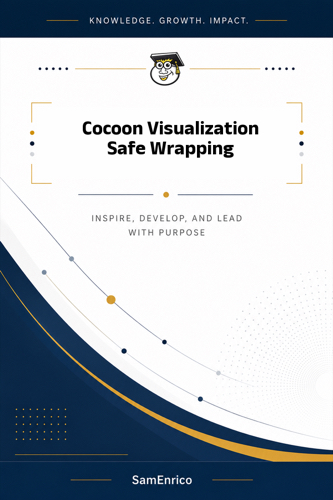
Cocoon Visualization Safe Wrapping eBook
Wrap yourself in an imagined silk cocoon, feeling
Wrap yourself in an imagined silk cocoon, feeling snug, protected, and preparing for renewal.
Formats
Free sample
Chapter 1: The Safety Lie--You have been told, probably hundreds of times, to “just relax.” Breathe deeply. Think positive thoughts. Let it go. And every time you tried, something inside you refused. Not because you are broken.
Not because you lack willpower. But because your nervous system does not speak English. It does not respond to commands, affirmations, or well-meaning advice from people who have never woken up at 3:00 a.m. with their heart pounding for no reason. Your nervous system responds to one thing only: signals of safety.
And most of what you have been taught about safety is a lie.The lie sounds like this: safety is the absence of danger. If you can just stop the bad thing—the thought, the memory, the panic—you will be safe. So you fight the feeling. You distract yourself. You scroll, eat, drink, clean, work, or dissociate into a television show.
And for a moment, the noise quiets. But it always comes back. Because you were never fighting the feeling. You were fighting your own biology.This book is built on a radically different premise: safety is not something you think your way into. Safety is something you feel your way into.
And the most powerful, fastest, most neurologically reliable way to generate felt safety is not a breathing technique, not a mantra, not a gratitude journal. It is containment. The experience of being gently, intentionally, and completely wrapped.You have already done this thousands of times without realizing it. The weighted blanket you bought during the pandemic. The way you tuck your hands under your thighs when you are nervous.
The tight hug you ask for when you are falling apart. The small closet you sat in as a child when the house was too loud. That is your nervous system desperately trying to create containment. This book gives you a tool that is always available, costs nothing, and works in sixty seconds or less: the imagined silk cocoon.But before you build a single thread of silk in your mind, you need to understand why containment works, why your current attempts at calm keep failing, and why your nervous system has been lying to you about what safety actually feels like.The Myth of the Relaxed Beach Every guided meditation you have ever tried probably started the same way. Close your eyes.
Imagine you are on a beautiful beach. Feel the warm sun on your skin. Hear the waves. And then someone told you to let your thoughts float away like clouds.For a certain kind of person, this works beautifully. That person is not you.
Or if it is you some days, it is absolutely not you on the days you actually need help. Because here is what the beach meditation does not tell you: an open, expansive, unbounded environment is the opposite of safe for a dysregulated nervous system. When you are already in fight-or-flight, the last thing your brain wants is an endless horizon. It wants walls. It wants boundaries.
It wants to know that nothing can sneak up behind you.This is not a metaphor. This is neurobiology.The human nervous system, specifically the branch called the ventral vagal pathway, is activated by what Stephen Porges, the creator of polyvagal theory, calls “neuroception.” Neuroception is your brain’s automatic, unconscious scanning system for cues of safety or danger. It happens before you think. Before you feel. Before you have any conscious awareness at all.
Your brain is constantly asking one question: Am I safe?And the answer is not determined by your thoughts. You can tell yourself “I am safe” a hundred times. If your neuroception detects a signal of danger—a raised voice, a tight chest, a memory that feels real—your nervous system will override your thoughts every single time. You cannot talk your way out of what your body believes to be true.So what does your body believe is safe?Deep, gentle, consistent pressure. Warmth.
Softness. Breathability. The feeling of being held without being trapped. The feeling of being contained without being crushed.In other words: a cocoon.Why Silk and Not Something Else You might be wondering why this book specifies silk rather than cotton, wool, or simply a generic “safe container.” The answer is both practical and symbolic.Cotton, in the language of the body, feels utilitarian. It is what sheets are made of.
It is what bandages are made of. Cotton does not signal intentional care; it signals necessity. Wool can be itchy, hot, or rough. For many people with sensory sensitivities, wool is the opposite of safe. But silk carries a different set of unconscious associations.
Silk is deliberate. Silk is chosen. Silk is soft without being weak, strong without being rigid, and breathable without being flimsy. Silk is also, historically, a luxury. And your nervous system pays attention when you offer it something luxurious rather than something functional.The word “silk” alone, even before you visualize it, begins to shift your autonomic state.
Try it now. Say the word out loud. Silk. Notice what happens in your chest, your shoulders, your jaw. For most people, there is a subtle softening.
That is neuroception in action.But the cocoon you will build in this book is not generic silk. It is your silk. Your color, your temperature, your weight, your sound, your scent. The more specific you make it, the more real it becomes to your nervous system. And the more real it becomes, the faster it works.The Nervous System Check-In: Your First Tool Before you visualize anything, you need to know where you are starting from.
This is not optional. Attempting to build a cocoon while your nervous system is in active survival mode is like trying to build a house during an earthquake. It will not work, and it may make things worse.The Nervous System Check-In is a two-minute scan that answers one question: What color light am I in right now?You will use this check-in before every single practice in this book. Eventually, it will become automatic, something you do in three breaths without thinking. But for now, do it slowly and honestly.Find a comfortable position.
Sitting is better than lying down for this check-in, because lying down can trigger a freeze response in some people. Place your feet flat on the floor. Let your hands rest on your thighs. Take one breath, nothing special, just noticing what is already there.Now ask yourself three questions. Do not judge the answers.
Do not try to change them. Just notice.Question One: What is happening in my body?Scan from the top of your head to the tips of your toes. Is your jaw clenched? Are your shoulders up near your ears? Is your stomach tight?
Are your hands cold? Is your breathing shallow and high in your chest? Or do you feel a sense of ease? Is your jaw soft? Are your shoulders down and back?
Is your belly soft? Is your breath slow and low?Write down what you notice. Be specific. Not “I feel bad” but “My jaw is clenched and my right shoulder is burning.”Question Two: What is…
This is the end of the free sample. Get the eBook to keep going. Buy now
About this book
Details
- Author
- Mcgovern Sheridan
- Publisher
- SamEnrico
- Language
- English
- Genre
- Non-Fiction, Self-Help, Safety Imagery
- Released
- 2026-06-08
- Pages (approx.)
- 124
- Available as
- eBook, Audiobook

Read better in the ZLOADR app
Your eBooks on your phone or tablet. Sign in with your SamEnrico account and start reading.
More by Mcgovern Sheridan
 GPS Error Rage StrategyMcgovern Sheridan$11.99
 Desk Stretch Stress ReliefMcgovern Sheridan$11.99
 PCOS Grocery Shopping ListMcgovern Sheridan$11.99
 The Percy Bridgman High PressureMcgovern Sheridan$11.99
 The Ghost of Station X: Breaking the Enigma Code of World War IIMcgovern Sheridan$11.99
 Understanding OsteomyelitisMcgovern Sheridan$17.99
 Pronunciation Teaching for Chinese LearnersMcgovern Sheridan$12.99
 Freemium Terms of Service HandbookMcgovern Sheridan$12.99
 Team Leader Case Management ServicesMcgovern Sheridan$11.99
 How to Start a Christmas Tree Lights (wholesale) Business (Beginners Guide)Mcgovern Sheridan$11.99