
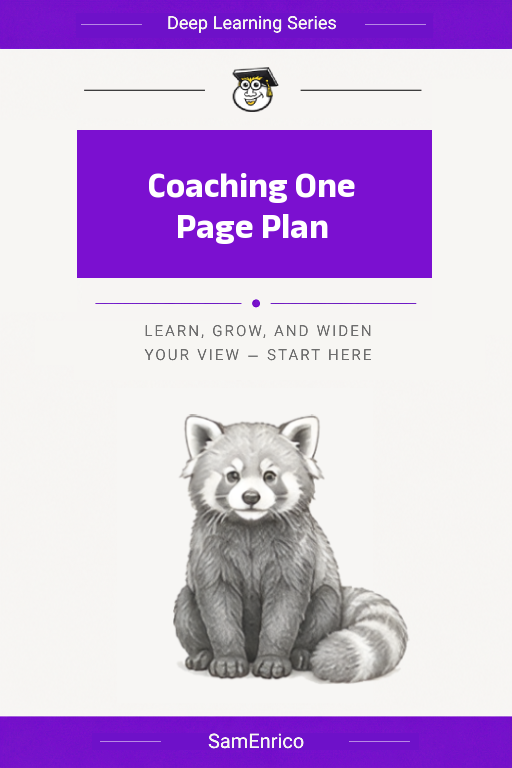
Coaching One Page Plan eBook
Build a lean canvas for coaching practice, adding
Build a lean canvas for coaching practice, adding program pricing, client acquisition channels, and certification requirements.
Formats
Free sample
Chapter 1: The Busy Fool--–- The statistic hit me like a cold shower on a winter morning. Eighty-two percent of coaching businesses fail within two years. Not because the coaches lacked skill, not because they weren't passionate, and certainly not because they didn't care. They failed because they confused activity with progress. They became what I call the Busy Fool.The Busy Fool wakes up at 5:00 AM, posts an inspirational quote on Instagram, attends a webinar on "10 Ways to Get More Coaching Clients," buys a new certification course, redesigns their website for the third time in six months, and collapses at midnight feeling exhausted yet strangely empty.
They have done everything and accomplished nothing.I know because I was that fool.For eighteen months, I built a coaching practice the way someone builds a sandcastle during high tide—frantically, reactively, and destined for collapse. I collected certifications like baseball cards: ICF Associate Certified Coach, Gallup Strengths Coach, NLP Practitioner, and two niche certifications that I cannot even remember without checking my framed certificates on the wall. I had a mailing list with four hundred names, a podcast with twelve episodes and forty-seven downloads, and a bank account that hovered perpetually near zero.The turning point came on a Tuesday. I had just finished a free "discovery session" with a prospect who loved me, said they would "think about it," and never returned my email. I sat at my kitchen table, surrounded by sticky notes, business cards, and three different coaching models I had downloaded from various gurus, and I asked myself a question that changed everything: What if I stopped doing everything and started doing the right thing?That question led me to the One-Page Plan.The Myth of the Overwhelmed Coach Let me name something you have probably felt but never articulated: the coaching industry has an overwhelm problem disguised as an opportunity problem.
We are told that success comes from more—more certifications, more social media platforms, more content, more free workshops, more niches, more offers. The implicit message is that your current failure is simply a failure of effort. Try harder. Do more. Be everywhere.This is a lie.The data tells a different story.
According to the International Coaching Federation's 2023 Global Coaching Study, the average professional coach earns 62,000annually.Butthataveragehidesabrutalbimodaldistribution:thebottomseventypercentofcoachesearnlessthan62,000 annually. But that average hides a brutal bimodal distribution: the bottom seventy percent of coaches earn less than 62,000annually.Butthataveragehidesabrutalbimodaldistribution:thebottomseventypercentofcoachesearnlessthan35,000, while the top ten percent earn over $200,000. The difference is not effort. The difference is focus.The top ten percent do not have more certifications than everyone else. They do not post more on Linked In.
They do not attend more webinars. What they have is clarity. They know exactly who they serve, what problem they solve, how much they charge, and where their next client is coming from. They have a plan, and that plan fits on one page.The Busy Fool, by contrast, has a plan that requires a spreadsheet with seven tabs. Or no plan at all.
Or a plan borrowed from a coach who serves an entirely different market with an entirely different offer.This book is the antidote to the Busy Fool.The Genesis of the One-Page Plan The Lean Canvas methodology was originally developed by Ash Maurya in his book Running Lean. Maurya realized that traditional business plans were works of fiction—fifty-page documents that took months to write and were obsolete the moment the pen lifted from the page. He distilled the entire business model down to nine boxes on a single page, forcing entrepreneurs to focus on what actually matters: problem, solution, customer segments, unique value proposition, channels, revenue streams, cost structure, key metrics, and unfair advantage.This worked brilliantly for software startups. But coaching is not software. Coaches sell transformation, not features.
Coaches build relationships, not code. Coaches deal with human emotion, resistance, and accountability—none of which fit neatly into a box labeled "key metrics."So I adapted the Lean Canvas specifically for coaching practices. Over three years, working with hundreds of coaches, I tested, discarded, and refined until the Coaching Lean Canvas emerged. It retains the nine-box structure of the original but reframes each box for the unique realities of coaching businesses.Here is what the Coaching Lean Canvas looks like at a glance:The Left Side (Problem Focused):Problem Box: The top three urgent problems your ideal client faces Customer Segments Box: The specific demographic and psychographic profile of who you serve Unique Value Proposition: The single compelling message that makes someone choose you Unfair Advantage: What you have that cannot be easily copied The Right Side (Solution Focused):Solution Box: Your coaching method, framework, and delivery structure Channels Box: Where and how you find clients Revenue Streams: Your pricing models and packages Cost Structure: Your fixed and variable expenses Key Metrics: The numbers that tell you if you are winning By the end of this book, you will have every box filled out for your practice. But more importantly, you will understand why each box exists and how the boxes work together.
A plan is not a collection of answers. A plan is a system of relationships.The One Thing Principle Before we touch the canvas, we need to anchor on a philosophical foundation. Otherwise, the nine boxes will become just another form of busyness—another spreadsheet, another template, another thing to fill out and ignore.Gary Keller, in his extraordinary book The One Thing, asks a deceptively simple question: What is the one thing you can do such that by doing it, everything else becomes easier or unnecessary?Let that question land. Everything else becomes easier or unnecessary. This is not about prioritization—ranking tasks from one to ten.
This is about leverage. The one thing is the domino that knocks down all the other dominoes. The one thing is the lever that moves the world.For a coaching business, the one thing is different for every coach. For one coach, the one thing might be nailing a specific niche. For another, it might be creating a signature framework that can be taught to other coaches.
For a third, it might be building a referral partnership with three corporate HR departments.But here is what the one thing is never: it is never "post on Instagram every day." It is never "get another certification." It is never "redesign my website." Those are activities, not levers. They feel productive, but they rarely produce.Throughout this book, I will return to The One Thing principle. At the end of every chapter, you will be asked to identify the one insight you are taking away. At the end of Part II, you will identify the one change you are making to your pricing. In Chapter 11, you will identify the one action you are committing to for the next ninety days.This book has twelve chapters.
You do not need to implement twelve things. You need to implement one thing from each chapter—twelve things total, but only one at a time. That is the rhythm of the One-Page Plan.The 82% Problem (And Why Skill Is Not the Issue)Let me tell you about Sarah. Sarah…
This is the end of the free sample. Get the eBook to keep going. Buy now
About this book
Details
- Author
- Bobo Marquetta
- Publisher
- SamEnrico
- Language
- English
- Genre
- Non-Fiction, First 30 Days
- Released
- 2026-06-01
- Pages (approx.)
- 141
- Available as
- eBook, Audiobook

Read better in the ZLOADR app
Your eBooks on your phone or tablet. Sign in with your SamEnrico account and start reading.
More by Bobo Marquetta
 Brand Momentum Growth IndicatorsBobo Marquetta$11.99
 Growing Up in Foster Care with a DisabilityBobo Marquetta$11.99
 Opioid Free Mindset Transformation ManualBobo Marquetta$11.99
 Social Proof Influence CourseBobo Marquetta$11.99
 Mick DodsonBobo Marquetta$11.99
 Russian Mafia in CyprusBobo Marquetta$11.99
 Purpose After Empty NestBobo Marquetta$11.99
 Middle Passage Liberated AfricansBobo Marquetta$11.99
 The Wolf in Sheep's Clothing: How Wolfgang Beltracchi Fooled the Art WorldBobo Marquetta$11.99
 Enki's Abzu: The Architect of the DeepBobo Marquetta$11.99
 Service Providers Guide to Public SpeakersBobo Marquetta$11.99
 A Collector's Handbook to the Mini MkiiBobo Marquetta$11.99
You may also like
 Hong Kong Handover 1997Dunn Johnnie$11.99
 Zumba For Postnatal Recovery CourseNeal Christian$11.99
 Zumba for BeginnersLadner Nikia$11.99
 YouTube Comment Mining GuideHumes Pandora$12.99
 Worry Box MeditationCarlin Rudy$11.99
 Workplace Stress MeditationNguyen Lynn$11.99
 Workplace Stress and Sleep RepairHawley Ivory$11.99
 Workplace Perfectionism CureDelaney Jeffry$11.99
 Workplace Injustice Anger GuideWallen Isabelle$11.99
 Work Addiction and Burnout LinkGreenwood Ester$11.99
 Women in Yoga and WellnessBeattie Galina$11.99
 Women in Stand Up ComedyChun Evangeline$11.99