
Non-FictionFirst 30 DaysReferences
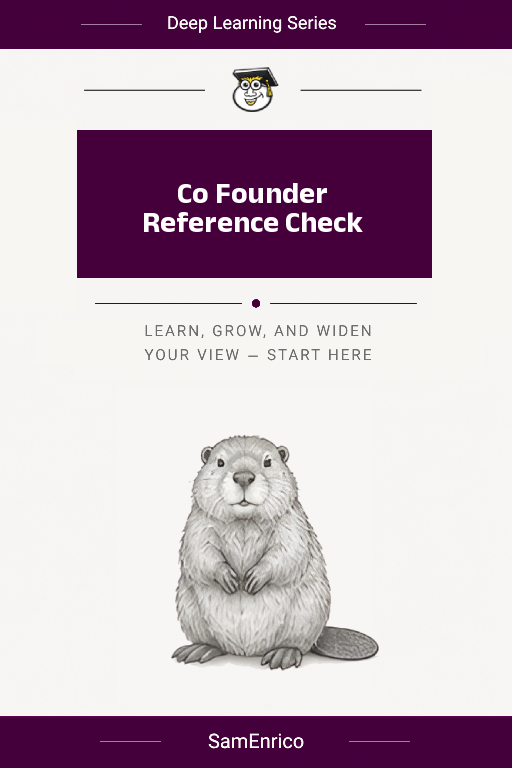
Co Founder Reference Check eBook
Call former colleagues and managers to verify co-f
Call former colleagues and managers to verify co-founder's work history and reputation.
Formats
Free sample
Chapter 1: The Brilliant Jerk--–- The most dangerous person in any startup is not the incompetent founder. It is not the lazy one. It is not the one who cannot code, cannot sell, cannot raise money. The most dangerous person is the one who can do all of those things brilliantly—and who will destroy everyone around them while doing it. This is the person who will cost you your best employees, your peace of mind, and eventually your company.
And you will not see them coming because their resume will blind you.The $8 Million Mistake In 2017, a founder we will call Marcus had a problem that most entrepreneurs would kill for. He had too much interest from too many top-tier venture capital firms. His Series A was oversubscribed. He had three term sheets on the table. The only thing standing between him and an $8 million wire was one decision: choosing a technical co-founder.Marcus was a business founder.
He had the vision, the network, the fundraising ability, and the sales charisma. What he did not have was the ability to build the product himself. He needed a technical co-founder who could lead engineering, architect the platform, and scale the team from zero to fifty engineers within eighteen months.Through a mutual angel investor, Marcus was introduced to someone we will call Dmitri. Dmitri had a resume that would make any founder drool. He had been the lead engineer at a unicorn that had exited for $2 billion.
He had a computer science degree from Stanford. He had three patents. He had been featured in a Forbes 30 Under 30 list. He spoke at conferences about scalable architectures. His Git Hub was a work of art.Marcus was, in his own words, "starstruck."He did what most founders do.
He took Dmitri to dinner. They talked for four hours about microservices, cloud infrastructure, and the future of the industry. Dmitri was brilliant. He was confident. He had opinions about everything, and those opinions were backed by data and experience.
Marcus went home that night and told his wife, "I found him. The one."Then Marcus did the standard reference check. Dmitri provided three names: his former manager at the unicorn, a peer from the same company, and a mentor from his early career. Marcus called all three. Every conversation lasted less than fifteen minutes.
Every reference said the same things: "Dmitri is a brilliant engineer." "He is incredibly talented." "You would be lucky to have him."Marcus signed the co-founder agreement. He gave Dmitri 40 percent of the company. He wired the first $2 million of the Series A into the company account. And then the nightmare began.Within six weeks, the engineering team started quitting. The first was a senior backend engineer who had been with Marcus since the pre-seed stage.
When Marcus asked why, the engineer said, "I cannot work with Dmitri. He does not just review code. He reviews people. He told me my architecture was 'embarrassing' in front of the whole team. He does not want me to succeed.
He wants me to feel small."Marcus dismissed it. "Dmitri has high standards," he told himself. "That is why he is so successful."Within three months, four more engineers had quit. The product roadmap was delayed by six weeks. Dmitri had stopped attending stand-up meetings and was working alone, refusing to share his code with the team.
When Marcus confronted him, Dmitri said, "The team is not good enough. I am carrying them. If you want this product to ship, let me work and stop questioning me."Marcus let him work.By month six, the company had lost eight engineers. The product was still not ready. The board was asking questions.
And Dmitri had started blaming Marcus for everything. "Your product requirements are unclear," he said. "Your sales team promised features we cannot build. Your investors are breathing down our necks."Marcus finally did what he should have done on day one. He found a former colleague of Dmitri's who was not on the reference list.
He found her on Linked In. She had worked with Dmitri at the unicorn. She had left after eighteen months. Marcus sent her a message. She agreed to a fifteen-minute call.In the first five minutes, she said: "I have been waiting for someone to ask me about Dmitri for three years."She told Marcus the truth.
Dmitri had been put on a performance improvement plan at the unicorn. He had been asked to leave after a formal HR complaint from three junior engineers who said he had created a "hostile work environment." He had not been the lead architect of the famous product—he had been one of twelve engineers on the team. And every single person who had reported to him had transferred off his team within a year.Marcus asked her: "Why did no one tell me this when I called your HR department?"She laughed. "HR will never tell you that. They are terrified of lawsuits.
And Dmitri is very good at managing his references. He gave you the three people who would say nice things about him. He did not give you the people who actually worked for him."Marcus tried to unwind the partnership. It was too late. The co-founder agreement had a standard one-year cliff.
Dmitri had not yet vested his equity, but he was already entrenched. He had built a small fiefdom of two engineers who were loyal to him. He refused to leave unless Marcus bought him out for 1.5million.Marcusdidnothave1.5 million. Marcus did not have 1.5million.Marcusdidnothave1.5 million. The company limped along for another eight months before the board forced Marcus to shut it down.The $8 million was gone.
The product never shipped. Marcus lost his reputation. Dmitri updated his Linked In to say "Co-Founder of a venture-backed startup (acqui-hire pending)" — a lie, but no one checked.This story is not an outlier. It is a pattern. And it happens because founders are sedated by technical excellence and blinded by their own confirmation bias.The Seduction of the Resume Why did Marcus ignore the early warning signs?
Why did he dismiss the first engineer who quit? Why did he let Dmitri work alone for three months before asking questions?The answer is not that Marcus was stupid or lazy. The answer is that Marcus was human. And humans are wired to trust what we see first.When Marcus saw Dmitri's resume—Stanford, Forbes, unicorn exit, three patents—his brain made a snap judgment. This is what psychologist Daniel Kahneman calls "System 1 thinking." It is fast, automatic, and almost impossible to override.
System 1 said: "This person is successful. Successful people are good. Therefore, this person is good."Once that judgment was made, Marcus engaged in what researchers call "confirmation bias." He sought out evidence that confirmed his belief and ignored evidence that contradicted it. The engineer who quit? Dmitri has high standards.
The missed roadmap? Dmitri is working hard. The hostile tone in meetings? Dmitri is passionate.This is the seduction of the resume. A decorated past creates an emotional halo that makes it nearly impossible to see present toxicity.
And the more brilliant the candidate, the stronger the halo.Robert Sutton, a Stanford professor and author of The No Asshole…
This is the end of the free sample. Get the eBook to keep going. Buy now
About this book
Details
- Author
- Caudle Chantel
- Publisher
- SamEnrico
- Language
- English
- Genre
- Non-Fiction, First 30 Days, References
- Released
- 2026-05-29
- Pages (approx.)
- 145
- Available as
- eBook, Audiobook

Read better in the ZLOADR app
Your eBooks on your phone or tablet. Sign in with your SamEnrico account and start reading.
More by Caudle Chantel
 Loneliness And Reading ConnectionCaudle Chantel$11.99
 Professional Relationship MaintenanceCaudle Chantel$11.99
 No More MartyrdomCaudle Chantel$11.99
 Menstrual Diarrhea ManagementCaudle Chantel$11.99
 TikTok Voiceover Comparison TrapCaudle Chantel$11.99
 The Lighthouse Keeper’s Last BroadcastCaudle Chantel$11.99
 The Silent Coup: How a Leak Changed the WorldCaudle Chantel$11.99
 Customer Application EngineerCaudle Chantel$11.99
 How to Start a Parcels Delivery Service (not Post office) Licensed Business (Beginners Guide)Caudle Chantel$11.99
 Fiverr Voiceover Gigs GuideCaudle Chantel$12.99
 Understanding Dyssegmental Dysplasia Silverman–handmaker TypeCaudle Chantel$17.99
You may also like
 Hong Kong Handover 1997Dunn Johnnie$11.99
 Zumba For Postnatal Recovery CourseNeal Christian$11.99
 Zumba for BeginnersLadner Nikia$11.99
 YouTube Comment Mining GuideHumes Pandora$12.99
 Worry Box MeditationCarlin Rudy$11.99
 Workplace Stress MeditationNguyen Lynn$11.99
 Workplace Stress and Sleep RepairHawley Ivory$11.99
 Workplace Perfectionism CureDelaney Jeffry$11.99
 Workplace Injustice Anger GuideWallen Isabelle$11.99
 Work Addiction and Burnout LinkGreenwood Ester$11.99
 Women in Yoga and WellnessBeattie Galina$11.99
 Women in Stand Up ComedyChun Evangeline$11.99