
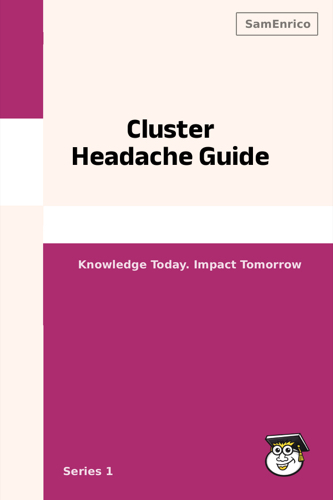
Cluster Headache Guide eBook
Recognize and treat severe one sided pain with aut
Recognize and treat severe one sided pain with autonomic symptoms.
Formats
Free sample
Chapter 1: The Suicide Headache...--It begins without warning. You are fine one second—perhaps eating dinner, reading a book, or drifting toward sleep—and the next second, a red-hot poker drives itself through your right eye socket. Not metaphorically. Not "like" a poker. Your brain registers only one signal: something is inside my skull, and it is trying to get out.You cannot sit still.
You pace. You rock. You press the heel of your palm against your temple so hard that you will later find bruises. The eye on the affected side waters uncontrollably, as if you are sobbing, though you are not sad—you are simply being tortured. Your nostril on that same side runs clear fluid.
Your eyelid droops. Your pupil shrinks to a pinprick. And the pain, which has been building for the last ninety seconds, now reaches a level that has no name.At the emergency room, they will ask you to rate your pain from zero to ten. You will say ten. They will nod and write it down.
But you know, and every cluster headache sufferer knows, that the standard pain scale was not designed for this. The difference between a ten from a kidney stone and a ten from a cluster headache is the difference between being held underwater and being set on fire while drowning. Both are terrible. Only one makes you understand why human beings have drilled holes in their own skulls with power tools.This is the reality of cluster headache (CH). And if you are reading this book, you already know that reality intimately—or you love someone who does.The Most Painful Condition You Have Never Heard Of Cluster headache has been called many things by the patients who endure it: the suicide headache, the beast, the alarm clock headache, the widow-maker.
But the medical literature uses a more clinical phrase: "one of the most painful conditions known to humanity." In fact, cluster headache is routinely ranked by pain specialists as more severe than childbirth, kidney stones, pancreatitis, and even phantom limb pain. A 2013 study published in Cephalalgia asked patients with various painful conditions to rate their experience. Cluster headache sufferers consistently rated their attacks higher than any other group, including patients with untreated cancer pain.Let that land for a moment. Cancer pain—the thing we use as the universal benchmark for human suffering—is less severe, on average, than a cluster headache attack.And yet, most people have never heard of it. Most doctors have never seen a case.
Most emergency rooms treat it incorrectly. Most neurologists receive fewer than two hours of training on trigeminal autonomic cephalalgias (the family of disorders to which CH belongs) during their entire residency. This is not a failure of individual doctors. It is a failure of medical education, public awareness, and research funding. Cluster headache affects approximately one in one thousand people—roughly 750,000 people in the United States alone, and millions worldwide.
That is not rare. That is as common as multiple sclerosis. But MS has hundreds of advocacy organizations, billions in research funding, and near-universal public recognition. Cluster headache has a fraction of that.This book exists to close that gap.What This Chapter Will Do For You Before we dive into the anatomy, treatment, and psychology of cluster headache—all of which will come in later chapters—this opening chapter has three essential jobs. First, it will validate what you are experiencing.
If you have been told that you are "just having bad migraines" or that "it's all in your head" (a phrase that infuriates every CH patient, since of course it is in your head—that is where pain lives), this chapter will confirm that you are not crazy, not weak, and not alone. Second, it will give you the basic framework for understanding what cluster headache is—and what it is not. Third, it will provide an immediate action plan for the very next attack, because waiting is not an option.Let us begin with the validation.The Suicide Statistic: Why We Must Speak Honestly According to a 2012 study by Dr. Mark Rozen and colleagues, people with cluster headache are twenty times more likely to attempt suicide than the general population. Let me repeat that: twenty times more likely.
To put that in perspective, depression increases suicide risk by roughly five to ten times. Schizophrenia increases it by about eight times. Cluster headache increases it by twenty.This is not because people with CH are mentally weak. It is not because they have pre-existing psychiatric conditions (though those often develop as a result of the pain). It is because the human nervous system has a breaking point, and cluster headache pushes it there repeatedly, often multiple times per day, for weeks or months at a stretch, year after year.One patient described it this way: "Imagine someone holds your head underwater.
You will fight like hell to get air. That's survival instinct. Now imagine someone tells you that they will hold your head underwater for forty-five minutes, three times a day, every day, for the next eight weeks. And then they will stop for a while, but they will be back next spring. After a while, the thought of just letting go starts to feel reasonable."That is the suicide link.
It is not about depression in the clinical sense, though depression often follows. It is about the anticipation of unavoidable, inescapable, maximum-intensity pain. The late neurologist Dr. John Graham, one of the first physicians to specialize in cluster headache, famously said that the most dangerous moment for a CH patient is not during an attack—it is in the minutes after an attack ends, when the exhaustion and terror combine into a single, crushing realization: it will happen again.If you have had that thought, you are not broken. You are not a bad person.
You are a person who has been asked to endure something that no human being should have to endure. And the fact that you are still here, still reading, still looking for answers, is not a sign of weakness. It is the strongest possible proof of your will to live.What Cluster Headache Actually Is Now let us move from validation to education. What, precisely, is cluster headache?Cluster headache is a primary headache disorder—meaning it is not caused by a tumor, aneurysm, infection, or injury. It originates in the nervous system itself.
Specifically, it belongs to a family of disorders called the trigeminal autonomic cephalalgias (TACs), which you will learn about in detail in Chapter 2. For now, the key points are these:The pain is strictly one-sided. During a given cluster bout, the pain almost never switches sides. It may switch between bouts—some patients have "side-shifters"—but within a single cluster, the beast has a favorite eye.The pain is accompanied by autonomic symptoms on the same side. These include tearing (lacrimation), redness of the eye (conjunctival injection), nasal congestion or runny nose (rhinorrhea), drooping eyelid (ptosis), and pupil constriction (miosis).
These are not allergies. They are neurological signs.The pain is severe to very severe. On the standard 0-10 pain scale, cluster attacks are almost…
This is the end of the free sample. Get the eBook to keep going. Buy now
About this book
Details
- Author
- Tapia Apolonia
- Publisher
- SamEnrico
- Language
- English
- Genre
- Non-Fiction, Health & Wellness, Cluster, Severe
- Released
- 2026-06-10
- Pages (approx.)
- 136
- Available as
- eBook, Audiobook

Read better in the ZLOADR app
Your eBooks on your phone or tablet. Sign in with your SamEnrico account and start reading.
More by Tapia Apolonia
 Cocaine Nose Repair GuideTapia Apolonia$11.99
 Whole Grains Metabolic HealthTapia Apolonia$11.99
 BoardGameGeek Rating TrapTapia Apolonia$11.99
 Tango Under the Stars: The Forbidden Love That Ignited Buenos AiresTapia Apolonia$11.99
 Vendor Communication WorkflowsTapia Apolonia$12.99
 Learn to Play the Mezzo-sopranoTapia Apolonia$11.99
 How to Start a Drilling Ship Business (Beginners Guide)Tapia Apolonia$11.99
 Communications LawTapia Apolonia$11.99