
Non-FictionCrisis ManagementCloud Security
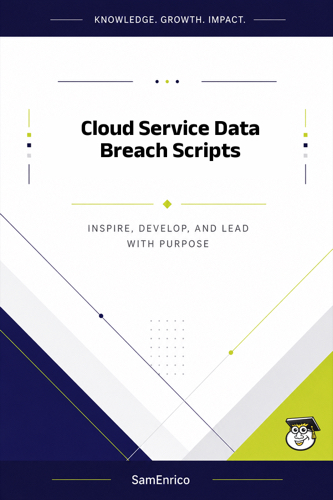
Cloud Service Data Breach Scripts eBook
Notifies SaaS customers of infrastructure leak.
Notifies SaaS customers of infrastructure leak.
Formats
Free sample
Chapter 1: The 2:00 AM Alarm...-- The first sound you hear is not an alarm. It is the Pager Duty notification on your phone, vibrating across the nightstand like a trapped insect. You were dreaming about something ordinary—a forgotten grocery list, a childhood hallway—and now you are awake, staring at a white screen in a dark room. Your thumb hovers over the message. You already know, somewhere in your spine, that this is not a false positive.The message reads: "Potential exposure event detected.
S3 bucket configuration changed. Public listing detected. Affected: customer-data-prod-02. Immediate investigation required."You sit up. The room is still.
Your partner murmurs something and rolls over. You walk to the home office, closing the door behind you. On the screen, the logs load slowly, each line revealing more: the bucket was misconfigured for 47 days. Not hours. Not days.
Forty-seven days. Customer lists, API keys, hashed passwords, and internal file paths. You scroll. The access logs show connections from IP addresses you do not recognize. Some of them belong to security scanners.
Some of them belong to something else.This is the moment. The moment before you write a single word to your customers. The moment before your CEO calls at 6:00 AM. The moment before your legal counsel starts deleting sentences from your draft. This moment—the raw, unfiltered instant of discovery—is what separates companies that survive a data leak from companies that die from the notification itself.Welcome to Chapter 1.
This is not a theoretical exercise. By the time you finish this chapter, you will understand exactly what kind of infrastructure failure you are facing, the critical distinction that will save your customer relationships, and the first document you must complete before any words leave your organization. Let us begin.The Four Faces of Infrastructure Failure Before you can notify anyone, you must understand what actually broke. Most Saa S companies discover their infrastructure leak through one of four common failure modes. Each requires a different notification tone, a different technical explanation, and a different set of promises to your customers.
Learn them now, before the 2:00 AM alarm.The Open Storage Bucket This is the most common infrastructure leak in the history of cloud computing. An S3 bucket, an Azure Blob container, or a Google Cloud Storage bucket is created with permissions set to "public" instead of "private." Sometimes this happens because an engineer clicked the wrong checkbox. Sometimes because a CI/CD pipeline inherited the wrong IAM role. Sometimes because a contractor created a "temporary" bucket for testing and forgot to delete it for three years.The customer impact is immediate and terrifying: anyone with the bucket's URL can list, read, or in worst cases, write to the contents. If the bucket contains backup files, database dumps, or log archives, the leak may include customer PII, API keys, internal credentials, and proprietary code.
The notification for an open storage bucket must answer one question above all others: "How long was it open?" The answer determines whether you are dealing with a leak (exposure without evidence of extraction) or a breach (confirmed exfiltration).The Over-Permissive APIYour API is the front door to your Saa S. It is also, in many architectures, the back door, the side window, and the unlocked basement entrance. An over-permissive API endpoint occurs when an engineer implements a new feature—say, a reporting endpoint that returns customer usage statistics—and forgets to add authentication checks. Or when an internal endpoint is accidentally exposed to the public internet. Or when a Graph QL schema allows queries that traverse relationships without proper authorization.The customer impact is subtle and therefore more dangerous.
Unlike an open bucket, where the exposure is obvious, an over-permissive API may have been queried by automated scanners, malicious bots, or curious developers for months before anyone notices. The notification for an API leak must address the question: "What data could have been retrieved?" If the answer includes session tokens, password reset links, or customer payment information, you are in breach territory. If the answer is limited to metadata or non-sensitive fields, you may be in leak territory.The Logging Failure This failure mode is the cruelest irony of cloud security. You enable verbose logging to debug a production issue. You write log files that contain request bodies, authentication tokens, and database query results.
You forget that those logs are stored in a centralized logging system (Splunk, Datadog, Elasticsearch) that is itself accessible to too many employees or, in the worst case, exposed to the public internet. Or you fail to rotate the logs, and they accumulate for years, becoming a treasure trove of customer data for anyone who gains access.The customer impact is delayed and incomplete. You may not know what was logged. You may not know who accessed the logs. You may not even know the logs existed until a security researcher tells you.
The notification for a logging failure must be honest about uncertainty: "We cannot confirm whether your data was accessed during this window. We are conducting a forensic review." This is painful to write, but it is the only truthful path.The Database Snapshot Database snapshots are the shadow infrastructure of Saa S. You create a snapshot before a migration, store it in a backup bucket, and forget it exists. The snapshot contains everything: customer records, billing information, internal configuration, and sometimes plaintext passwords (if you have not yet implemented hashing correctly). The snapshot is not encrypted at rest.
The snapshot's storage location is misconfigured. The snapshot sits, quietly, for months or years, until someone discovers it.The customer impact is total. A database snapshot is not a subset of data—it is everything. The notification for a database snapshot leak must assume the worst: all customer data in that snapshot is compromised. There is no "potential impact" language here.
There is only containment, disclosure, and remediation.The Critical Distinction: Leak vs. Breach You will see this distinction throughout the book. It is the single most important concept in breach notification. Learn it now, commit it to memory, and never confuse the two in front of your customers.A leak is an exposure of data without evidence that the data was copied, viewed, or accessed by an unauthorized party. The bucket was open, but the logs show no connections.
The API was misconfigured, but the access logs show only automated scanners with no data extraction. The snapshot was public, but the storage provider's audit trail shows no downloads. In a leak, the harm is potential, not actual. Your notification language can include phrases like "may have been exposed" and "we have no evidence of unauthorized access."A breach is a confirmed exfiltration or unauthorized access. The logs show downloads.
The API returns a spike in traffic from an unknown IP. The researcher provides proof that they retrieved data. In a breach, the harm is actual. Your notification language must include phrases like "we have confirmed that data was accessed" and "we assume that the following data was compromised."Why does this distinction matter? Because the tone of your notification determines customer behavior.
A leak notification can be measured, technical, and focused on remediation. A breach notification must be immediate, personal, and focused…
This is the end of the free sample. Get the eBook to keep going. Buy now
About this book
Details
- Author
- Goldman Antony
- Publisher
- SamEnrico
- Language
- English
- Genre
- Non-Fiction, Crisis Management, Cloud Security
- Released
- 2026-06-08
- Pages (approx.)
- 140
- Available as
- eBook, Audiobook

Read better in the ZLOADR app
Your eBooks on your phone or tablet. Sign in with your SamEnrico account and start reading.
More by Goldman Antony
 Overgiving Relationship RecoveryGoldman Antony$11.99
 Candida Overgrowth FixGoldman Antony$11.99
 Rex Tillerson ExxonGoldman Antony$11.99
 Prison AA Meeting GuideGoldman Antony$11.99
 TM for Emotional RegulationGoldman Antony$11.99
 Raised by Working Poor ParentsGoldman Antony$11.99
 Overhead Press Strength GuideGoldman Antony$11.99
 Compliance Team BurnoutGoldman Antony$11.99
 Quetzalcoatl’s Feathered Flight: The Serpent’s SecretGoldman Antony$11.99
 The Heavenly Vault: Secrets of the Gothic MastersGoldman Antony$11.99
 Supply Chain Digital TransformationGoldman Antony$11.99
 Time Blocking Success MetricsGoldman Antony$12.99
You may also like
 Hong Kong Handover 1997Dunn Johnnie$11.99
 Zumba For Postnatal Recovery CourseNeal Christian$11.99
 Zumba for BeginnersLadner Nikia$11.99
 YouTube Comment Mining GuideHumes Pandora$12.99
 Worry Box MeditationCarlin Rudy$11.99
 Workplace Stress MeditationNguyen Lynn$11.99
 Workplace Stress and Sleep RepairHawley Ivory$11.99
 Workplace Perfectionism CureDelaney Jeffry$11.99
 Workplace Injustice Anger GuideWallen Isabelle$11.99
 Work Addiction and Burnout LinkGreenwood Ester$11.99
 Women in Yoga and WellnessBeattie Galina$11.99
 Women in Stand Up ComedyChun Evangeline$11.99