
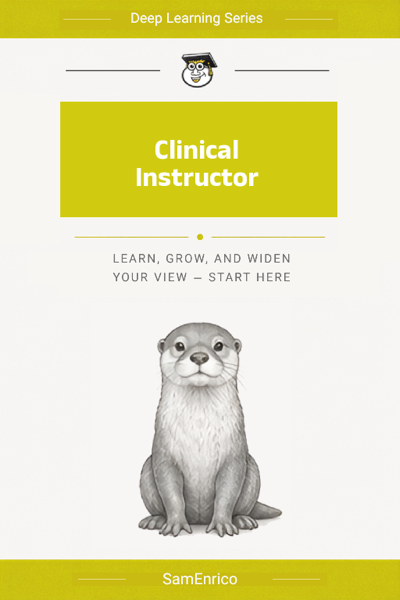
Non-FictionInformativeEducational
Clinical Instructor eBook
A Coursebook on Clinical Instructor
A Coursebook on Clinical Instructor
Formats
Free sample
Chapter 1: The Hidden Curriculum...--–- You have been a clinician for seven years. You have saved lives, made split-second decisions under pressure, and earned the trust of hundreds of patients. But today, standing outside Examination Room 4 with a third-year medical student named Priya, you feel something unfamiliar: the cold sweat of incompetence. Priya has just asked you a question you cannot answer. Not about medicine—you know that.
She asked: “How do I tell the family that their father is dying? What exactly do I say?” And in that moment, you realize that no one ever taught you how to teach. You know how to do. You do not know how to show someone else how to do. This chapter is for that moment.
It is for the skilled clinician who suddenly discovers that clinical excellence and teaching excellence are two different skills—and that the gap between them is where learners either flourish or fail.The Day You Stop Being Just a Clinician Every clinical instructor remembers the exact moment they realized that knowing and teaching are not the same thing. For some, it comes during their first attempt to explain a physical exam finding they can identify in seconds but cannot articulate in words. For others, it comes when a learner performs a procedure exactly as instructed—and exactly wrong—because the learner followed the words but missed the thirty small adjustments that make the procedure work. For nearly everyone, it comes with a jolt of humility that no medical training prepares you for.The problem is not that you lack expertise. The problem is that your expertise has become invisible to you.
Cognitive psychologists call this the expertise reversal effect: the more expert you become, the harder it is to remember what it felt like to be a novice. The movements that once required conscious thought have become automatic. The diagnostic patterns that once required deliberate analysis now appear as instantaneous intuitions. You have forgotten the intermediate steps, the failed attempts, the wrong turns that taught you what not to do. And so when a learner asks, “How did you know that?” you hear yourself saying, “I just knew.” Those three words are the most unhelpful teaching statement in the English language.This chapter is about making your expertise visible again—not to yourself, but to the learners who need to see the scaffolding beneath your competence.
It is about the fundamental identity shift from practitioner to educator, a shift that requires you to think not just about what you are doing but about how you are modeling the act of doing it. And it is about the hidden curriculum: the unspoken lessons about professionalism, empathy, resilience, and hierarchy that learners absorb simply by watching you, whether you intend to teach those lessons or not.The Two Roles, Side by Side To understand the shift from clinician to educator, you must first understand how the two roles differ in their fundamental focus. The table below is not a ranking—both roles are essential, and you will toggle between them many times in a single shift. But the differences matter because they explain why clinical excellence is not a reliable predictor of teaching excellence.Dimension Clinician Focus Instructor Focus Primary goal Patient outcome Learner development Time horizon This encounter, this shift This rotation, this career Decision style Efficient, authoritative, decisive Scaffolded, questioning, delegated Error response Correct and move forward Diagnose, debrief, teach from Communication Direct, action-oriented Explanatory, metacognitive Relationship with learner Colleague or supervisor Coach and role model The most important difference is the last one. As a clinician, your relationship with a learner is primarily supervisory: you ensure they do not harm the patient, and you correct errors when they occur.
As an instructor, your relationship is primarily developmental: you deliberately create opportunities for the learner to practice, make safe mistakes, and reflect on those mistakes. The supervisor protects the patient. The coach protects the learner’s trajectory.Here is the paradox: you cannot be a good coach without also being a good supervisor. Learner development cannot come at the expense of patient safety. But you can be a good supervisor without being a good coach—and many clinical instructors are.
They keep patients safe. They correct errors. They ensure the work gets done. But their learners leave the rotation no more competent than when they arrived, because the instructor never shifted from supervision to development.The shift requires deliberate effort. It requires you to ask, before every teaching interaction: “Am I about to tell this learner the answer, or am I about to help them discover it?” It requires you to tolerate the discomfort of watching a learner struggle with a problem you could solve in ten seconds.
And it requires you to recognize that your own cognitive load—your stress, your fatigue, your competing priorities—is the single greatest barrier to making the shift. You cannot teach well when you are drowning. The oxygen mask rule from the preface applies here: secure your own cognitive safety before you try to teach someone else.The One-Minute Preceptor: Your First Teaching Tool The most common objection new instructors raise is the most practical one: “I don’t have time to teach.” The clinical environment is too fast-paced, too unpredictable, too crowded with competing demands. A thoughtful, reflective teaching conversation feels like a luxury you cannot afford.The One-Minute Preceptor (OMP) is the answer to this objection. Developed by medical educators at the University of Washington in the 1990s and validated by decades of research, the OMP is a five-microskill model designed to fit into the cracks of a busy clinical day.
Despite its name, the OMP rarely takes exactly one minute. It takes between ninety seconds and five minutes, depending on the complexity of the case. But compared to the fifteen-minute unstructured teaching conversation that most instructors imagine, the OMP is a revolution in efficiency.The five microskills are sequential. You cannot skip steps without losing the model’s power.Microskill 1: Get a commitment.Ask the learner to commit to a diagnosis, a plan, or an interpretation before you offer your own opinion. This forces the learner to synthesize information and take an intellectual risk, rather than passively waiting for you to provide the answer.Weak phrasing: “What do you think about the chest pain?”Strong phrasing: “Based on what you have told me, what is your leading diagnosis for this patient’s chest pain?”The difference is specificity.
The weak phrasing invites a vague answer (“I’m not sure”). The strong phrasing demands a specific commitment. If the learner cannot commit, that is valuable diagnostic information: you have identified a gap that needs filling before the learner can function independently.Microskill 2: Probe for supporting evidence.Once the learner has committed to a position, ask them to explain their reasoning. This reveals the structure of their clinical thinking and allows you to identify gaps, misconceptions, or leaps in logic.Weak phrasing: “Why do you think that?”Strong phrasing: “What two pieces of evidence most strongly support your diagnosis? What one piece of evidence contradicts it?”The strong phrasing pushes the learner beyond a single justification and explicitly invites consideration of disconfirming…
This is the end of the free sample. Get the eBook to keep going. Buy now
About this book
Details
- Author
- Borders Syreeta
- Publisher
- SamEnrico
- Language
- English
- Genre
- Non-Fiction, Informative, Educational
- Released
- 2026-06-02
- Pages (approx.)
- 141
- Available as
- eBook, Audiobook

Read better in the ZLOADR app
Your eBooks on your phone or tablet. Sign in with your SamEnrico account and start reading.
More by Borders Syreeta
 Brand Value Review MiningBorders Syreeta$11.99
 Churn Reduction Growth HackBorders Syreeta$11.99
 Governor of InfrastructureBorders Syreeta$11.99
 Financial Stress Journal WorkbookBorders Syreeta$11.99
 The Devil's Mark: The Forgotten Witchcraft Trials of MaineBorders Syreeta$11.99
 The Mind of a Maverick: Unraveling the Psychology of Steve JobsBorders Syreeta$11.99
 Understanding Hyperbilirubinemia Type 1Borders Syreeta$17.99
 Telehealth Consumer Adoption OutlookBorders Syreeta$12.99
 Cybersecurity Certificate PathBorders Syreeta$12.99
 How to Start a Cases Made of Corrugated Fibreboard Business (Beginners Guide)Borders Syreeta$11.99
You may also like
 Hong Kong Handover 1997Dunn Johnnie$11.99
 Zumba For Postnatal Recovery CourseNeal Christian$11.99
 Zumba for BeginnersLadner Nikia$11.99
 YouTube Comment Mining GuideHumes Pandora$12.99
 Worry Box MeditationCarlin Rudy$11.99
 Workplace Stress MeditationNguyen Lynn$11.99
 Workplace Stress and Sleep RepairHawley Ivory$11.99
 Workplace Perfectionism CureDelaney Jeffry$11.99
 Workplace Injustice Anger GuideWallen Isabelle$11.99
 Work Addiction and Burnout LinkGreenwood Ester$11.99
 Women in Yoga and WellnessBeattie Galina$11.99
 Women in Stand Up ComedyChun Evangeline$11.99