
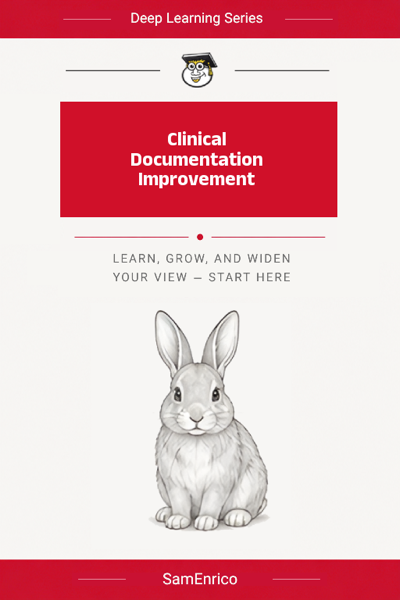
Non-FictionInformativeEducational
Clinical Documentation Improvement eBook
A Coursebook on Clinical Documentation Improvement
A Coursebook on Clinical Documentation Improvement
Formats
Free sample
Chapter 1: The Million-Dollar Question--–- You are about to read a sentence that, if fully understood, will change how you see every patient chart for the rest of your career. Here it is: The difference between a hospital that thrives and a hospital that merely survives is often not better doctors, better technology, or better location—it is better documentation of what the doctors and technology actually did. Read that again. Let it land. Because if you are a clinical documentation specialist, a nurse, a physician, a coder, or a hospital administrator, this single idea is the foundation of everything that follows in this book.Most people outside the healthcare industry assume that the quality of care drives financial success.
And they are not wrong—excellent care is non-negotiable. But here is what they do not understand: you can provide world-class, life-saving treatment to every patient who walks through the door, and still lose money on every single one of them if the documentation does not accurately capture the complexity of the care provided. Conversely, you can provide mediocre care and get paid exceptionally well if the documentation is inflated or misleading—though that path leads to fraud investigations, OIG penalties, and reputational ruin. The goal of this book, and the purpose of this chapter, is to put you firmly on the right side of that line: accurate, complete, clinically valid documentation that reflects the true story of the patient's illness and treatment.This chapter is called "The Million-Dollar Question" because that is literally what is at stake. Not figuratively.
Not metaphorically. A single missing modifier—the word "acute" instead of "chronic," the phrase "with sepsis" instead of "without sepsis"—can shift a patient's Diagnosis Related Group (DRG) by two or three levels, changing reimbursement by tens of thousands of dollars per case. Multiply that by hundreds or thousands of cases per year, and you are talking about millions of dollars in lost revenue that no amount of cost-cutting or operational efficiency will ever recover. But money is only part of the story. Poor documentation also leads to incorrect quality scores, inappropriate denial of services, inaccurate mortality data, and—most importantly—incomplete or misleading information for the next clinician who treats that patient.The good news is that you already have everything you need to fix this problem.
You do not need a new electronic health record. You do not need to hire more physicians. You do not need to wait for a regulatory change or a new payment model. The solution is already sitting in front of you, in the charts you review every day. The missing information is already known to someone—the bedside nurse, the consulting specialist, the lab report, the radiology finding.
Your job, as a clinical documentation professional, is simply to connect the dots and ask the right question at the right time. That is what this book will teach you to do, starting right now.Why This Book Exists Before we dive into the mechanics of clinical documentation improvement, let me tell you a story. It is a true story, though the names and identifying details have been changed to protect the people involved. A few years ago, a 67-year-old man named Robert was admitted to a community hospital with shortness of breath, fever, and confusion. His wife brought him in after he collapsed in the bathroom.
In the emergency department, his temperature was 102.8, his heart rate was 118, his blood pressure was 92/58, and his lactate was 3.8. He met every clinical criterion for sepsis. The emergency physician wrote "possible sepsis" in the note and started broad-spectrum antibiotics and intravenous fluids. Robert was admitted to the intensive care unit.Over the next five days, Robert improved. His fever resolved, his blood pressure normalized, and he was transferred to a medical-surgical floor.
On day seven, he went home. The hospital billed Medicare for the inpatient stay. The DRG assigned was based on the documented principal diagnosis of "pneumonia, unspecified." The reimbursement was approximately $9,000. The hospital lost money on Robert's care because the cost of the ICU stay, the antibiotics, the imaging, and the nursing hours far exceeded that amount.Here is what the chart actually contained but was never synthesized: the lactate of 3.8, the hypotension requiring intravenous fluids, the bandemia of 15 percent, and the mention in a nursing note that Robert "looks very sick." Any one of these clinical indicators, combined with the documented infection, would have supported a diagnosis of sepsis. A concurrent clinical documentation specialist—someone reviewing the chart on day two or three of Robert's stay—could have queried the physician: "The patient meets clinical criteria for sepsis with a lactate of 3.8 and hypotension.
Do you agree with sepsis?" If the physician had answered yes, the DRG would have shifted from pneumonia alone to sepsis with pneumonia, increasing reimbursement to approximately 21,000.Thatisadifferenceof21,000. That is a difference of 21,000.Thatisadifferenceof12,000 on a single patient. In a hospital with 200 sepsis admissions per year, that is $2.4 million in missed revenue annually.But here is the more troubling part. When Robert was readmitted three months later with recurrent pneumonia, the discharging physician looked at his prior records and saw "pneumonia, unspecified." There was no mention of sepsis. The physician did not know that Robert had previously progressed to septic shock.
The readmission was treated less aggressively. Robert developed respiratory failure and spent two weeks in the ICU. That second admission cost the hospital even more money and, more importantly, nearly cost Robert his life.This story illustrates the three consequences of poor documentation:Financial: The hospital leaves revenue on the table when severity is under-documented.Quality: Risk-adjusted mortality rates appear worse than they truly are because the denominator (sickness of patients) is understated.Clinical: Future clinicians lack critical information about the patient's illness trajectory.Clinical documentation improvement exists to prevent all three. And that is why this book exists—to give you a complete, practical, evidence-based coursebook that synthesizes the best practices from the top resources in the field: the CDI Pocket Guide by Pinson and Tang, the Clinical Documentation Improvement Specialist's Handbook by Kruse and Taillon, the AHIMA standards, and the ACDIS guidelines. You do not need to read ten different books.
Everything you need is here.The Evolution of CDI: From Afterthought to Imperative To understand where clinical documentation improvement is going, you need to understand where it came from. Before the early 2000s, documentation was primarily a coding function. Coders would receive a chart after the patient was discharged, read what the physician wrote, and assign codes. If the documentation was vague or incomplete, the coder would either assign an unspecified code or, in some organizations, send a query weeks later that the physician might or might not answer. This retrospective, reactive model left enormous value on the table and did nothing to improve patient care during the admission.The turning point came with the implementation of the Medicare Severity Diagnosis Related Groups (MS-DRGs) in 2007-2008.
For the first time, Medicare explicitly tied reimbursement to the severity of illness, using comorbidities (CCs) and major comorbidities (MCCs) to adjust DRG weights. A patient with pneumonia and a major comorbidity—say, chronic kidney disease stage 4—generated a higher payment…
This is the end of the free sample. Get the eBook to keep going. Buy now
About this book
Details
- Author
- Smyth Camilla
- Publisher
- SamEnrico
- Language
- English
- Genre
- Non-Fiction, Informative, Educational
- Released
- 2026-05-11
- Pages (approx.)
- 148
- Available as
- eBook, Audiobook

Read better in the ZLOADR app
Your eBooks on your phone or tablet. Sign in with your SamEnrico account and start reading.
More by Smyth Camilla
 Step Four for Trauma SurvivorsSmyth Camilla$11.99
 Metta for EmployeesSmyth Camilla$11.99
 The Buffett Walton ConnectionSmyth Camilla$11.99
 Sugar Plantation MachineSmyth Camilla$11.99
 Hurling: The Ancient Game That Shaped Celtic WarriorsSmyth Camilla$11.99
 How to Produce a Bottling LINESmyth Camilla$11.99
 10 Ways to Use Agar (Recipe Book)Smyth Camilla$11.99
 China Franchise StrategySmyth Camilla$12.99
You may also like
 Hong Kong Handover 1997Dunn Johnnie$11.99
 Zumba For Postnatal Recovery CourseNeal Christian$11.99
 Zumba for BeginnersLadner Nikia$11.99
 YouTube Comment Mining GuideHumes Pandora$12.99
 Worry Box MeditationCarlin Rudy$11.99
 Workplace Stress MeditationNguyen Lynn$11.99
 Workplace Stress and Sleep RepairHawley Ivory$11.99
 Workplace Perfectionism CureDelaney Jeffry$11.99
 Workplace Injustice Anger GuideWallen Isabelle$11.99
 Work Addiction and Burnout LinkGreenwood Ester$11.99
 Women in Yoga and WellnessBeattie Galina$11.99
 Women in Stand Up ComedyChun Evangeline$11.99