
Non-FictionInformativeEducational
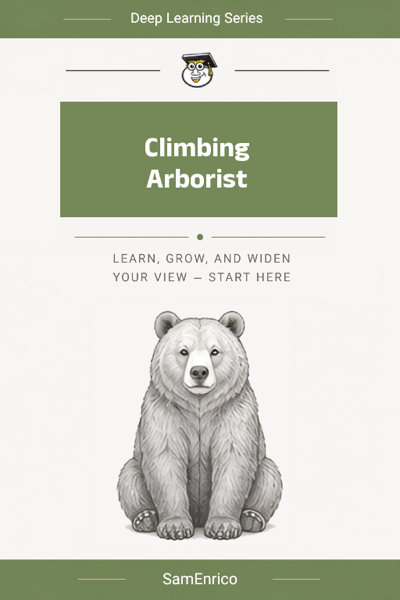
Climbing Arborist eBook
A Coursebook on Climbing Arborist
by Alonzo Leida
A Coursebook on Climbing Arborist
Formats
Free sample
Chapter 1: The Broken Branch--– The oak had stood for two hundred years, its crown a sprawling cathedral of limbs that had weathered hurricanes, droughts, and the steady creep of suburban development. Dave had climbed it a dozen times before. He knew its quirks—the hollow in the main crotch where rainwater pooled, the deadwood limb on the east side that shed bark like a snake, the perfect handhold just above the first major union. On paper, Dave was exactly the kind of climber any company would want. Fifteen years in the trade.
ISA Certified Arborist. No lost-time accidents. He had a reputation for being fast without being reckless, careful without being slow. That morning in late October, the crew was behind schedule. A cold front was moving in, and the pruning job on the old oak was the third of five that day.
The foreman, a younger guy named Marcus who had been promoted six months earlier, was feeling the pressure from the owner. "Dave, you good to hit this one quick? We've got that maple removal after lunch." Dave looked up at the oak. The tie-in point he usually used—a thick lateral limb on the west side, about forty-five feet up—looked solid. He had used it before.
He waved off the pre-climb inspection. "I know this tree," he said. "Let's get it done."He threw his line on the first shot, an unusual stroke of luck. Within ten minutes, he was body-thrusting up the rope, his boots finding the trunk in a rhythm as familiar as breathing. At thirty feet, he paused to advance his lanyard.
At forty feet, he swung out onto the lateral limb. He set his climbing line around the branch—no friction saver, just the natural crotch—and settled into his saddle. The view was good. The leaves were turning, and the neighborhood below was quiet. He pulled out his handsaw and started on the first dead branch.
That was when he heard it. A sound less than a crack and more than a creak. A dull, wet pop. The limb beneath his tie-in point didn't break. It exploded.
The sound of two hundred years of oak releasing its hold on a latent defect is not loud. It is final. Dave fell forty-five feet in something close to silence. He remembered the wind rushing past his ears, the strange sensation of his climbing line going slack, and then the ground. He survived.
Broken pelvis, crushed heel, three fractured vertebrae. He never climbed again. The limb that failed? It had included bark running through the union—a defect visible from the ground with a pair of binoculars. Dave had skipped the inspection because he thought experience was a substitute for procedure.
He was wrong.This book exists to make sure you are not wrong.The Difference Between a Recreational Climber and a Professional Arborist If you came to this book thinking that climbing arboriculture is just tree climbing with a chainsaw, stop here. The distinction is not semantic. It is the difference between a hobby and a profession, between recreation and responsibility, between a near-miss story and an obituary.A recreational climber ascends trees for fun. They use recreational climbing gear—dynamic ropes designed to stretch during a fall, harnesses built for comfort rather than work positioning, and a single attachment point because the risk of an unplanned descent is low. They are accountable to themselves and, perhaps, to a climbing partner.
A professional arborist ascends trees to work. They use static or low-stretch ropes designed for positioning, not falling. Their harness is a tool platform, with attachment points for lanyards, saws, and rigging gear. They are accountable to their crew, their employer, the tree owner, the public below, and the law.But the deepest difference is structural. A recreational climber trusts the tree.
A professional arborist verifies the tree. Trust is an emotion. Verification is a process. The recreational climber looks at a limb and thinks, "That looks strong." The professional arborist looks at the same limb and asks specific, answerable questions: What species is this? What is its known failure pattern?
Is there included bark at the attachment? Are there cracks, cankers, or cavities that a quick glance would miss? What is the angle of the limb relative to the trunk? If the limb whips under load, will it contact another limb and snap? The recreational climber climbs on hope.
The professional climbs on evidence.This chapter is about building that professional mindset from the ground up. Not the skills—those come later. Not the gear—that is Chapter 3. Not the knots or the systems or the cutting techniques. This chapter is about the architecture of your brain.
How you think about risk. How you prepare. How you communicate. And how you hold yourself accountable when no one is watching.The Ethics of the Cut: Why Topping Is Never Acceptable Before you learn how to cut, you must learn when and why. The climbing arborist does not simply remove branches.
They make surgical decisions that affect a tree's health, safety, and longevity for decades. The most important ethical boundary in arboriculture is also the simplest: you do not top trees.Topping is the practice of cutting back a tree's main stems to stubs, leaving a pollarded or "hat-racked" appearance. Homeowners sometimes request it because they want to reduce a tree's height or thin its canopy. Unscrupulous or uninformed arborists sometimes perform it because it is fast and pays the same as proper pruning. Topping is never, ever acceptable.
Here is why.First, topping creates a hazard. When you cut a branch back to a stub, you remove the branch collar—the tree's natural sealing mechanism. The stub dies back, and decay enters the living tissue. New shoots called epicormic sprouts emerge from the stub, but they are weakly attached. In a few years, those sprouts become large limbs that break without warning, often causing property damage or injury.
The "solution" of topping creates a more dangerous tree than the original problem.Second, topping starves the tree. Leaves are the tree's food factories. When you remove more than 25% of a tree's live canopy in a single season, you induce a starvation response. The tree draws on stored energy reserves to produce those weakly attached sprouts, depleting its carbohydrate budget. Repeated topping kills trees slowly, over five to fifteen years, as the tree exhausts its reserves and succumbs to pathogens that would not have affected a healthy specimen.Third, topping is ugly.
This is not an aesthetic opinion. It is a statement of professional consensus. The ISA (International Society of Arboriculture) explicitly condemns topping as an unacceptable practice. ANSI A300 pruning standards forbid the practice. Municipal tree ordinances in hundreds of cities fine arborists who top trees.
If you are caught topping a tree, you will lose certification, lose insurance, and lose your reputation.The ethical arborist does not top. The ethical arborist educates the client. When a homeowner says "I want this tree shorter," you explain why topping kills. You explain that crown reduction—cutting individual branches back to lateral limbs that are at least one-third the diameter of the removed branch—is the only acceptable…
This is the end of the free sample. Get the eBook to keep going. Buy now
About this book
Details
- Author
- Alonzo Leida
- Publisher
- SamEnrico
- Language
- English
- Genre
- Non-Fiction, Informative, Educational
- Released
- 2026-05-06
- Pages (approx.)
- 139
- Available as
- eBook, Audiobook

Read better in the ZLOADR app
Your eBooks on your phone or tablet. Sign in with your SamEnrico account and start reading.
More by Alonzo Leida
 Fantasy Football AddictionAlonzo Leida$11.99
 Psychological Relapse Prevention in the WorkplaceAlonzo Leida$11.99
 Immigrant Family DysfunctionAlonzo Leida$11.99
 Tabletop Body LanguageAlonzo Leida$11.99
 The Thesis Writer AnxietyAlonzo Leida$11.99
 Life After Caregiving GuideAlonzo Leida$11.99
 Relapse Prevention PlanningAlonzo Leida$11.99
 Melatonin Growth Hormone SynergyAlonzo Leida$11.99
 MS Anticipatory GriefAlonzo Leida$11.99
 The Lamplighters of Timbuktu: Beacons of the Golden AgeAlonzo Leida$11.99
 Ragnarok’s Shadow: The Norse Gods’ Forgotten War with RomeAlonzo Leida$11.99
 White Gold & Blood Diamonds: The Untold War of the CartelsAlonzo Leida$11.99
You may also like
 Hong Kong Handover 1997Dunn Johnnie$11.99
 Zumba For Postnatal Recovery CourseNeal Christian$11.99
 Zumba for BeginnersLadner Nikia$11.99
 YouTube Comment Mining GuideHumes Pandora$12.99
 Worry Box MeditationCarlin Rudy$11.99
 Workplace Stress MeditationNguyen Lynn$11.99
 Workplace Stress and Sleep RepairHawley Ivory$11.99
 Workplace Perfectionism CureDelaney Jeffry$11.99
 Workplace Injustice Anger GuideWallen Isabelle$11.99
 Work Addiction and Burnout LinkGreenwood Ester$11.99
 Women in Yoga and WellnessBeattie Galina$11.99
 Women in Stand Up ComedyChun Evangeline$11.99