
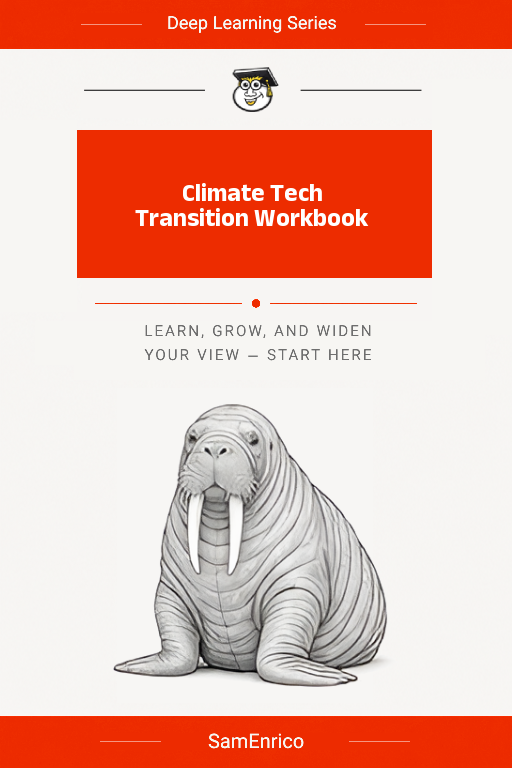
Climate Tech Transition Workbook
Translate corporate marketing, sales, or ops skill
Translate corporate marketing, sales, or ops skills into climate tech roles. Includes skills mapping worksheets, job description decoders, and industry networking scripts.
Formats
About this book
Free sample
Climate Tech Transition Workbook – Fully Revised Edition Structural Changes Made (Summary)Change Description Chapter reordering Portfolio chapter moved from Ch 8 → Ch 4 (build proof before applying)30% Rule relocated Moved from Ch 4 → Ch 1 (mindset before tactics)Translation consolidated All translation work now in Ch 3 only; Ch 5 and Ch 7 reference it Volunteering consolidated All volunteering guidance now in Ch 4 only Knowledge Tiers added New table in Ch 2 resolves "how much do I need to know?"Chapter 9 expanded Added HR, Legal, Product, and Program Management tracks (now 8 tracks)Risk Profile Quiz added New in Ch 10 helps readers choose startup vs. incumbent path Incumbent Compensation sidebar New in Ch 11 adapts pay guidance for non-startups Cross-references added throughout No orphaned concepts; every tool points back to its source NEW IN-DEPTH CHAPTER SUMMARIES (250+ words each)PART I: THE ASSESSMENT & MINDSET SHIFTChapter 1: The "Carbon Connector" Mindset Core argument: The single greatest barrier to entering climate tech is not a lack of technical knowledge—it is an identity problem. Corporate professionals mistakenly believe their profit-focused roles are irrelevant to mission-driven work. This chapter dismantles that myth and introduces the foundational rule that governs the entire book.The two mindset shifts: Shift #1 – From "Profit Center" to "Impact Driver" teaches readers to reframe P&L ownership as resource stewardship. Driving revenue is not anti-climate; it funds scaling.
A marketing manager who generated $10M in revenue did not waste time—they proved they can move money, which is exactly what climate startups need to grow. Shift #2 – From "Risk Management" to "Resilience Engineering" rebrands traditional ops or compliance roles as expertise in anticipating system failures. A supply chain manager who navigated port closures during COVID has exactly the skills needed to manage grid intermittency or supply chain disruptions for solar panels. These are not peripheral skills; they are core climate competencies.Myth vs. reality: The chapter directly confronts the imposter syndrome triggered by "I don't have a climate science degree." It argues that climate tech's current bottleneck is not basic research (which is largely solved) but execution: sales, supply chains, project management, and go-to-market strategy.
Climate startups fail because they cannot sell, not because their technology doesn't work. Corporate professionals are trained in exactly what…
This is the end of the free sample. Get the eBook to keep going. Buy now
Contents
- Chapter 1
- Chapter 2
- Chapter 3
- Chapter 4
- Chapter 5
- Chapter 6
- Chapter 7
- Chapter 8
- Chapter 9
- Chapter 10
- Chapter 11
- Chapter 12
Details
- Author
- Pettit Adelia
- Publisher
- SamEnrico
- Language
- English
- Genre
- Non-Fiction, Non-Obvious Career, Green Jobs, Workbook
- Released
- 2026-05-29
- Pages (approx.)
- 154
- Available as
- eBook, Audiobook

Read better in the ZLOADR app
Your eBooks on your phone or tablet. Sign in with your SamEnrico account and start reading.
More by Pettit Adelia
 Brand Ranking Regulatory HeadwindsPettit Adelia$11.99
 Chronic Pain Biomarkers GuidePettit Adelia$11.99
 Anger And ADHD Child GuidePettit Adelia$11.99
 Interruption Recovery Time BlocksPettit Adelia$11.99
 The Phantom of 5th Avenue: The Vanishing of Dorothy ArnoldPettit Adelia$11.99
 Anansi’s Web of Wisdom: The Spider’s Great BargainPettit Adelia$11.99
 Alternative Payment Rail GuidePettit Adelia$12.99
 Understanding Hyperlipoproteinemia Type IiPettit Adelia$17.99
 How to Start a Hobby in Model figuresPettit Adelia$11.99