
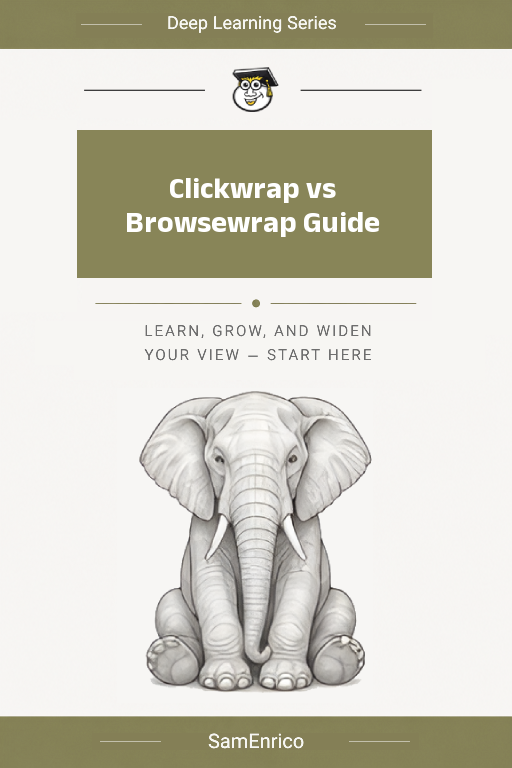
Non-FictionFirst 30 DaysEnforceability
Clickwrap vs Browsewrap Guide eBook
Choose between clickwrap agreement (checkbox) or b
Choose between clickwrap agreement (checkbox) or browsewrap (use constitutes acceptance) for enforceability.
Formats
Free sample
Chapter 1: The Thousand Lies--–- Every time you click “I Agree,” you commit a small act of perjury. You swear, by that click, that you have read, understood, and accepted a binding legal contract. And almost every single time, you have done none of those things.The average internet user clicks “I Agree,” “Accept,” “Continue,” or “OK” over one thousand times per year. That is nearly three times per day, every single day, without exception. Over a decade, that number climbs past ten thousand clicks.
And yet, study after study confirms what you already know in your gut: virtually no one reads the terms they are agreeing to. In one widely cited 2017 study, researchers estimated that if the average American actually read every privacy policy they encountered in a year, they would spend 76 working days doing nothing else. No email. No meetings. No actual work.
Just reading legal documents.The math is damning. If you were to read every clickwrap agreement presented to you in a single year, you would forfeit more than three months of your productive life. So you don’t. You can’t. No reasonable person could.
And yet, courts have consistently held that you are bound by every single one of those unread contracts.This is the great paradox of digital life. You are legally obligated to terms you have never seen, bound by promises you never knowingly made, and subject to arbitration clauses that strip you of your right to sue—all because your finger twitched over a button labeled “I Agree.”Welcome to the fiction of digital assent. And this book is going to tear it apart.The Attention Economy’s Perfect Trap To understand why you click without reading, you first have to understand the economic engine that makes it profitable for companies to present you with contracts you will never read. That engine is called the attention economy.In the pre-internet era, attention was abundant and contracts were rare. You signed a lease.
You signed a mortgage. You signed an employment agreement. Each signature was a deliberate, conscious act, often reviewed with the help of a lawyer or at least a skeptical friend. The transaction cost of forming a contract was high—printing, mailing, signing, returning—so contracts were reserved for meaningful exchanges.The internet changed everything. Suddenly, the marginal cost of presenting a contract dropped to zero.
A website can show a terms-of-service pop-up to ten million users for the same cost as showing it to ten users. And because users are impatient, companies discovered a brutal optimization: the longer and more complex the contract, the less likely anyone reads it, and the more favorable terms you can bury inside.This is not an accident. It is a design feature.Behavioral economists have documented what they call cognitive load—the limited mental bandwidth each person has for processing information. When you are confronted with a dense wall of legal text, your brain instinctively recoils. It cannot process forty paragraphs of legalese while also remembering your password, avoiding typos in your email address, and wondering if you left the oven on.
Something has to give. And what gives is reading.Instead, your brain takes a shortcut. It sees the familiar pattern of a button labeled “I Agree” and clicks it reflexively. This is not stupidity. This is efficiency.
Your brain has learned, through thousands of repetitions, that clicking “I Agree” removes a barrier and grants access. It has also learned, through the same thousands of repetitions, that nothing bad ever happens immediately after clicking. No electric shock. No fine. No lawsuit filed within seconds.
The reinforcement is purely positive: click, and you get what you want.Over time, this conditioning becomes automatic. You stop even registering the existence of the contract. It becomes visual noise, like the blur of trees when you drive down a highway. Your finger knows what to do before your conscious mind has finished asking, “Wait, should I read this?”The Legal Fiction: Why Courts Enforce What Nobody Reads If no one reads these contracts, why do courts enforce them? The answer lies in a legal doctrine that sounds reasonable in theory but becomes absurd in practice: mutual assent.In traditional contract law, a contract is formed when two parties exchange an offer and an acceptance, and both manifest their intent to be bound.
This is called mutual assent. In the physical world, mutual assent is easy to identify. You say, “I’ll sell you my car for $5,000.” The other person says, “I accept,” and hands you cash. Both parties have clearly demonstrated their intent.But on the internet, mutual assent has been stretched to its breaking point. Courts have developed a doctrine called the “reasonable person” standard: would a reasonable person in the user’s position have understood that clicking this button constituted agreement to these terms?
If the answer is yes—or even maybe—the court will enforce the contract, regardless of whether the user actually read a single word.The most famous case establishing this principle is Feldman v. Google, Inc. (2007). Howard Feldman was a Google Ad Words advertiser who lost money due to what he claimed were billing errors. He sued Google.
Google pointed to its clickwrap agreement, which Feldman had clicked “I Agree” to when he signed up. Feldman argued that he had never read the terms and therefore could not be bound by them.The court was unmoved. “Plaintiff’s failure to read the agreement does not relieve him of his obligation to its terms,” the judge wrote. “By clicking ‘I Agree,’ plaintiff manifested his assent to be bound by the agreement.”This is the bedrock of digital contract enforcement: the click is enough. The law cares about the act, not the reading.
You are bound not because you understood what you agreed to, but because you performed the ritual of clicking.There is a certain logic to this. If courts required proof of actual reading, no digital contract would ever be enforceable. The entire e-commerce economy would grind to a halt. Every purchase, every account creation, every software download would be subject to a retrospective argument about whether the user genuinely read the fine print. That is not a workable system.But the opposite extreme—binding users to terms they never saw and never could have seen—is equally unworkable.
It creates a world of invisible obligations and hidden traps. And courts have begun to push back. They have drawn a line: a click is enough, but only if the contract was conspicuously presented and reasonably understandable.That line is what this entire book is about.The Two Families of Digital Contracts Before we go any further, we need to define the two primary types of digital agreements that you encounter every day. These definitions will serve as the foundation for every case study, every courtroom battle, and every practical recommendation in the remaining eleven chapters.Browsewrap is the older, more passive form of digital contracting. In a browsewrap agreement, the terms of service are linked somewhere on the website—usually in the footer, often in tiny gray type—and the website claims that by merely using the site, you have agreed to those terms.…
This is the end of the free sample. Get the eBook to keep going. Buy now
About this book
Details
- Author
- Creech Cecila
- Publisher
- SamEnrico
- Language
- English
- Genre
- Non-Fiction, First 30 Days, Enforceability
- Released
- 2026-06-01
- Pages (approx.)
- 147
- Available as
- eBook, Audiobook

Read better in the ZLOADR app
Your eBooks on your phone or tablet. Sign in with your SamEnrico account and start reading.
More by Creech Cecila
 Major Depressive Disorder Explained for Social WorkersCreech Cecila$11.99
 Complete Protein Sources GuideCreech Cecila$11.99
 Anacaona Taíno ChiefCreech Cecila$11.99
 Substance Abuse Prevention CoordinatorCreech Cecila$11.99
 The Resilience PharmacyCreech Cecila$11.99
 Loving Kindness for Addiction CounselingCreech Cecila$11.99
 Daily Review Evening RitualCreech Cecila$11.99
 Purpose in Retirement YearsCreech Cecila$11.99
 The Phantom Trucker: Australia's Highway of HorrorsCreech Cecila$11.99
 The Secret Stitch: How a Medieval Tailor Revolutionized Rugby in the Southern CrossCreech Cecila$11.99
 Service Providers Guide to Portrait & Wedding PhotographyCreech Cecila$11.99
 How to Start a Cork Products (except Cork Life Preservers)(manufacture) Business (Beginners Guide)Creech Cecila$11.99
You may also like
 Hong Kong Handover 1997Dunn Johnnie$11.99
 Zumba For Postnatal Recovery CourseNeal Christian$11.99
 Zumba for BeginnersLadner Nikia$11.99
 YouTube Comment Mining GuideHumes Pandora$12.99
 Worry Box MeditationCarlin Rudy$11.99
 Workplace Stress MeditationNguyen Lynn$11.99
 Workplace Stress and Sleep RepairHawley Ivory$11.99
 Workplace Perfectionism CureDelaney Jeffry$11.99
 Workplace Injustice Anger GuideWallen Isabelle$11.99
 Work Addiction and Burnout LinkGreenwood Ester$11.99
 Women in Yoga and WellnessBeattie Galina$11.99
 Women in Stand Up ComedyChun Evangeline$11.99