
Non-FictionStudent's ShortcutTranslation
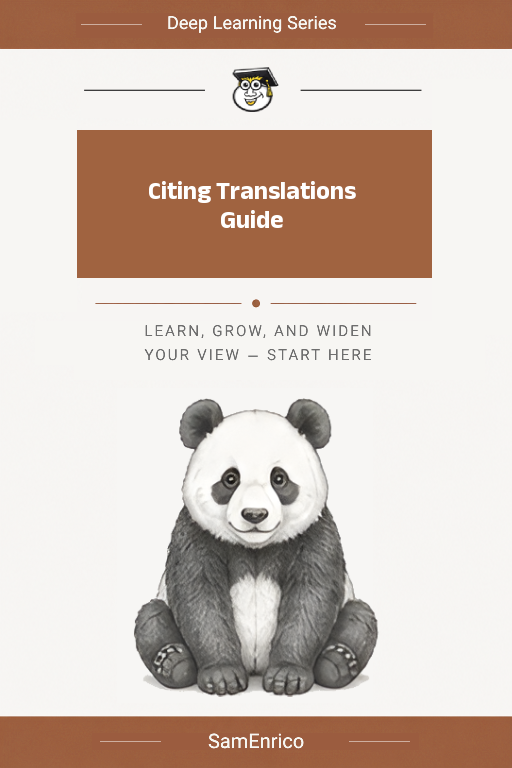
Citing Translations Guide
Cite translated works with original and translator
Cite translated works with original and translator information in reference lists.
Formats
About this book
Free sample
Chapter 1: The Silent Partners--–- Every book you have ever read in translation arrived in your hands through an act of quiet heroism. The words on the page—the rhythm of sentences, the weight of a metaphor, the sting of dialogue—were shaped not only by the original author but by another hand entirely, one that history has trained us to overlook. This chapter is not about how to format a citation. That comes later. This chapter is about why you will never again treat that citation as an afterthought.
It is about the ethical and scholarly imperative to see translators as what they truly are: co-creators, intellectual partners, and, all too often, the invisible laborers who determine whether a foreign masterpiece sinks into obscurity or rises to become a global bestseller.The Great Erasure: A History of Seeing Without Noticing In 1611, when the King James Bible was published, no translator's name appeared anywhere on its pages. Forty-seven scholars had labored for seven years, yet their collective identity was subsumed into the authority of the crown and the church. This was not an accident. It was the operating system of translation for centuries: the translator as a conduit, a window, a servant—anything but an author. The Latin phrase interpres (translator) was distinct from auctor (author), and the distinction carried a hierarchy.
The author created; the translator merely reproduced.The term "translator invisibility" was formally coined by translation theorist Lawrence Venuti in his 1995 book The Translator's Invisibility: A History of Translation, but the phenomenon he described had been in practice for millennia. In ancient Rome, translators like Livius Andronicus (who rendered Homer's Odyssey into Latin) were often slaves or freedmen—literally owned labor. Their names appeared, if at all, in the colophon or as a small note, never on par with the original author. This pattern held through the Middle Ages, when monastic scribes translated religious texts anonymously as an act of piety, not self-promotion. Through the Renaissance, when translators like John Florio (who translated Montaigne's Essays) struggled for recognition even as their work shaped English literature.
And through the twentieth century, when university tenure committees routinely dismissed translation as "service" rather than "research."Consider this: when Gabriel…
This is the end of the free sample. Get the eBook to keep going. Buy now
Contents
- Chapter 1
- Chapter 2
- Chapter 3
- Chapter 4
- Chapter 5
- Chapter 6
- Chapter 7
- Chapter 8
- Chapter 9
- Chapter 10
- Chapter 11
- Chapter 12
Details
- Author
- Redman Garland
- Publisher
- SamEnrico
- Language
- English
- Genre
- Non-Fiction, Student's Shortcut, Translation
- Released
- 2026-06-01
- Pages (approx.)
- 157
- Available as
- eBook, Audiobook

Read better in the ZLOADR app
Your eBooks on your phone or tablet. Sign in with your SamEnrico account and start reading.
More by Redman Garland
 DBT For Depression SkillsRedman Garland$11.99
 Workaholism for VeteransRedman Garland$11.99
 Teacher Who Changed LivesRedman Garland$11.99
 Breath Awareness For ChildrenRedman Garland$11.99
 Interstitial Cystitis GuideRedman Garland$11.99
 The Team Priority MatrixRedman Garland$11.99
 Rudolf Steiner AnthroposophyRedman Garland$11.99
 Pomodoro Deep Work IntegrationRedman Garland$11.99
 The Diamond Run: Moscow's Gold Heist in the Heart of AfricaRedman Garland$11.99
 Baba Yaga’s Enchanted Quest: The Knight Who Rode the NeedleRedman Garland$11.99
 How to Produce Hair WreathsRedman Garland$11.99
 How to Produce Straight PinsRedman Garland$11.99
You may also like
 Hong Kong Handover 1997Dunn Johnnie$11.99
 Zumba For Postnatal Recovery CourseNeal Christian$11.99
 Zumba for BeginnersLadner Nikia$11.99
 YouTube Comment Mining GuideHumes Pandora$12.99
 Worry Box MeditationCarlin Rudy$11.99
 Workplace Stress MeditationNguyen Lynn$11.99
 Workplace Stress and Sleep RepairHawley Ivory$11.99
 Workplace Perfectionism CureDelaney Jeffry$11.99
 Workplace Injustice Anger GuideWallen Isabelle$11.99
 Work Addiction and Burnout LinkGreenwood Ester$11.99
 Women in Yoga and WellnessBeattie Galina$11.99
 Women in Stand Up ComedyChun Evangeline$11.99