
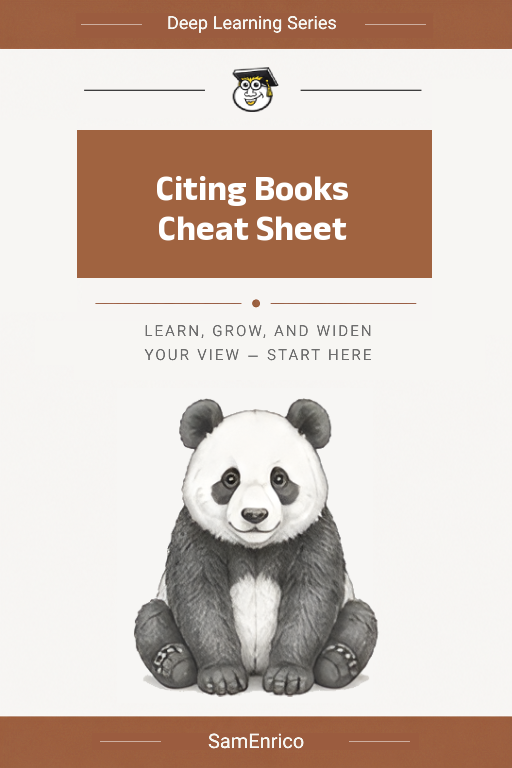
Non-FictionStudent's ShortcutBooks
Citing Books Cheat Sheet eBook
Format single author, multiple authors, edited boo
Format single author, multiple authors, edited books, and chapters across citation styles.
Formats
Free sample
Chapter 1: The Citation Panic...--You have just finished a ten-page research paper. Your fingers ache. Your eyes burn. The argument is solid, the evidence is woven in seamlessly, and the conclusion lands like a gavel. You feel the quiet pride of having produced something genuinely good.Then you remember the bibliography.That sudden cold drip in your chest.
The scramble to find the book you returned to the library yesterday. The desperate scroll through your browser history for that one PDF you read but cannot remember downloading. The dreaded realization that your professor deducts five points for every missing comma, every misplaced period, every italicized period that should not have been italicized.This is the citation panic. And if you have ever felt it, you are not alone.Over eighty percent of college students report that formatting citations correctly is the most stressful part of writing a research paper—more stressful than finding sources, more stressful than writing the thesis, more stressful than the actual argumentation. That statistic is not published in any peer-reviewed journal, but ask any professor, any writing center tutor, any student who has ever stared at a blinking cursor at 2 AM, and they will confirm it.
Citations are where good papers go to lose points.But here is the secret that the thousand-page style guides do not want you to know: citations are not complicated. They are merely precise. There is a difference. Rocket science is complicated. Brain surgery is complicated.
Knowing where to put a comma and whether to italicize a period is not complicated. It is a rule. Rules can be learned. Rules can be memorized. Rules can be—and this is the entire point of this book—looked up in under thirty seconds.This chapter is not about citations yet.
Before you learn how to format a single author book in APA or a chapter in an edited collection in Chicago, you need to understand what a citation actually is. Not the definition you memorized for a quiz and immediately forgot. The real, functional, practical understanding that will allow you to look at any citation in any style and immediately see the pattern. Once you see the pattern, you never have to memorize again.The Five Questions Every Citation Answers Think of a citation as a delivery address. If you want someone to find a house, you give them the street number, the street name, the city, the state, and the zip code.
If any piece is missing, the delivery fails. Citations work exactly the same way. Every citation, regardless of whether it follows APA, MLA, Chicago, AMA, or any other style, answers the same five questions. The order changes. The punctuation changes.
The capitalization changes. But the five answers are always there.Question One: Who wrote it?This is the author. In most cases, this is straightforward: a person’s name. But straightforward does not mean simple, because styles disagree violently about how that name should appear. Should it be "Smith, J.
A." or "Smith, John A." or "John A. Smith"? Should there be a period after the middle initial? Should the middle initial be included at all? These are not philosophical questions.
They are formatting questions. And they all get answered in Chapter 3.Question Two: When was it published?This is the date. For most books, this is the copyright year printed on the back of the title page. For APA users, the date is so important that it appears right after the author’s name, in parentheses, before you even learn the title of the book. For MLA users, the date appears at the end of the citation, almost as an afterthought.
Same information, different priority. Neither is wrong. They just serve different scholarly values.Question Three: What is it called?This is the title. All styles italicize book titles. All of them.
APA, MLA, Chicago, AMA—every single one. This is the rare moment of universal agreement in the citation world. However, they disagree on capitalization. APA and AMA use sentence case, meaning only the first word of the title, the first word of the subtitle, and proper nouns are capitalized. MLA and Chicago use headline case, meaning every major word is capitalized.
This matters because your professor will absolutely deduct points for the wrong capitalization pattern, even if the rest of the citation is perfect.Question Four: Where is the whole source located?This is the container. For a book, the container is the book itself. But for a chapter inside that book, the book is the container of the chapter, and the library or database might be the container of the book. This is called the container concept, and it is the single most important idea in this entire chapter. A citation is not just a list of information.
It is a map of nested containers. Imagine a set of Russian nesting dolls. The smallest doll is the part you actually read: a chapter, an essay, a single page. That small doll sits inside a larger doll: the book. That book might sit inside an even larger doll: a database or a physical library shelf.
A correct citation tells the reader how to open all the dolls to reach the smallest one.Question Five: Where exactly did you find this part?This is the locator. For a print book, the locator is usually a page number or a range of pages. For a chapter in an edited book, the locator is the page range of the entire chapter. For an e-book without page numbers, the locator might be a chapter number, a section heading, or a paragraph number. The locator answers the question: if I find the book, where inside it is the specific information you used?Five questions.
Every citation answers them all. The only thing that changes from style to style is the sequence, punctuation, and capitalization. That is it. That is the entire mystery.Why Styles Exist and Why You Cannot Ignore Them You might be asking yourself: why do we need multiple citation styles in the first place? Why cannot everyone just use the same format and be done with it?The answer is that different academic disciplines value different kinds of information.
Citation styles are not arbitrary. They evolved to serve the needs of specific scholarly communities. Understanding why a style does what it does makes the rules feel less like punishments and more like tools.APA comes from psychology and the social sciences. In these fields, research dates rapidly. A study from 1985 might be completely obsolete.
A study from last month might be groundbreaking. Therefore, APA puts the date right after the author’s name, in parentheses, so that readers see the currency of the source before they even finish reading the sentence. When you see "(Smith, 2024)" you know immediately that this is recent research. When you see "(Smith, 1985)" you know to be cautious. The date is not an afterthought.
It is a signal.MLA comes from literature, languages, and the humanities. In these fields, ideas endure. A critical essay from 1950 might still be the definitive word on a poem. The currency of the source matters less than the authority of…
This is the end of the free sample. Get the eBook to keep going. Buy now
About this book
Details
- Author
- Willett Melva
- Publisher
- SamEnrico
- Language
- English
- Genre
- Non-Fiction, Student's Shortcut, Books
- Released
- 2026-05-29
- Pages (approx.)
- 160
- Available as
- eBook, Audiobook

Read better in the ZLOADR app
Your eBooks on your phone or tablet. Sign in with your SamEnrico account and start reading.
More by Willett Melva
 Emotion Regulation For Chronic PainWillett Melva$11.99
 Self Esteem for Arranged MarriageWillett Melva$11.99
 Colonoscopy PrepWillett Melva$11.99
 Antwerp Heist Documentary GuideWillett Melva$11.99
 One Page Delegation SystemWillett Melva$11.99
 Happiness Breath CultivationWillett Melva$11.99
 Sexual Health Pelvic GuideWillett Melva$11.99
 James Van PraaghWillett Melva$11.99
 The Phantom of the Andes: Argentina's Victorian-Era Highway KillerWillett Melva$11.99
 The Ballistic Brain of H.H. Holmes: America's First Serial Killer and the Birth of Forensic Firearms ScienceWillett Melva$11.99
 How to Produce StoneWillett Melva$11.99
 European Student Work GuideWillett Melva$12.99
You may also like
 Hong Kong Handover 1997Dunn Johnnie$11.99
 Zumba For Postnatal Recovery CourseNeal Christian$11.99
 Zumba for BeginnersLadner Nikia$11.99
 YouTube Comment Mining GuideHumes Pandora$12.99
 Worry Box MeditationCarlin Rudy$11.99
 Workplace Stress MeditationNguyen Lynn$11.99
 Workplace Stress and Sleep RepairHawley Ivory$11.99
 Workplace Perfectionism CureDelaney Jeffry$11.99
 Workplace Injustice Anger GuideWallen Isabelle$11.99
 Work Addiction and Burnout LinkGreenwood Ester$11.99
 Women in Yoga and WellnessBeattie Galina$11.99
 Women in Stand Up ComedyChun Evangeline$11.99