
Non-FictionStudent's ShortcutPunctuation
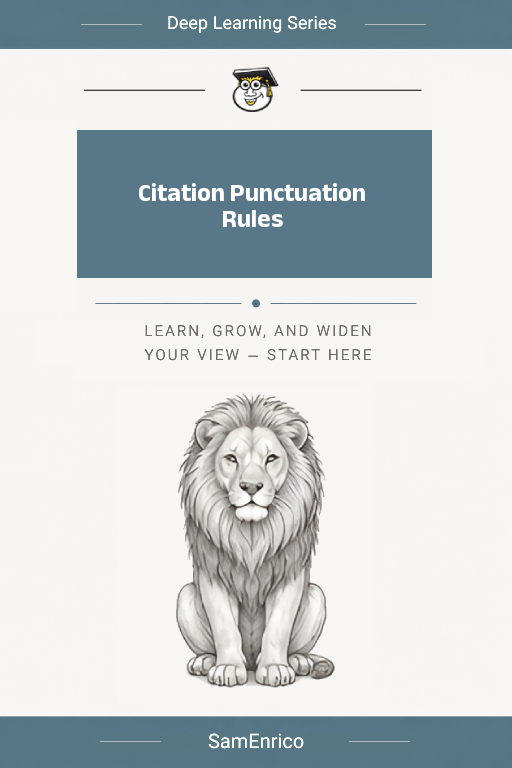
Citation Punctuation Rules eBook
Place periods, commas, and quotation marks correct
by Ralph Danica
Place periods, commas, and quotation marks correctly before or after citations in sentences.
Formats
Free sample
Chapter 1: The Invisible War...–- Every time you write a sentence that borrows someone else’s words, you enter a battlefield you did not know existed. The weapons are small—a period here, a comma there, a pair of quotation marks hovering like parentheses. But the casualties are real: lost credibility, marked-down papers, rejected manuscripts, and the quiet humiliation of being told your punctuation is “distracting.” You are not alone. Millions of writers—students, academics, journalists, and authors—fight this same invisible war every day. They cite their sources correctly.
They quote accurately. They format their bibliographies with care. And then, somewhere between the closing quotation mark and the final period, everything falls apart.The problem is not laziness. The problem is not a lack of intelligence or effort. The problem is that no one ever taught you the secret logic that governs how periods, commas, and quotation marks behave when citations enter the room.
And worse, the rules seem to contradict themselves. You have probably seen a sentence like this:Correct: Smith argues that “the data are conclusive” (45).But wait—you were also taught that periods always go inside quotation marks in American English. You remember that rule from elementary school. “Always put the period inside the quotes,” your teacher said. So why does the period in the example above sit outside the quotation mark, after the parentheses?
And what happens if you quote a question? Or a fragment? Or if the citation appears in the middle of a sentence rather than at the end? The more you learn, the more confused you become.This chapter exists to end that confusion. Before we can master the specific rules of citation punctuation—which we will cover in detail throughout this book—we must first understand the deeper conflict that creates all the confusion in the first place.
That conflict is a war between two competing punctuation philosophies: the American system and the British system. Everything else in this book flows from understanding this one foundational split.The Great Split: Two Worlds, One Punctuation Mark The United States and Great Britain are two nations separated by a common language, as the saying goes. Nowhere is that separation more visible—and more maddening for writers—than in the placement of periods and commas relative to quotation marks. In American English, periods and commas almost always go inside the closing quotation mark. In British English (also called “logical punctuation”), they go inside only if they belong to the quoted material; otherwise, they go outside.
That is the entire war in one sentence.Consider this simple sentence without any citation:American: She called the movie “boring,” but I disagreed.British: She called the movie ‘boring’, but I disagreed.Notice the difference. The American version places the comma inside the closing quotation mark after the word “boring.” The British version places the comma outside the closing quotation mark (and uses single quotation marks instead of double, though that is a separate convention). Both are correct in their respective systems. Both are incorrect if you mix them.Now introduce a citation, and the war escalates dramatically. In American academic writing—which follows the conventions of the MLA Handbook, the Chicago Manual of Style, and the Publication Manual of the American Psychological Association—the default rule is that periods and commas belong inside quotation marks.
However, when a parenthetical citation follows the quotation, the period moves outside the quotation mark and after the citation. That is not a contradiction; it is an exception born of necessity. The citation creates a new grammatical unit that must be closed before the sentence can end.To see why this exception exists, imagine the chaos if the period stayed inside. You would have a quotation mark, then a period, then a space, then a parenthesis, then a citation, then a closing parenthesis, and then… nothing. The sentence would look like this:Incorrect: Smith argues that “the data are conclusive.” (45)That sentence has a period inside the quotation mark and a closing parenthesis with nothing after it.
Grammatically, the sentence has not ended because the period belongs to the quoted sentence inside the quotation marks, not to the larger sentence that contains the citation. The citation is stranded. The reader does not know whether the citation is part of the quoted material or part of your own sentence. The correct version solves this by moving the period to the very end, after the citation:Correct: Smith argues that “the data are conclusive” (45).Now the period serves its proper function: it ends the entire sentence, not just the quoted portion. The quotation marks close after “conclusive,” the parenthetical citation follows immediately, and the period closes everything.
This is the Golden Rule of citation punctuation, which we will explore in depth in Chapter 3.But here is where the invisible war becomes truly treacherous: the American system’s default rule (periods and commas inside quotation marks) conflicts directly with the citation exception (period after the citation, outside the quotation mark). Writers who learned the default rule internalize it so deeply that they reflexively place periods inside quotation marks even when a citation follows. Their muscle memory betrays them. They write “no significant effect.” (Smith 12) and never notice the error because it looks correct based on what they learned in grade school. They have become casualties of the invisible war without ever knowing they were fighting.The Typographical Origins: Why Americans Put Periods Inside To understand why Americans and British differ, we must travel back to the era of metal type and printing presses.
In the late nineteenth century, American typesetters faced a mechanical problem: the periods and commas of the day were tiny metal slugs that could easily break if they were placed at the end of a line of type, hanging outside the quotation mark. To protect these delicate marks, typesetters began placing them inside the quotation marks, where the surrounding metal provided structural support. The British, using different presses and different typefaces, did not face the same breakage risk. Their typesetters continued placing punctuation logically, based on grammar rather than mechanics.What began as a practical solution to a mechanical problem became a entrenched convention. American publishers standardized the “inside” rule, and generations of American schoolchildren learned it as an immutable law of grammar.
The British kept the “logical” system. Neither is inherently superior. Both are arbitrary conventions that have persisted for more than a century.The problem for modern writers is that we now live in a global, digital publishing environment. You might write a paper for an American professor using MLA style, submit an article to a British journal using Oxford style, and post on social media where both conventions collide. You might read a British novel that uses single quotation marks and outside punctuation, then write an APA paper that requires double quotation marks and inside punctuation for commas but outside punctuation for periods when citations are present.
The cognitive load is enormous.Why Citations Break the “Inside” Rule Now we arrive at the central paradox that this book exists to resolve. If American English demands that periods and commas go inside quotation marks, why do citations force the period to…
This is the end of the free sample. Get the eBook to keep going. Buy now
About this book
Details
- Author
- Ralph Danica
- Publisher
- SamEnrico
- Language
- English
- Genre
- Non-Fiction, Student's Shortcut, Punctuation
- Released
- 2026-06-01
- Pages (approx.)
- 159
- Available as
- eBook, Audiobook

Read better in the ZLOADR app
Your eBooks on your phone or tablet. Sign in with your SamEnrico account and start reading.
More by Ralph Danica
 Candy Crush Compulsive PlayRalph Danica$11.99
 Job Candidate Nonverbal TipsRalph Danica$11.99
 Gambling Financial RecoveryRalph Danica$11.99
 Antwerp Vault Breach NightRalph Danica$11.99
 The Career Break Confidence GuideRalph Danica$11.99
 Remote Work MeditationRalph Danica$11.99
 Doe Network Matching TechniquesRalph Danica$11.99
 Leg Stretching GuideRalph Danica$11.99
 The Grand Alliance: Marlborough’s Gambit and the Birth of Modern WarfareRalph Danica$11.99
 The Ballot Box Conspiracy: When Votes Vanished in 1876Ralph Danica$11.99
 A Collector's Handbook to the Rover Ten (1939-40)Ralph Danica$11.99
 How to Produce Musical TrianglesRalph Danica$11.99
You may also like
 Hong Kong Handover 1997Dunn Johnnie$11.99
 Zumba For Postnatal Recovery CourseNeal Christian$11.99
 Zumba for BeginnersLadner Nikia$11.99
 YouTube Comment Mining GuideHumes Pandora$12.99
 Worry Box MeditationCarlin Rudy$11.99
 Workplace Stress MeditationNguyen Lynn$11.99
 Workplace Stress and Sleep RepairHawley Ivory$11.99
 Workplace Perfectionism CureDelaney Jeffry$11.99
 Workplace Injustice Anger GuideWallen Isabelle$11.99
 Work Addiction and Burnout LinkGreenwood Ester$11.99
 Women in Yoga and WellnessBeattie Galina$11.99
 Women in Stand Up ComedyChun Evangeline$11.99