
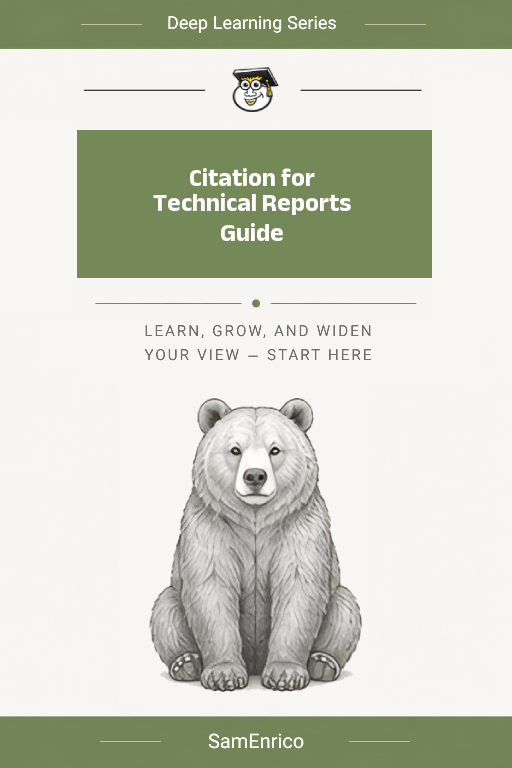
Non-FictionStudent's ShortcutReport Citation
Citation for Technical Reports Guide eBook
Reference white papers, industry research, and org
by Beebe Chet
Reference white papers, industry research, and organizational publications.
Formats
Free sample
Chapter 1: The Gray Lit Trap--It starts with a blank line in your reference list and a slowly rising sense of panic.You have been staring at the same PDF for twelve minutes. The white paper in front of you is polished, data-dense, and cited by three other sources you are already using. But the PDF has no publication date in any obvious place. The cover page shows a consulting firm’s logo but no individual author. The URL in your browser is a hundred and forty-seven characters of session gibberish that will expire by tomorrow morning.
And the style guide on your desk — the one you have dog-eared and highlighted and whispered apologies to — dedicates exactly two paragraphs to “gray literature,” neither of which mentions white papers, industry reports, or anything produced by a market research firm.You are not alone.This chapter is called The Gray Lit Trap because the problem is not that you are bad at citations. The problem is that the rules you learned for books and journal articles do not work for technical reports, white papers, and industry research. And every minute you spend trying to force a white paper into a book citation template is a minute stolen from your actual research.The trap has four jaws. First, gray literature lacks the standard metadata that traditional sources provide: no ISBN, no ISSN, no volume numbers, and often no clear publication date. Second, authorship is ambiguous — was the report written by the named executive on the cover, the research team credited on page eight, or the consulting agency that produced it for a client?
Third, the documents themselves are ephemeral: white papers disappear from corporate websites, industry reports move behind paywalls, and government publications are reorganized or delisted without warning. Fourth, and most dangerously, the major style guides treat gray literature as an afterthought. APA’s Section 10.4 gives you four templates, none of which fit a Gartner Magic Quadrant. Chicago scatters its gray literature guidance across fourteen different sections, burying working papers in 14.223 and preprints in 14.219. NLM covers technical reports but assumes you are citing a government document with a clear report number, not a marketing white paper with no date.The result is predictable: researchers guess.
They improvise. They copy citations from other papers that are themselves wrong. And then their work gets questioned — not on its substance, but on its references.This book exists because the guessing has to stop.The Researcher Who Lost Forty-Five Minutes Let me tell you about Sarah. She is a senior analyst at a mid-sized consulting firm, and she is not a real person — she is a composite of every researcher I have watched struggle with gray literature citations. But her story is true in aggregate.Sarah was writing a market assessment for a client in the renewable energy sector.
She needed to cite three sources: a white paper from a major consulting firm, an industry report from a subscription database, and a technical memorandum from a government research laboratory. She had the APA 7th Edition manual open on her desk. She had three browser tabs open with citation generators. She had a deadline in four hours.She spent forty-five minutes on the white paper alone.The white paper had a title like “The Future of Grid-Scale Storage” and listed six “contributors” on the second page, but no single author. The copyright line read “© 2023 Global Energy Consulting” but the PDF footer showed “Prepared for the Energy Storage Association.” Was the author Global Energy Consulting?
The Energy Storage Association? The six named contributors? Sarah did not know. She tried the citation generator built into her reference manager. It produced a template that treated the white paper as a book chapter, complete with a fake publisher location that did not exist.
She tried the citation button on the consulting firm’s website. It gave her a URL that had already expired.Forty-five minutes. For one citation.The industry report took another twenty minutes. It came from a database called IBISWorld, which she accessed through her university’s library portal. The report had a report number — “IBISWorld Report OD5678” — but the database also added its own header information.
Was IBISWorld the publisher or just the distributor? The APA manual did not say. She found a blog post that suggested treating database reports as “archival sources,” but the blog post was from 2015 and referenced a version of APA that had been replaced twice over.By the time Sarah finished her reference list, she had lost over an hour to citation guesswork. She was frustrated, less confident in her work, and quietly resentful that something as seemingly simple as citing a source had become such an obstacle.Sarah’s story matters because her experience is not unusual. In surveys of business researchers and technical writers, citation formatting consistently ranks among the top three frustrations of the writing process.
And gray literature is the primary culprit — not because the sources are hard to find, but because the rules for citing them are scattered, inconsistent, and often silent.Why Books and Journals Are Easy (And Gray Literature Is Not)To understand why gray literature citations are so frustrating, you have to understand what makes traditional citations work. A book has a title page with four essential pieces of information: author, title, publisher, and publication date. A journal article has a similar package, plus a volume number, issue number, and page range that pinpoints the exact location of the source. These elements are standardized across millions of publications. When you open a book published by Oxford University Press, you know exactly where to find the copyright date, the edition number, and the publisher’s city.
The system is designed for consistency.Gray literature was not designed at all. It was produced to be read, not cited. A white paper is a marketing document first and a research source second. An industry report is a product sold to paying subscribers, not a scholarly artifact meant for permanent preservation. A government technical memorandum is written by a team of engineers who are more concerned with accuracy than with formatting their names according to APA guidelines.
These documents are not broken; they are just built for different purposes.Consider the differences systematically.ISBNs and ISSNs. Every commercially published book has an International Standard Book Number — a unique identifier that links to metadata about the book. Every journal has an International Standard Serial Number. Gray literature has neither. You cannot look up a white paper by ISBN because no ISBN exists.
You cannot find an industry report’s ISSN because there is none. The identifiers that make traditional citation so straightforward are simply absent.Authorship. A book credits one to three authors on the cover. A journal article lists every author in a standardized byline. Gray literature credits “Global Knowledge Teams,” “Thought Leadership Councils,” “Research Divisions,” and occasionally no one at all.
Some white papers are written by freelance writers who are not credited anywhere. Others are produced by consulting firms but signed by client executives. The APA manual’s guidance on group authors — “cite the group name” — assumes that the group is a stable, identifiable entity. But what…
This is the end of the free sample. Get the eBook to keep going. Buy now
About this book
Details
- Author
- Beebe Chet
- Publisher
- SamEnrico
- Language
- English
- Genre
- Non-Fiction, Student's Shortcut, Report Citation
- Released
- 2026-05-30
- Pages (approx.)
- 152
- Available as
- eBook, Audiobook

Read better in the ZLOADR app
Your eBooks on your phone or tablet. Sign in with your SamEnrico account and start reading.
More by Beebe Chet
 Collaboration Tools GuideBeebe Chet$11.99
 Lunch Break Reset GuideBeebe Chet$11.99
 Conversation Starters for FuneralsBeebe Chet$11.99
 Anger at Childs LyingBeebe Chet$11.99
 Immigrant Child Museum TripsBeebe Chet$11.99
 UAE Post Interview Follow UpBeebe Chet$11.99
 Dream Species JournalBeebe Chet$11.99
 Prototyping for Problem SolversBeebe Chet$11.99
 Cartier's Crown Jewels: The Rise of a Luxury Empire (1900-1950)Beebe Chet$11.99
 The Dark Web Syndicate: Australia's Cyber Crime UnderworldBeebe Chet$11.99
 How to Produce Oil MediumBeebe Chet$11.99
 A Collector's Handbook to the Standard Flying TenBeebe Chet$11.99
You may also like
 Hong Kong Handover 1997Dunn Johnnie$11.99
 Zumba For Postnatal Recovery CourseNeal Christian$11.99
 Zumba for BeginnersLadner Nikia$11.99
 YouTube Comment Mining GuideHumes Pandora$12.99
 Worry Box MeditationCarlin Rudy$11.99
 Workplace Stress MeditationNguyen Lynn$11.99
 Workplace Stress and Sleep RepairHawley Ivory$11.99
 Workplace Perfectionism CureDelaney Jeffry$11.99
 Workplace Injustice Anger GuideWallen Isabelle$11.99
 Work Addiction and Burnout LinkGreenwood Ester$11.99
 Women in Yoga and WellnessBeattie Galina$11.99
 Women in Stand Up ComedyChun Evangeline$11.99