
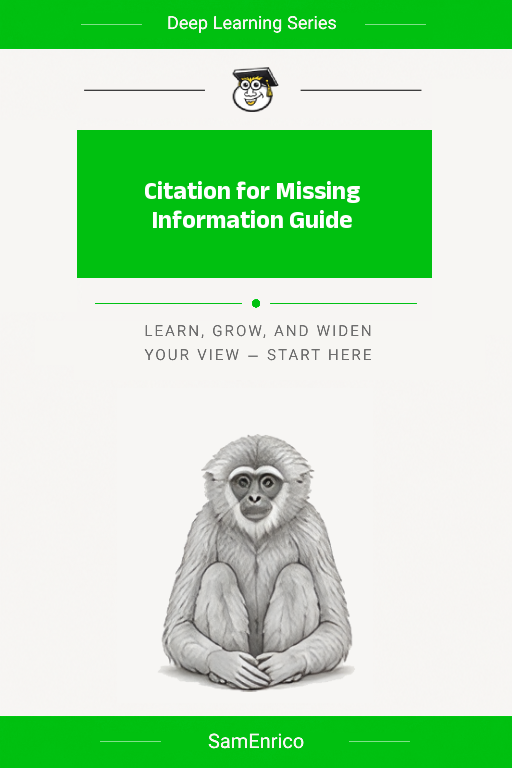
Non-FictionStudent's ShortcutMissing Data
Citation for Missing Information Guide eBook
Handle sources missing publisher, place, or page n
by Harms Ester
Handle sources missing publisher, place, or page numbers across all styles.
Formats
Free sample
Chapter 1: The Broken Promise--–- Every citation is a promise. When you write “(Smith, 2020, p. 45)” or place a footnote at the end of a sentence, you are making a contract with your reader. The promise is simple: If you go looking for this source, you will find exactly what I found, at exactly the location I used. That promise holds the entire edifice of academic integrity together.
Break it once, and you might get away with it. Break it systematically, and you are no longer a researcher—you are a storyteller who happens to use footnotes.But here is the dirty secret that no style manual wants to admit: most sources are broken. Not morally broken, not intellectually dishonest, but structurally broken. They arrive in your hands missing critical information. A PDF from a government website with no author.
A scanned nineteenth-century pamphlet with no publisher. A blog post that has somehow survived for eight years without a date stamp. A Kindle book that paginates differently on every device. A tweet from an account that has since been deleted, leaving only a screen name and a ghost.The official style manuals—APA, MLA, Chicago, Harvard—were written for a world that no longer exists. That world had printed books with title pages that listed the author, publisher, city, and year in clear, standardized locations.
That world had journals with consecutive page numbers and physical archives. That world did not have the internet, PDFs, EPUBs, or deleted Reddit threads. And yet, those manuals expect you to apply their rules to sources they never anticipated.This book exists because the manuals failed you. They hide the rules for missing information in appendices, footnotes, and obscure online supplements. They assume that missing data is the exception rather than the rule.
They write as if every source you encounter will be as tidy as a 1985 university press monograph. But you and I know better. You are working with webpages that have no author, PDFs that have no date, and sources that exist only as a URL and a prayer.This chapter will teach you how to think about missing information before you try to fix it. You will learn why some missing elements are catastrophic while others are trivial. You will learn where to look for hidden metadata before you give up.
And you will learn the single most important rule of ethical citation: Never invent what you cannot find.Welcome to the real world of citation. The manuals lied to you. Let's fix that.The Four Pillars of Every Citation Every citation, regardless of style, rests on four foundational pieces of information. Think of these as the legs of a table. Remove one leg, and the table can still stand—awkwardly, perhaps, but it stands.
Remove two, and you are balancing on a precipice. Remove three, and you have nothing but a flat board on the floor.Pillar One: Author. Who created this work? An individual person? A corporation?
A government agency? A pseudonymous screen name? A collective like “Anonymous” or “Staff Writer”? The author is the first piece of information most citation styles ask for, and when it is missing, the entire structure of the citation shifts.Pillar Two: Date. When was this work created, published, or last updated?
Dates establish currency, context, and intellectual history. A medical study from 1995 is not the same as a medical study from 2025, even if the author and title are identical. When the date is missing, you lose the ability to position the source in time.Pillar Three: Location. In the physical world, location meant two things: the city where a book was published and the name of the publisher. In the digital world, location has become more complex.
It can mean a DOI (digital object identifier), a stable URL, a database name, a repository, or a physical archive. Location is the answer to the question: Where can my reader go to find this source?Pillar Four: Retrieval. This is the most misunderstood pillar. Retrieval information tells the reader where within the source you found your specific evidence. Page numbers are the classic form, but paragraph numbers, section headings, chapter numbers, timestamps, and even line counts can serve the same function.
Without retrieval information, your reader knows that you used a source but not where to look for your claim.These four pillars appear in every citation style, though they are ordered and formatted differently. APA puts the date immediately after the author. MLA puts the date near the end. Chicago puts the date wherever it pleases, depending on the note or bibliography entry. Harvard invents its own rules from institution to institution.
But the pillars themselves are universal.Here is what you need to internalize before you read another word of this book: You will almost never have all four pillars complete. Real-world sources are messy. Government reports omit authors. Webpages omit dates. Scanned documents omit page numbers.
Conference proceedings omit publishers. Your job is not to complain about this reality. Your job is to apply consistent, ethical, style-appropriate rules to fill the gaps.The Hierarchy of Loss: What Hurts and What Doesn't Not all missing pillars are created equal. Losing your car keys is annoying. Losing your passport before an international flight is a crisis.
The same principle applies to missing citation data. Some missing information can be fixed with a simple workaround. Other missing information requires you to rethink whether you should use the source at all.Low Severity – Missing Page Numbers. This is the most common and least damaging gap. Digital sources often lack stable pagination.
E-books reflow. PDFs are scanned without OCR. Websites have no pages at all. The solution is straightforward: use paragraph numbers, section headings, chapter numbers, or timestamps instead. Every major style manual has a rule for this.
Chapter 6 of this book is devoted entirely to solving the missing page problem. For now, know that you can almost always salvage a citation that lacks page numbers.Medium Severity – Missing Date. This is where things get trickier. A source without a date is a source without a temporal context. In some fields (history, medicine, technology), a missing date can render a source unusable.
In other fields (philosophy, literary criticism, mathematics), an undated source might still be perfectly acceptable if the content is timeless. The style manuals offer tools like “n.d.” (no date), “ca.” (circa), and retrieval dates as workarounds. But you must make a judgment call: does this source need a date to be credible? Chapter 3 walks you through this decision.High Severity – Missing Publisher. A missing publisher raises red flags, especially for books and reports.
Publishers provide authority, quality control, and verifiability. A book with no publisher listed could be self-published, vanity-pressed, or entirely fabricated. That said, many perfectly legitimate sources lack publishers: websites, blog posts, government documents, and institutional reports often have no traditional publisher. The key distinction is whether the missing publisher indicates a lack of authority or merely a different publishing model. Chapter 5 separates legitimate missing publishers from concerning ones.Maximum Severity – Missing Author.
This is the hardest gap to fix gracefully. When a source has no author, you lose the ability to attribute…
This is the end of the free sample. Get the eBook to keep going. Buy now
About this book
Details
- Author
- Harms Ester
- Publisher
- SamEnrico
- Language
- English
- Genre
- Non-Fiction, Student's Shortcut, Missing Data
- Released
- 2026-05-29
- Pages (approx.)
- 150
- Available as
- eBook, Audiobook

Read better in the ZLOADR app
Your eBooks on your phone or tablet. Sign in with your SamEnrico account and start reading.
More by Harms Ester
 Immigrant Web Design EmpireHarms Ester$11.99
 Foot Direction MeaningHarms Ester$11.99
 Watching Parents Struggle JobsHarms Ester$11.99
 Verbal Abuse ScarsHarms Ester$11.99
 Teen Peer Pressure ResilienceHarms Ester$11.99
 Dream Fitness LogHarms Ester$11.99
 Finasteride GuideHarms Ester$11.99
 Conversation Starters for IntrovertsHarms Ester$11.99
 Blitzkrieg of the Danube: Prince Eugene's Triumph at Zenta (1697)Harms Ester$11.99
 The Siege of Handan: Qin's Brutal GambitHarms Ester$11.99
 How to Produce Office Furniture SetsHarms Ester$11.99
 How to Produce a Clothes DryerHarms Ester$11.99
You may also like
 Hong Kong Handover 1997Dunn Johnnie$11.99
 Zumba For Postnatal Recovery CourseNeal Christian$11.99
 Zumba for BeginnersLadner Nikia$11.99
 YouTube Comment Mining GuideHumes Pandora$12.99
 Worry Box MeditationCarlin Rudy$11.99
 Workplace Stress MeditationNguyen Lynn$11.99
 Workplace Stress and Sleep RepairHawley Ivory$11.99
 Workplace Perfectionism CureDelaney Jeffry$11.99
 Workplace Injustice Anger GuideWallen Isabelle$11.99
 Work Addiction and Burnout LinkGreenwood Ester$11.99
 Women in Yoga and WellnessBeattie Galina$11.99
 Women in Stand Up ComedyChun Evangeline$11.99