
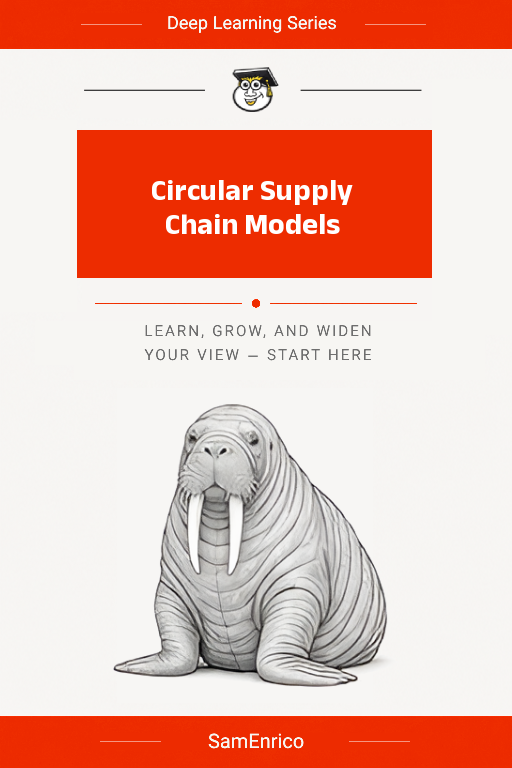
Non-FictionAnnual CheckupCircularReverse Logistics
Circular Supply Chain Models eBook
Transition to circular supply chains including rev
Transition to circular supply chains including reverse logistics and recycled material sourcing to reduce disruption risk.
Formats
Free sample
Chapter 1: The Fragile Thread--–- On a Tuesday morning in March 2021, a supply chain director at one of the world’s largest automakers watched a single email change everything. The message, which arrived at 6:47 AM from a longtime semiconductor supplier in Taiwan, contained just three sentences: “Due to unforeseen production constraints, we are suspending all shipments of microcontroller units effective immediately. We will provide updates on a weekly basis. We regret the inconvenience.” Within seventy-two hours, that one email had idled three assembly plants, put 8,000 workers on temporary furlough, and shaved $500 million from the company’s quarterly forecast. The director had done everything right by traditional supply chain standards: dual sourcing, safety stock, long-term contracts, and a dedicated risk management team.
None of it mattered. The supply chain hadn’t broken because of poor management. It had broken because it was linear—and linear chains snap when you pull on them hard enough.This is a book about why linear supply chains are failing and how circular models offer a way out. But before we get to solutions, we need to sit with the problem. We need to understand, in visceral and financial detail, why the “take-make-dispose” model that powered industrial growth for a century has become the single greatest source of disruption risk for modern businesses.
This chapter diagnoses the inherent vulnerabilities of the linear economy: dependence on virgin raw materials, disregard for product returns, and the illusion that supply chains can be both efficient and fragile at the same time. By the end, you will see your own supply chain differently. You will see the weak points you have been trained to ignore. And you will understand why circularity is not an environmental luxury but an operational necessity.The Myth of the Smooth Flow For decades, supply chain professionals were taught a seductive story. The story went like this: raw materials flow from mines and farms to factories, where they become products.
Products flow to distribution centers, then to stores, then to customers. Customers use the products and eventually discard them. The end. The diagram on every Power Point slide showed arrows pointing in one direction: left to right, top to bottom, from extraction to disposal. It was clean.
It was predictable. It was a lie.The lie was not intentional. For much of the twentieth century, the linear model worked reasonably well because raw materials were abundant, labor was cheap, and no one thought much about what happened after a product left the store. But the assumptions that made linear chains work have collapsed, one by one, over the past two decades. Abundance became scarcity.
Cheap became expensive. And “out of sight, out of mind” became “out of compliance, out of business” as regulators began demanding accountability for waste.The linear model’s fundamental vulnerability is its dependency on continuous forward flow. A linear supply chain is like a garden hose with no shutoff valve: water flows in one direction, and the only way to stop a leak is to turn off the source. When a disruption occurs—a factory fire, a port closure, a trade war, a pandemic—there are no alternative pathways built into the system. Returns are seen as anomalies to be processed as quickly and cheaply as possible, not as resources to be recaptured.
Waste is shipped to landfills or incinerators, taking with it the embedded energy, labor, and materials that went into making the product in the first place.This is not an efficient system. It is a fragile one dressed in efficient clothing.The Hidden Costs of Virgin Dependency The most obvious vulnerability of the linear model is its reliance on virgin raw materials. Every product begins with extraction: mining, logging, drilling, farming. These activities are subject to a level of volatility that would be considered insane in any other business context. Commodity prices swing by fifty percent or more in a single year.
Geopolitical events can cut off access to critical materials overnight. Labor strikes, export restrictions, and environmental regulations appear with little warning.Consider the case of rare earth elements—seventeen metallic elements essential for everything from electric vehicle motors to fighter jet radar systems. China controls approximately eighty-five percent of global rare earth refining capacity. In 2010, amid a territorial dispute with Japan, China halted rare earth exports for several weeks. Prices spiked by as much as five hundred percent for some elements.
Companies that had no alternative sources were forced to pay whatever the market demanded or shut down production. The disruption lasted only a month, but the lesson lasted much longer: when you depend on a single source for a critical material, you are not managing risk. You are gambling.The automotive industry learned this lesson again in 2021, when the semiconductor shortage revealed just how deeply linear thinking had penetrated even the most sophisticated supply chains. The shortage had many causes: pandemic-related factory closures, a surge in demand for consumer electronics, and a fire at a Renesas plant in Japan. But the root cause was structural.
Automakers had spent years optimizing their supply chains for efficiency—just-in-time delivery, minimal inventory, single-source components. They had not spent equivalent effort building resilience. When the flow stopped, it stopped everywhere.A senior executive at a German automaker described the experience to me in stark terms: “We had maps showing every supplier down to the raw material level. We had risk registers with hundreds of line items. We had crisis simulation exercises every quarter.
None of it prepared us for a shortage of five-cent chips that cost us billions.” The problem was not a lack of information. The problem was a lack of optionality. Linear chains have no branches. When the main channel clogs, everything stops.The Returns Black Hole If virgin dependency is the linear model’s most obvious vulnerability, its treatment of returns is the most insidious. In a linear system, returns are an afterthought—a problem to be minimized, not an opportunity to be optimized.
The typical retail return flows something like this: a customer returns a product to a store or ships it back to an online retailer. The product sits in a returns bin for days or weeks. Eventually, someone opens the box, glances at the product, and makes a snap judgment: resell, refurbish, recycle, or trash. In many cases, the least expensive option is also the least value-preserving: throw it away and take the loss.The economics of this approach are astonishingly bad. According to industry data, the average cost of processing a returned product is between twenty and thirty percent of the product’s original price.
For low-cost items, the cost of processing can exceed the item’s residual value, making disposal the rational financial choice—even though it destroys all the value embedded in the product. The result is that billions of dollars of usable products end up in landfills every year because the reverse logistics system was designed for speed and low cost, not for value recovery.But the cost of poor returns management goes beyond the direct financial loss. There is also the opportunity cost. Every product that is thrown away represents a missed opportunity to recapture materials, refurbish for resale, or harvest components…
This is the end of the free sample. Get the eBook to keep going. Buy now
About this book
Details
- Author
- Ramey Elisabeth
- Publisher
- SamEnrico
- Language
- English
- Genre
- Non-Fiction, Annual Checkup, Circular, Reverse Logistics
- Released
- 2026-06-01
- Pages (approx.)
- 141
- Available as
- eBook, Audiobook

Read better in the ZLOADR app
Your eBooks on your phone or tablet. Sign in with your SamEnrico account and start reading.
More by Ramey Elisabeth
 Influencer Induced Inadequacy GuideRamey Elisabeth$11.99
 Hopelessness In Persistent DepressionRamey Elisabeth$11.99
 Congress Member Retirement PlanningRamey Elisabeth$11.99
 Executive Hostage Survival Field GuideRamey Elisabeth$11.99
 Self Hypnosis Labor PainRamey Elisabeth$11.99
 The Velvet Underground’s Exploding Factory: Warhol, Nico, and the Birth of PunkRamey Elisabeth$11.99
 The Curse of the Black Pharaoh: Tutankhamun’s Tomb and the Race for Ancient SecretsRamey Elisabeth$11.99
 Middlesex University DubaiRamey Elisabeth$12.99
 Robotic Process Automation DeveloperRamey Elisabeth$11.99
 Understanding Congenital MegaloureterRamey Elisabeth$17.99
 How to Become a Cell TesterRamey Elisabeth$11.99
You may also like
 Hong Kong Handover 1997Dunn Johnnie$11.99
 Zumba For Postnatal Recovery CourseNeal Christian$11.99
 Zumba for BeginnersLadner Nikia$11.99
 YouTube Comment Mining GuideHumes Pandora$12.99
 Worry Box MeditationCarlin Rudy$11.99
 Workplace Stress MeditationNguyen Lynn$11.99
 Workplace Stress and Sleep RepairHawley Ivory$11.99
 Workplace Perfectionism CureDelaney Jeffry$11.99
 Workplace Injustice Anger GuideWallen Isabelle$11.99
 Work Addiction and Burnout LinkGreenwood Ester$11.99
 Women in Yoga and WellnessBeattie Galina$11.99
 Women in Stand Up ComedyChun Evangeline$11.99