
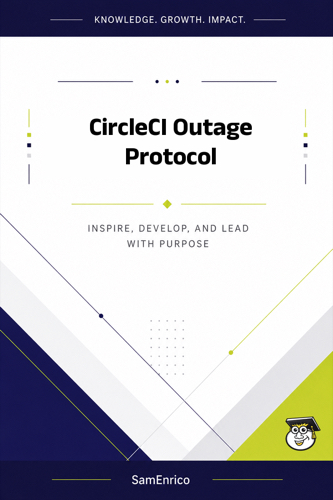
Non-FictionCrisis ManagementContinuous Integration
CircleCI Outage Protocol eBook
Emergency CI/CD when CircleCI fails, including loc
Emergency CI/CD when CircleCI fails, including local orchestration and manual approvals.
Formats
Free sample
Chapter 1: The Glass Pipeline--The alert came in at 2:17 AM on a Tuesday, which was predictable enough—production systems, like small children and house cats, reserve their most spectacular failures for the hours when only one engineer is awake. Maya Chen, senior platform engineer at a fintech startup called Veridian, rolled over in bed and squinted at her phone. The Pager Duty notification read: [CRITICAL] Circle CI API: 100% error rate for 5 minutes. She blinked twice, waiting for the second notification that would inevitably follow—the one that would tell her it was a false alarm, that the monitoring system had hiccupped, that she could go back to sleep.The second notification never came. The third one did.
Then a fourth, from a different monitoring system. Then her Slack started blowing up with automated alerts from Datadog, from New Relic, from the custom dashboard her team had built specifically for CI/CD observability. By the time her feet hit the floor at 2:23 AM, she already knew what the next hour would look like: a frantic scramble, a growing sense of helplessness, and eventually, a conversation with her VP of Engineering about why a critical security patch could not be deployed to production.What Maya did not yet know was that this particular outage would last eight hours. That eight hours of downtime on Circle CI—just the CI/CD orchestrator, not the production application itself—would cost Veridian $2.1 million in contract penalties. That the security patch she was trying to deploy would have fixed a vulnerability that an attacker would discover and exploit exactly thirty-one days later.
That she would spend the next six months rebuilding her team's deployment pipelines from scratch, and that the experience would fundamentally change how she thought about the relationship between her code, her tools, and her own ability to ship software when it mattered most.This book is for everyone who has ever been Maya. It is for the on-call engineer whose phone lights up at 2:17 AM. It is for the platform team that discovers, mid-outage, that their carefully curated CI/CD pipeline is a single point of failure disguised as a cloud convenience. It is for the engineering manager who must explain to the CEO why deployments are halted indefinitely while they wait for a third-party vendor to resolve an incident. And it is for the architect who understands, perhaps too late, that treating their CI/CD orchestrator as a reliable utility rather than a critical distributed system was a bet that the house was always going to win.This chapter establishes the fundamental premise of this book: your CI/CD pipeline is a single point of failure, and most engineering teams do not realize it until it is too late.
We will explore why this blind spot exists, what it costs when it is exposed, and how shifting your mindset from "passive user" to "active incident commander" transforms not just your outage response but your entire approach to delivery resilience.The Convenience Trap Continuous Integration and Continuous Delivery (CI/CD) systems emerged to solve a real problem: the chaos of manual deployments, the friction of integrating code changes, the impossibility of maintaining quality without automation. Circle CI, along with its competitors Git Hub Actions, Git Lab CI, Jenkins, and Build Kite, transformed software delivery from an artisanal craft into an industrial process. You push code. Tests run. Artifacts build.
Deployments happen. A green checkmark appears. Everyone moves on.This convenience came with an invisible cost: the normalization of dependency. When a system works reliably for months or years, engineers stop thinking about it. The CI/CD pipeline becomes like electricity or running water—a utility that is simply there, assumed to function, noticed only when it fails.
And when it fails, the realization is brutal: you cannot build. You cannot test. You cannot deploy. Your entire software delivery capability grinds to a halt.Consider the language teams use to describe their CI/CD systems. "The build failed" is a statement about code quality.
"The tests are flaky" is a complaint about reliability. But when the orchestrator itself goes down, the language shifts to helplessness: "Circle CI is having issues." "We're waiting for them to fix it." "There's nothing we can do."This passive voice reveals the underlying assumption: the CI/CD vendor is responsible for uptime, and the engineering team is merely a passenger. But this assumption is dangerous because it conflates two entirely different concepts: reliability (the vendor's ability to keep their service running) and resilience (your ability to deliver software when that service fails).A reliable vendor has high uptime. A resilient team has a protocol for the remaining uptime. This book is about building the latter, regardless of the former.Defining the Glass Pipeline To understand why CI/CD systems are uniquely dangerous single points of failure, we need a precise definition.
A glass pipeline is a delivery system that shatters completely when its central orchestrator fails. It has three characteristic properties:Property 1: Total dependency. Every build, test, and deployment passes through a single logical control point. There is no alternative path, no fallback mechanism, no way to bypass the orchestrator.Property 2: Assumed reliability. The system was designed with the implicit assumption that the orchestrator would always be available.
Failure modes were not considered, because failure was not considered plausible.Property 3: Opacity during failure. When the orchestrator fails, the engineering team cannot see what is happening, cannot determine which jobs succeeded or failed, and cannot safely resume operations without manual intervention.Most CI/CD implementations are glass pipelines. Circle CI, for all its strengths, is often the glass. Teams write config.yml files that define their entire delivery process—from dependency installation to production deployment—as a series of jobs orchestrated by Circle CI's cloud infrastructure. When that infrastructure becomes unavailable, the pipeline does not degrade gracefully.
It does not fall back to a secondary orchestrator. It does not continue running locally. It simply stops.This is not a criticism of Circle CI. Any centralized orchestrator, whether self-hosted Jenkins or cloud-native Git Hub Actions, exhibits the same properties. The problem is not the vendor; the problem is the architecture of dependency.The Cost of an Outage: Beyond the Obvious When Maya's phone lit up at 2:17 AM, she understood the immediate cost of the outage: she would lose sleep, she would be stressed, she would spend her morning in incident response mode.
But the full cost of a CI/CD outage extends far beyond the immediate pain, cascading through the organization in ways that are often invisible until an incident post-mortem brings them to light.Direct Financial Costs Let us start with the numbers. Based on anonymized data from the State of Software Delivery reports and public incident post-mortems, a one-hour CI/CD outage at a mid-sized technology company (100-500 engineers) typically generates the following direct costs:Idle engineering time: Multiply the number of engineers blocked from deploying by their average hourly compensation. For a team of 50 engineers blocked for one hour, at an average loaded cost of $100 per hour, this is $5,000. This is the smallest cost.Delayed revenue: If your organization deploys on a schedule that ties code changes to revenue (e.g., feature…
This is the end of the free sample. Get the eBook to keep going. Buy now
About this book
Details
- Author
- German Golden
- Publisher
- SamEnrico
- Language
- English
- Genre
- Non-Fiction, Crisis Management, Continuous Integration
- Released
- 2026-06-11
- Pages (approx.)
- 152
- Available as
- eBook, Audiobook

Read better in the ZLOADR app
Your eBooks on your phone or tablet. Sign in with your SamEnrico account and start reading.
More by German Golden
 TM For LonelinessGerman Golden$11.99
 Carbohydrate Craving ControlGerman Golden$11.99
 The Spaced Repetition HandbookGerman Golden$11.99
 Stress Decompression Rituals TogetherGerman Golden$11.99
 Whispers of the Silk Road: The Lost Caravans of ZaytonGerman Golden$11.99
 Shipping SupervisorGerman Golden$11.99
 How to Start a Blocks Made of Graphite Business (Beginners Guide)German Golden$11.99
 ARIPO Member States ListGerman Golden$12.99
 Angel Investor Red FlagsGerman Golden$12.99
 Understanding Warkany SyndromeGerman Golden$17.99
You may also like
 Hong Kong Handover 1997Dunn Johnnie$11.99
 Zumba For Postnatal Recovery CourseNeal Christian$11.99
 Zumba for BeginnersLadner Nikia$11.99
 YouTube Comment Mining GuideHumes Pandora$12.99
 Worry Box MeditationCarlin Rudy$11.99
 Workplace Stress MeditationNguyen Lynn$11.99
 Workplace Stress and Sleep RepairHawley Ivory$11.99
 Workplace Perfectionism CureDelaney Jeffry$11.99
 Workplace Injustice Anger GuideWallen Isabelle$11.99
 Work Addiction and Burnout LinkGreenwood Ester$11.99
 Women in Yoga and WellnessBeattie Galina$11.99
 Women in Stand Up ComedyChun Evangeline$11.99