
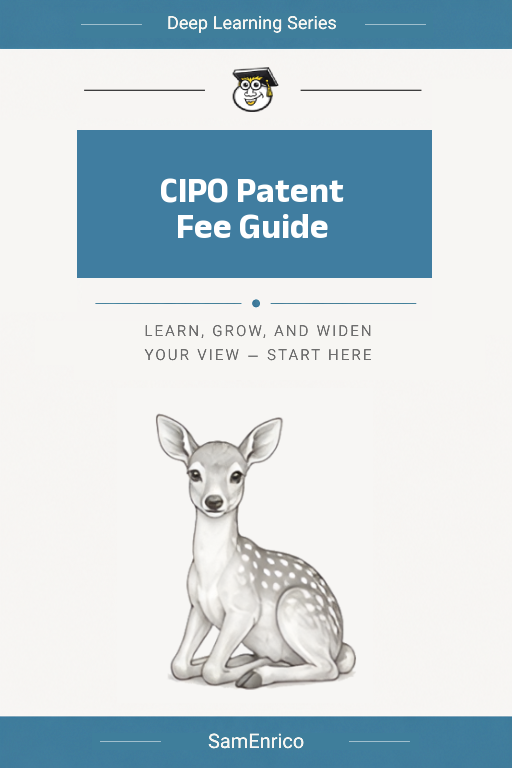
Non-FictionAnnual CheckupCIPOCanada
CIPO Patent Fee Guide eBook
Navigate Canadian Intellectual Property Office fee
Navigate Canadian Intellectual Property Office fees including filing, examination, and annual maintenance costs.
Formats
Free sample
Chapter 1: The $10,000 Mistake--–- Every year, thousands of Canadian inventors, startups, and small businesses pay thousands of dollars more than they ever should to the Canadian Intellectual Property Office. They file their patents in good faith, pay what they think are the required fees, and assume the government is charging them a fair price. They are wrong.–- The difference between what most inventors pay and what they actually owe over the life of a patent can exceed $10,000. That is not a typo. Ten thousand dollars.
For a solo inventor working out of a garage, that is the difference between protecting an idea and abandoning it. For a small startup with three employees, that is the difference between hiring a developer or burning out. And for a university researcher, that is the difference between commercializing a discovery or watching it gather dust in a filing cabinet.–- This book exists because that $10,000 gap is not the result of complex legal maneuvering or hidden loopholes buried deep in the Patent Act. It is the result of simple, predictable, and entirely avoidable mistakes that CIPO has no incentive to warn you about. The government collects fees.
It does not offer advice. It does not send you a letter saying, "By the way, you qualify for a 60 percent discount if you check this box." It processes what you submit and charges you accordingly. If you overpay, that is your problem.–- This chapter dismantles the single most expensive misconception in Canadian patent law: that patent protection is only for deep-pocketed corporations with legal departments and unlimited budgets. It introduces the 20+ Year Financial Roadmap, a framework that will guide you through every dollar you will ever pay to CIPO from the moment you file your application to the moment your patent expires or is abandoned. It analyzes the 2026 fee updates under the Service Fees Act, specifically the 2.7 percent annual adjustment that most applicants never notice but that compounds into real money over two decades.
And it tells the story of a hypothetical Canadian startup that saved over $10,000 across the life of a patent not by hiring a better lawyer or inventing a better mousetrap, but by simply understanding how the fee schedule works and timing their payments strategically.–- By the end of this chapter, you will never look at a CIPO fee notice the same way again.The Invention Tax You Did Not Know You Were Paying–- Let us start with a simple question. If two inventors file identical patent applications on the same day, both receive approval, and both maintain their patents for the full term, should they pay the same total amount to CIPO?–- The intuitive answer is yes. The same service from the same government for the same product should cost the same. But the correct answer is no. In fact, the difference can exceed $10,000.–- Consider two inventors.
Inventor A pays standard fees across the board, requests examination immediately upon filing, and never thinks about timing. Inventor B qualifies for small entity status, delays examination until the fourth year, keeps their application lean, and pays attention to deadlines. They both end up with a granted patent. They both enjoy 20 years of exclusive rights. But Inventor B pockets an extra $10,400 over the life of the patent.
That money goes back into research, marketing, or simply keeping the lights on.–- This is what I call the Invention Tax. It is not a tax in the legal sense. CIPO does not impose a special surcharge on unsophisticated filers. But the effect is the same. People who do not know the rules pay more.
People who do know the rules pay less. And the government happily collects from both.–- The Invention Tax operates through four primary mechanisms, each of which will be explored in depth throughout this book. First, entity status. Most inventors do not realize that CIPO charges small entities roughly 40 to 60 percent less than standard entities for every single fee. Filing, examination, issuance, annuities—all of it.
If you qualify as a small entity and fail to claim that status, you are effectively volunteering to pay double. Second, timing. CIPO gives you four full years to request examination. Paying earlier rather than later costs you the time value of money without any benefit to your patent. Third, claim and page management.
CIPO charges per claim over 20 and per page over 100. Many applicants draft as if length does not matter, then receive a bill for hundreds or thousands of dollars in surcharges. Fourth, maintenance strategy. Annuities start low and escalate dramatically. Knowing when to abandon a patent can save more money than filing one in the first place.–- The best part?
None of these mechanisms requires a law degree. None requires expensive software or consulting. They require only that you know the rules exist and that you follow a simple set of strategic principles. That is what this book delivers.The 20+ Year Financial Roadmap–- Before you can save money on patent fees, you need to understand where your money is going. The 20+ Year Financial Roadmap provides a complete picture of every dollar you will ever pay to CIPO over the life of a Canadian patent, organized into four distinct phases.–- Phase One is Filing.
This is the moment you submit your application to CIPO and pay the initial filing fee. In 2026, that fee ranges from 241.24forasmallentityfilingelectronicallyto241.24 for a small entity filing electronically to 241.24forasmallentityfilingelectronicallyto595.06 for a standard entity filing on paper. But the filing phase also includes potential surcharges for excess pages and excess drawings, which many applicants discover only after receiving an unexpected bill. The filing phase sets your priority date, locks in your small entity status eligibility, and starts the clock on every deadline that follows.–- Phase Two is Examination. This phase begins when you request examination and continues until CIPO either grants or rejects your patent.
The examination fee in 2026 ranges from 482.48forasmallentitywithaqualifyinginternationalsearchto482.48 for a small entity with a qualifying international search to 482.48forasmallentitywithaqualifyinginternationalsearchto1,190.13 for a standard entity without one. But examination also triggers excess claim fees: 58.97perclaimover20forsmallentities,58.97 per claim over 20 for small entities, 58.97perclaimover20forsmallentities,117.94 for standard entities. If you request expedited examination, add another 744.10.Ifyourapplicationisrejectedandyourequestcontinuedexamination,addanother744.10. If your application is rejected and you request continued examination, add another 744.10.Ifyourapplicationisrejectedandyourequestcontinuedexamination,addanother1,190.13 each time. This phase is where most strategic decisions happen and where most money is either saved or wasted.–- Phase Three is Grant and Issuance.
This is the final step before you own a patent. The issuance fee in 2026 is 181.20forsmallentitiesand181.20 for small entities and 181.20forsmallentitiesand446.03 for standard entities. This fee is often overlooked because applicants assume that once CIPO approves the patent, the hard part is over. But missing this fee can cause your application to be abandoned after years of work and thousands of dollars in sunk costs.–- Phase Four is Maintenance. This is the longest phase and, for most patents, the most expensive.
Annuities are due every year starting from the second anniversary of your filing date. They start low: 60.26forsmallentitiesinyearstwothroughfour.Buttheyescalatedramatically.Byyears15through19,smallentitiespay60.26 for small entities in years two through four. But they escalate dramatically. By years 15 through 19, small entities pay 60.26forsmallentitiesinyearstwothroughfour.Buttheyescalatedramatically.Byyears15through19,smallentitiespay271.26 per…
This is the end of the free sample. Get the eBook to keep going. Buy now
About this book
Details
- Author
- Calvin Danyel
- Publisher
- SamEnrico
- Language
- English
- Genre
- Non-Fiction, Annual Checkup, CIPO, Canada
- Released
- 2026-05-29
- Pages (approx.)
- 129
- Available as
- eBook, Audiobook

Read better in the ZLOADR app
Your eBooks on your phone or tablet. Sign in with your SamEnrico account and start reading.
More by Calvin Danyel
 Vegan Eating Out GuideCalvin Danyel$11.99
 The Remote Work Shutdown RitualCalvin Danyel$11.99
 The Golfer Flexibility PlanCalvin Danyel$11.99
 Resentment and Jealousy HandbookCalvin Danyel$11.99
 John Quincy Adams Diplomatic JourneyCalvin Danyel$11.99
 Echoes of the Forbidden: The Ballad of Romeo and Juliet’s 21st-Century GhostsCalvin Danyel$11.99
 The Cosmic Whisperers: How the Wow! Signal Almost Changed HumanityCalvin Danyel$11.99
 Understanding Cronkhite–Canada SyndromeCalvin Danyel$17.99
 Value Proposition ScriptCalvin Danyel$12.99
 Restaurant Assistant ManagerCalvin Danyel$11.99
 How to Start a Pre-shave Lotion Business (Beginners Guide)Calvin Danyel$11.99
You may also like
 Hong Kong Handover 1997Dunn Johnnie$11.99
 Zumba For Postnatal Recovery CourseNeal Christian$11.99
 Zumba for BeginnersLadner Nikia$11.99
 YouTube Comment Mining GuideHumes Pandora$12.99
 Worry Box MeditationCarlin Rudy$11.99
 Workplace Stress MeditationNguyen Lynn$11.99
 Workplace Stress and Sleep RepairHawley Ivory$11.99
 Workplace Perfectionism CureDelaney Jeffry$11.99
 Workplace Injustice Anger GuideWallen Isabelle$11.99
 Work Addiction and Burnout LinkGreenwood Ester$11.99
 Women in Yoga and WellnessBeattie Galina$11.99
 Women in Stand Up ComedyChun Evangeline$11.99