
Non-FictionBusiness BriefProduct
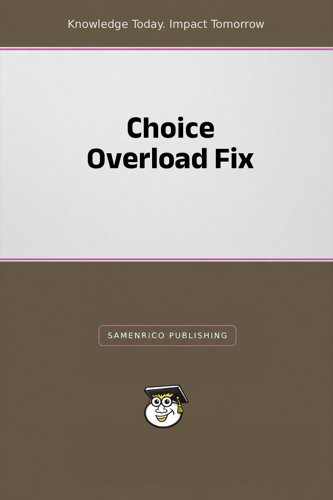
Choice Overload Fix eBook
Limit options to increase conversion rates and cus
Limit options to increase conversion rates and customer satisfaction.
Formats
Free sample
Chapter 1: The Jam That Broke E-Commerce--–- In 2000, two psychologists set up a tasting booth in a gourmet market in Menlo Park, California. They had no idea they were about to discover a truth that would save businesses billions of dollars. Their experiment was simple. On some days, they offered shoppers a tasting of six varieties of jam. On other days, they offered twenty-four varieties.
The result should have been obvious: more choices, more sales. That is not what happened.The twenty-four-jam booth attracted 60 percent more foot traffic. People loved the idea of endless options. But when it came time to buy, only 3 percent of those visitors actually purchased. The six-jam booth, by contrast, converted 30 percent of the people who stopped.
That is a tenfold increase in sales from offering fewer choices.This is the Jam Paradox. And it is the single most misunderstood force in modern commerce.Every day, business owners make the same mistake. They add more products, more colors, more pricing tiers, more features, more everything. They believe that abundance drives revenue. They believe that giving customers more options is a form of generosity.
They are wrong. Generosity without structure is cruelty. Abundance without curation is confusion.This book exists because you are probably losing money right now without knowing it. Somewhere in your business—on your pricing page, in your product catalog, at your checkout—you are showing customers twenty-four jams when you should be showing them six. And they are walking away.The Million-Dollar Mistake Let me tell you about a founder named Sarah.
She ran a direct-to-consumer skincare brand. Business was steady but not growing. She read the conventional wisdom: more products mean more revenue. So she expanded her line from seven products to twenty-two. She added serums for every skin type, moisturizers for every season, masks for every concern.
Her website looked impressive. Her inventory was massive. Her sales crashed.Traffic stayed the same. But conversion rates dropped by 40 percent. Customers would land on her site, scroll through twenty-two products, read reviews, compare ingredients, and then leave.
They were not leaving because her products were bad. They were leaving because they could not decide. Every day, Sarah lost thousands of dollars to a problem she did not even know existed.She is not alone. In 2024, a study of over fifty thousand e-commerce transactions found that for every ten additional products added to a category page, conversion rates dropped by an average of 8 percent. Not because the products were worse.
Because the choice became harder.The cost of choice overload is invisible. You do not see the customer who stared at your pricing page for three minutes and then closed the tab. You do not see the shopper who added a product to their cart, saw three shipping options, and abandoned the purchase. You do not see the subscriber who compared your four plans, got overwhelmed, and picked a competitor with only two.But those customers are real. And they are leaving money on your table.The Science of the Frozen Brain Why does this happen?
To understand choice overload, you must first understand how the human brain makes decisions.The prefrontal cortex is the part of your brain responsible for complex thinking, planning, and decision-making. It is powerful but limited. Cognitive scientists have discovered that the prefrontal cortex can only hold about seven pieces of information at once, plus or minus two. This is Miller's Law, named after psychologist George Miller, who published his findings in 1956. Seventy years later, the number has not changed.
Your brain is not a supercomputer. It is a bottleneck.When you present a customer with more than seven options, their brain does not get smarter. It gets slower. It begins to compare, contrast, eliminate, and reconsider. Each additional option adds cognitive load.
At a certain point, the system crashes. This is called decision paralysis.Barry Schwartz, a psychologist at Swarthmore College, spent decades studying this phenomenon. In his book The Paradox of Choice, he argued that while autonomy and choice are central to Western culture, an excess of options produces three negative effects.First, decision paralysis. Customers freeze and buy nothing. They cannot choose, so they do not choose.Second, post-purchase regret.
Customers who struggle to choose are less happy with what they eventually buy. They spend days wondering if a better option existed. They imagine the road not taken.Third, reduced satisfaction. Customers blame themselves for not choosing better. They feel anxious and inadequate.
They associate those negative emotions with your brand.Schwartz identified two customer archetypes. Maximizers are people who seek the absolute best option. They compare every variable, read every review, and agonize over every decision. Satisficers are people who look for "good enough." They find an option that meets their needs and stop searching. Choice overload disproportionately breaks Maximizers.
They freeze, they regret, and they rarely come back.Here is the painful truth. Most business owners design their offerings for Maximizers. They add more options because they believe Maximizers want abundance. But Maximizers are exactly the customers who suffer most from abundance. You are not helping them.
You are torturing them.The 64 Percent Rule In 2015, a team of e-commerce researchers analyzed over sixty thousand product recommendation sessions. They tracked what happened when customers were shown different numbers of recommendations on a product page. The results were stunning.When customers were shown six recommendations, the purchase probability was high. When they were shown twelve recommendations, purchase probability dropped. When they were shown twenty-four recommendations, purchase probability fell by 64 percent.
This became known as the 64 percent rule.But here is what the headlines miss. The 64 percent is an average. It masks enormous variation. For low-involvement products—items that are cheap, familiar, and low-risk, like jam or toothpaste or phone chargers—the effect is even larger. Customers make these purchases on autopilot.
Interrupting autopilot with too many choices causes catastrophic drops in conversion.For high-involvement products—items that are expensive, complex, or unfamiliar, like electronics or medical devices or financial services—the effect is smaller but still significant. Experts in these categories actually want more options. Novices still freeze.This is the nuance that most books ignore. And it is why Chapter 4 of this book is dedicated entirely to the question: when does less work, and when does it backfire? For now, understand that the 64 percent rule is real, but it is not absolute.
Your job is to know where your business falls on the spectrum.Why More Choice Feels Like Generosity If choice overload is so damaging, why do so many businesses get it wrong?The answer is psychological. Adding options feels productive. It feels like growth. When a business owner adds a new product, they can touch it, photograph it, list it, and feel a sense of accomplishment. When they add a new pricing tier, they can point to the expanded lineup and feel strategic.Subtracting options feels destructive.
It feels like failure. Cutting a product means admitting it was a mistake. Reducing a pricing tier means admitting it was unnecessary. Simplifying a menu means admitting it was confusing.We are wired to prefer addition over subtraction. In a famous study, researchers asked participants to improve…
This is the end of the free sample. Get the eBook to keep going. Buy now
About this book
Details
- Author
- Fishman Wiley
- Publisher
- SamEnrico
- Language
- English
- Genre
- Non-Fiction, Business Brief, Product
- Released
- 2026-06-07
- Pages (approx.)
- 129
- Available as
- eBook, Audiobook

Read better in the ZLOADR app
Your eBooks on your phone or tablet. Sign in with your SamEnrico account and start reading.
More by Fishman Wiley
 Tobacco Cessation Strategies That WorkFishman Wiley$11.99
 Dialectical Behavior Therapy SkillsFishman Wiley$11.99
 Workplace Stress and Toxic CultureFishman Wiley$11.99
 The Blood Covenant: The Madness of the Maji-Maji ProphetsFishman Wiley$11.99
 Advanced Analytics for Marketing StrategyFishman Wiley$11.99
 SaaS Specific Terms WorkbookFishman Wiley$12.99
 How to Produce Art and Collectible ItemsFishman Wiley$11.99
 A Beginners Guide to Knattleikr (Volume 1)Fishman Wiley$11.99
You may also like
 Hong Kong Handover 1997Dunn Johnnie$11.99
 Zumba For Postnatal Recovery CourseNeal Christian$11.99
 Zumba for BeginnersLadner Nikia$11.99
 YouTube Comment Mining GuideHumes Pandora$12.99
 Worry Box MeditationCarlin Rudy$11.99
 Workplace Stress MeditationNguyen Lynn$11.99
 Workplace Stress and Sleep RepairHawley Ivory$11.99
 Workplace Perfectionism CureDelaney Jeffry$11.99
 Workplace Injustice Anger GuideWallen Isabelle$11.99
 Work Addiction and Burnout LinkGreenwood Ester$11.99
 Women in Yoga and WellnessBeattie Galina$11.99
 Women in Stand Up ComedyChun Evangeline$11.99