
Non-FictionBusiness BriefPhilanthropy
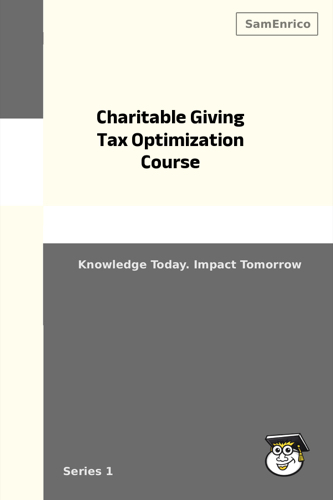
Charitable Giving Tax Optimization Course
Bunch donations, use donor-advised funds, and cont
by Ryder Hee
Bunch donations, use donor-advised funds, and contribute appreciated stock for maximum deductions.
Formats
About this book
Free sample
Chapter 1: The Giving Gap--– For most of my career as a financial planner, I watched generous people leave money on the table. Not because they were careless or uninformed, but because the tax code had quietly changed around them, and no one had explained what that meant for their charitable giving.I remember sitting across from a retired schoolteacher named Margaret. She had donated $500 each month to her church for twenty years—$120,000 in total. She was proud of her consistency, and rightfully so. But when I asked whether she had ever received a tax benefit for those donations, she looked confused.
“I give to charity,” she said. “Isn’t that supposed to be deductible?”It should have been. But in the previous tax year, Margaret had taken the standard deduction of $14,600. Her $6,000 in annual church donations never touched her tax return. She had received exactly zero tax benefit for twenty years of faithful giving.
Meanwhile, her neighbor across the street—who gave exactly the same amount—had saved nearly $2,000 in taxes each year by using a simple strategy that Margaret had never heard of.That conversation changed how I thought about charitable giving. It wasn’t about generosity versus stinginess. It was about knowledge. The tax code rewards strategic donors and punishes everyone else. And the gap between what you could be saving and what you are actually saving is what I call the Giving Gap.This chapter will show you how to measure your own Giving Gap, understand why the tax system works against most donors, and prepare you for the three strategies that will close that gap for good.The $10,000 Mistake You Don’t Know You’re Making Let’s start with a simple question that most donors never ask: What does a donation actually cost me?If you write a check for $1,000 to a food bank, you are out $1,000.
That is simple math. But if you receive a tax deduction for that $1,000, your after-tax cost drops. In the 24% tax bracket, that $1,000 donation costs you only $760. The government essentially rebates you $240. Your generosity…
This is the end of the free sample. Get the eBook to keep going. Buy now
Contents
- Chapter 1
- Chapter 2
- Chapter 3
- Chapter 4
- Chapter 5
- Chapter 6
- Chapter 7
- Chapter 8
- Chapter 9
- Chapter 10
- Chapter 11
- Chapter 12
Details
- Author
- Ryder Hee
- Publisher
- SamEnrico
- Language
- English
- Genre
- Non-Fiction, Business Brief, Philanthropy
- Released
- 2026-06-11
- Pages (approx.)
- 155
- Available as
- eBook, Audiobook

Read better in the ZLOADR app
Your eBooks on your phone or tablet. Sign in with your SamEnrico account and start reading.
More by Ryder Hee
 The Historian Who Preserved StoriesRyder Hee$11.99
 Awwwards Site ComparisonRyder Hee$11.99
 Anger At Child Leaving HomeRyder Hee$11.99
 SAMe Supplement GuideRyder Hee$11.99
 SaaS Accounting GuideRyder Hee$11.99
 Parenting Stress From Homework BattlesRyder Hee$11.99
 Berlin Conference 1884 PartitionRyder Hee$11.99
 Ludwig Guttmann: The Father of the Paralympic Games and the Birth of Adaptive SportsRyder Hee$11.99
 The Lion's Ink: Black Poets Who Shaped CivilizationsRyder Hee$11.99
 How to Produce Suspension TrainersRyder Hee$11.99
 How to Produce a Hay ElevatorRyder Hee$11.99
 Online Exam Device RequirementsRyder Hee$12.99
You may also like
 Hong Kong Handover 1997Dunn Johnnie$11.99
 Zumba For Postnatal Recovery CourseNeal Christian$11.99
 Zumba for BeginnersLadner Nikia$11.99
 YouTube Comment Mining GuideHumes Pandora$12.99
 Worry Box MeditationCarlin Rudy$11.99
 Workplace Stress MeditationNguyen Lynn$11.99
 Workplace Stress and Sleep RepairHawley Ivory$11.99
 Workplace Perfectionism CureDelaney Jeffry$11.99
 Workplace Injustice Anger GuideWallen Isabelle$11.99
 Work Addiction and Burnout LinkGreenwood Ester$11.99
 Women in Yoga and WellnessBeattie Galina$11.99
 Women in Stand Up ComedyChun Evangeline$11.99