
Non-FictionBiographySilent Film
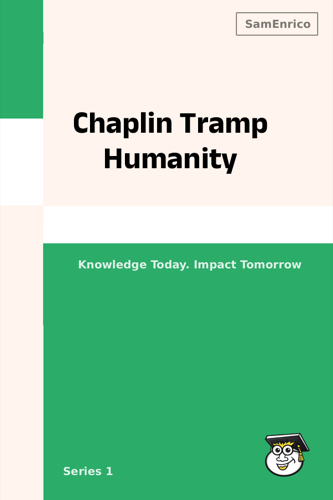
Chaplin Tramp Humanity eBook
Dissect the comedy, pathos, and social commentary
by Rollins Wes
Dissect the comedy, pathos, and social commentary of the Little Tramp.
Formats
Free sample
Chapter 1: The Paradox Suit...--The first time you see him, he is walking. That is the important part. He is not running, though he will run later. He is not falling, though he will fall spectacularly. He is simply walking—a shuffle, really, a peculiar rhythm that belongs to no one else.
The hat is too small. The coat is too tight. The pants are impossibly, almost mathematically, too large. The mustache is a postage stamp pasted above a mouth that has not decided whether to smile or weep. In one hand, a bamboo cane that he does not need but cannot release.
He is the Little Tramp, and he has just walked out of a Keystone studio in 1914 onto a screen that would never be the same.But let us pause here, because this is where most books about Chaplin make their first mistake. They treat the costume as decoration. They describe it, nod approvingly, and move on to the films. This chapter makes the opposite argument: the costume is the philosophy. It is not what the Tramp wears.
It is who he is. Every item of clothing is a contradiction, and every contradiction is a political statement. The too-tight coat says I aspire to respectability. The too-baggy pants say but my body refuses. The cane says I am a gentleman.
The shuffle says I have never been inside a gentleman's club. The Tramp is not a man in a costume. He is a walking manifesto, and the manifesto reads: I am no one, therefore I am everyone.To understand this paradox, we must perform what the Russian literary theorist Mikhail Bakhtin called a forensic reading of the grotesque body. For Bakhtin, the classical body—the body of Greek statuary, of Renaissance painting, of every advertisement you have ever seen—is closed, finished, polished. It does not leak.
It does not stumble. It does not age. The grotesque body, by contrast, is open, unfinished, and embarrassing. It eats, defecates, sweats, and falls down. It is the body of Rabelais, of Shakespeare's fools, of every carnival clown who ever tripped over his own feet.
The Tramp's body is grotesque in exactly this sense. His pants sag because he has no belt—not because he forgot one, but because belts belong to people with steady incomes. His coat pulls at the shoulders because it was tailored for someone who eats regular meals. His mustache is a joke about masculinity: a few scraps of hair pretending to be a statement. And yet.
And yet he walks with the cane like a king. That is the genius. The Tramp borrows the signifiers of power and wears them so badly that they become something else entirely: a mirror held up to the powerful, reflecting not their glory but their absurdity.The Accidental Icon Let us be precise about the costume's origins, because the story matters. Chaplin did not design the Tramp in a moment of inspiration. He assembled him from leftovers.
In 1914, working for Mack Sennett's Keystone Studios, Chaplin was just another struggling comedian in a sea of pie-throwing mayhem. He needed a gimmick. According to his autobiography, he walked into the costume department and began grabbing items at random: Fatty Arbuckle's too-large pants (Arbuckle was a heavier man), Charles Chaplin's own too-small coat (he had lost weight), a derby hat that belonged to another actor's father, a mustache made from crepe hair that he had intended to look dignified but that ended up looking like a joke. The cane was a prop from the property department. None of it fit.
None of it matched. And that was the revelation.Chaplin later wrote: "I wanted everything a contradiction: the pants baggy, the coat tight, the hat small, the shoes large." The contradiction was not accidental. It was the first draft of a philosophy. The Tramp would be a failed gentleman—a man who had read about dignity in books but had never been taught how to practice it. His clothes were the evidence of that failure.
They were also, paradoxically, his victory. Because the Tramp did not try to hide his contradictions. He wore them on his body for everyone to see. The banker in his pressed suit hides his hunger, his exhaustion, his terror of losing everything. The Tramp wears his hunger in the sag of his pants.
He wears his exhaustion in the shuffle of his feet. He has nothing to hide because he has nothing at all. That is freedom of a very particular kind.The filmmaker and critic Kyp Harness, in his analysis of Chaplin's early work, notes that the costume "announces the Tramp's relationship to the world before he ever opens his mouth—which is good, because he rarely opens his mouth." The relationship is this: the world demands a uniform. The Tramp wears a parody of that uniform. The world says fit in.
The Tramp says I cannot, so I will make my not-fitting-in into a spectacle. This is not resignation. It is guerrilla warfare conducted through haberdashery.The Hat: Ambition and Its Discontents Consider the derby hat. In 1914, the derby was the headwear of the middle-class clerk—the man who shuffled papers, who tipped his cap to his superiors, who dreamed of a corner office but would die at a shared desk. The derby said: I am respectable, which is to say, I am not poor.
But on the Tramp's head, the derby is too small. It sits atop his skull like a thimble on a thumb. It does not confer respectability; it mocks it. When the Tramp tips his hat to a lady, the gesture is correct, but the hat itself is wrong. He has learned the manners of the bourgeoisie, but he cannot afford the tools.
This is the tragedy of the American Dream compressed into a single accessory.There is a scene in The Kid (1921) that captures this perfectly. The Tramp has been raising an orphaned child, and they are poor—laughably, heartbreakingly poor. At one point, the Tramp tips his hat to a wealthy woman on the street. She ignores him. He tips it again.
She walks faster. He tips it a third time, and the hat falls off, rolling into the gutter. The child retrieves it, brushes it off, and hands it back. The Tramp puts it on, tips it once more, and keeps walking. The joke is on the woman, not the Tramp.
She has money, but she has no manners. He has no money, but he has the form. The hat is too small, but the gesture is perfect. Chaplin understood something that political theorists would spend decades trying to articulate: the powerless often perform the rituals of power more faithfully than the powerful themselves, because the powerless still believe in them.The hat also serves a practical comedic function. Its small size means it falls off easily—a gift to a comedian who built his career on things that fall off, fall down, or fall apart.
When the Tramp runs, the hat stays on for exactly three seconds before tumbling backward. When he fights, the hat becomes a shield, a weapon, a negotiation tool. In The Circus (1928), he…
This is the end of the free sample. Get the eBook to keep going. Buy now
About this book
Details
- Author
- Rollins Wes
- Publisher
- SamEnrico
- Language
- English
- Genre
- Non-Fiction, Biography, Silent Film
- Released
- 2026-06-10
- Pages (approx.)
- 132
- Available as
- eBook, Audiobook

Read better in the ZLOADR app
Your eBooks on your phone or tablet. Sign in with your SamEnrico account and start reading.
More by Rollins Wes
 Self Compassion Body Image WorkbookRollins Wes$11.99
 Parental Divorce Self Care GuideRollins Wes$11.99
 The Senior Spirituality Self Worth GuideRollins Wes$11.99
 Baby Illness Sleep RecoveryRollins Wes$11.99
 The Bloodstained Letters: The First Forensic Breakthrough in Victorian EnglandRollins Wes$11.99
 Understanding Mental Retardation Short Stature Wedge Shaped EpiphysesRollins Wes$17.99
 Sox ComplianceRollins Wes$11.99
 EU AI Act Compliance GuideRollins Wes$12.99
 Promotion Business Case For Remote WorkersRollins Wes$12.99
 How to Become a Truckload CheckerRollins Wes$11.99
You may also like
 Hong Kong Handover 1997Dunn Johnnie$11.99
 Zumba For Postnatal Recovery CourseNeal Christian$11.99
 Zumba for BeginnersLadner Nikia$11.99
 YouTube Comment Mining GuideHumes Pandora$12.99
 Worry Box MeditationCarlin Rudy$11.99
 Workplace Stress MeditationNguyen Lynn$11.99
 Workplace Stress and Sleep RepairHawley Ivory$11.99
 Workplace Perfectionism CureDelaney Jeffry$11.99
 Workplace Injustice Anger GuideWallen Isabelle$11.99
 Work Addiction and Burnout LinkGreenwood Ester$11.99
 Women in Yoga and WellnessBeattie Galina$11.99
 Women in Stand Up ComedyChun Evangeline$11.99