
Non-FictionBusiness BriefAudit Prep
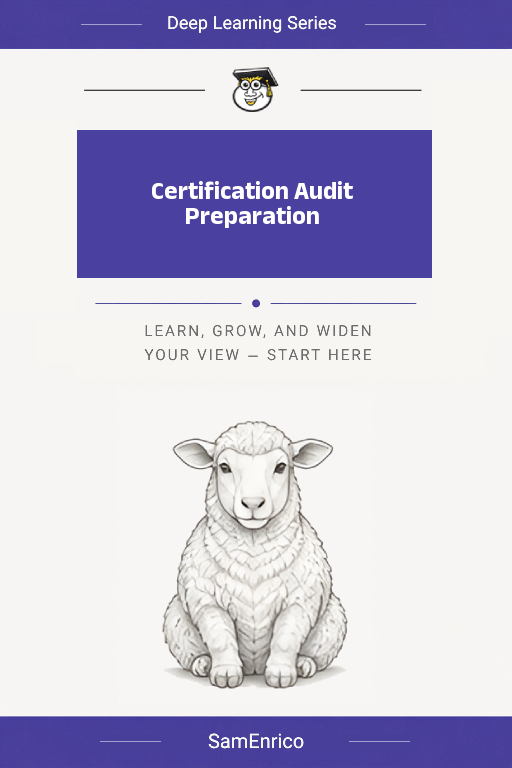
Certification Audit Preparation eBook
Prepare for sustainability certification audits wi
by Bonds Chante
Prepare for sustainability certification audits with document checklists and site readiness.
Formats
Free sample
Chapter 1: The Auditor’s Blindspot--–- The warehouse manager, a 20-year veteran of supply chain logistics, had prepared for the sustainability certification audit for six months. He had three binders, color-coded by requirement. He had a digital folder with 847 documents, each named according to a meticulous convention. He had trained his staff on the company's new sustainability policy. He had done everything the previous certification guide had told him to do.–- He failed the audit in the first hour.–- The auditor, a quiet woman from a certification body in Europe, did not ask to see his binders.
She did not open his digital folder. Instead, she asked to walk the facility. Fifteen minutes into the tour, she stopped at a small storage tank tucked behind the main processing building. The tank was not on the site plot plan the warehouse manager had submitted. It had no label.
It held a blend of certified and uncertified material – a common operational practice that no one had thought to document. The auditor pulled out a digital tablet and typed three words: "Major non-conformity. Scope incomplete."–- Six months of preparation ended because of a tank no one had remembered to mention.–- This story is not unusual. It is, in fact, the most common failure mode in sustainability certification audits. Not fraud.
Not malice. Not incompetence. The single most common reason organizations fail is what this book calls The Auditor’s Blindspot: the gap between what you think you need to prepare and what the auditor is actually trained to find.–- This chapter dismantles that blindspot. It introduces the foundational framework that will govern every page of this book: the Unified Evidence Framework (UEF). And it provides the first diagnostic tool you will need before you spend a single hour on document preparation or site hardening.The Myth of the Checklist–- Most certification preparation guides share a common DNA: they are checklists.
They ask you to collect policy documents, gather training records, assemble mass balance sheets, and then present these items to an auditor who will verify their existence and move on. This model assumes that certification is a box-ticking exercise – a transaction in which evidence is exchanged for approval.–- That assumption is wrong. And it is expensive.–- Professional auditors from schemes like ISCC (International Sustainability and Carbon Certification), ISO (International Organization for Standardization), SBP (Sustainable Biomass Program), and RSB (Roundtable on Sustainable Biomaterials) are not trained to check boxes. They are trained in a methodology called Risk-Based Thinking. Risk-Based Thinking means the auditor does not evaluate every document equally.
Instead, the auditor identifies where the greatest risk of error, omission, or fraud exists – and then concentrates their limited time on those areas.–- Here is what this means for you: if you prepare using a checklist, you will ensure that every document exists. But you will not know which documents the auditor will actually scrutinize. You will not know which gaps will trigger a major non-conformity versus a minor observation. And critically, you will not know which documents can be missing entirely without consequence because they are not relevant to your specific operation.–- The checklist approach treats all evidence as equal. Risk-Based Thinking does not.–- Consider two hypothetical facilities applying for the same ISCC certification.
Facility A is a small biofuel producer with a single feedstock supplier, one processing line, and one customer. Facility B is a large trading company sourcing from 47 suppliers across 12 countries, storing material in three leased warehouses, and selling to 23 customers. A checklist would require the same documents from both facilities. But an auditor applying Risk-Based Thinking will spend 90% of their time at Facility B examining supplier contracts, mass balance reconciliations between warehouses, and chain of custody transfer documentation – because those are the areas where the risk of error is highest. Facility A will receive a much lighter audit touch.–- The facilities that fail are not the ones with missing documents.
The facilities that fail are the ones that cannot distinguish between high-risk and low-risk evidence. They prepare everything equally, which means they prepare nothing with sufficient depth.The Unified Evidence Framework (UEF)–- This book introduces a single, unifying framework that will govern every chapter, every checklist, and every template that follows. It is called the Unified Evidence Framework (UEF) . The UEF replaces the scattered and sometimes contradictory hierarchies found in other certification guides. It is the lens through which you will view every audit requirement, every document, and every site condition from this point forward.–- The UEF consists of five layers.
Each layer builds upon the previous one. Evidence at a higher layer is more persuasive to an auditor than evidence at a lower layer. And crucially, evidence at a lower layer without corresponding evidence at the layer above it is considered orphaned evidence – a condition that triggers automatic scrutiny and often a non-conformity.–- Layer 1: Policy–- A policy is a documented statement of intent. It answers the question: "What do we commit to doing?" A sustainability policy, for example, might state that the organization commits to sourcing 100% certified feedstock by a certain date, or that it will reduce water intensity by 20% over three years.–- Policies are necessary but insufficient. An auditor who sees only a policy – with no evidence of implementation – will note that the organization has intent but cannot prove action.
This is orphaned evidence at Layer 1.–- Layer 2: Procedure–- A procedure is a documented set of step-by-step instructions. It answers the question: "How exactly do we do what we said we would do?" A procedure for mass balance, for example, might specify that every incoming delivery must be weighed, that the weighbridge ticket must be signed by both the driver and the receiving clerk, and that the ticket must be scanned into the document management system within two hours.–- Procedures demonstrate that the organization has thought through implementation. But an auditor who sees a procedure without proof that it was followed will note a gap between intention and reality.–- Layer 3: Proof of Execution–- Proof of execution is the record that a procedure was actually followed. It answers the question: "Can you show me that you did what you said you would do?" Proof of execution includes weighbridge tickets, delivery notes, training attendance sheets, signed inspection logs, dated photographs, and system-generated audit trails.–- This is where most organizations fail. They have beautiful policies and detailed procedures.
They have binders full of them. But when the auditor asks for the corresponding weighbridge tickets from the past six months, the organization produces three of the forty required. The rest are missing, misfiled, or were never created. This is orphaned evidence at Layer 3.–- Layer 4: Competence and Training–- Competence evidence answers the question: "Do the people responsible for executing these procedures actually understand them?" Training records are the most common form of Layer 4 evidence – attendance sheets, certificates of completion, exam scores. But there is a critical distinction that most organizations miss: training records prove attendance, not competence.–- Competence requires demonstration.
An operator who attended a mass balance training session but cannot explain what to do when a weighbridge ticket is…
This is the end of the free sample. Get the eBook to keep going. Buy now
About this book
Details
- Author
- Bonds Chante
- Publisher
- SamEnrico
- Language
- English
- Genre
- Non-Fiction, Business Brief, Audit Prep
- Released
- 2026-05-29
- Pages (approx.)
- 152
- Available as
- eBook, Audiobook

Read better in the ZLOADR app
Your eBooks on your phone or tablet. Sign in with your SamEnrico account and start reading.
More by Bonds Chante
 Emotional Wisdom Aging GuideBonds Chante$11.99
 Gambling Addiction For EntertainersBonds Chante$11.99
 ABCDE Task Ranking SystemBonds Chante$11.99
 Family Recovery Support HandbookBonds Chante$11.99
 Stolen Diamonds RecoveryBonds Chante$11.99
 Soviet Jewish RefusenikBonds Chante$11.99
 ESOP Accounting GuideBonds Chante$11.99
 Sri Sri Ravi ShankarBonds Chante$11.99
 The Silk and Scandal of Rose Bertin: Marie Antoinette’s Fashion RevolutionaryBonds Chante$11.99
 The Enlightenment’s Sky: How Thinkers Shaped the Modern WorldBonds Chante$11.99
 How to Become a Rod-puller And CoilerBonds Chante$11.99
 A Collector's Handbook to the Dkw Meisterklasse Luxus F5Bonds Chante$11.99
You may also like
 Hong Kong Handover 1997Dunn Johnnie$11.99
 Zumba For Postnatal Recovery CourseNeal Christian$11.99
 Zumba for BeginnersLadner Nikia$11.99
 YouTube Comment Mining GuideHumes Pandora$12.99
 Worry Box MeditationCarlin Rudy$11.99
 Workplace Stress MeditationNguyen Lynn$11.99
 Workplace Stress and Sleep RepairHawley Ivory$11.99
 Workplace Perfectionism CureDelaney Jeffry$11.99
 Workplace Injustice Anger GuideWallen Isabelle$11.99
 Work Addiction and Burnout LinkGreenwood Ester$11.99
 Women in Yoga and WellnessBeattie Galina$11.99
 Women in Stand Up ComedyChun Evangeline$11.99