
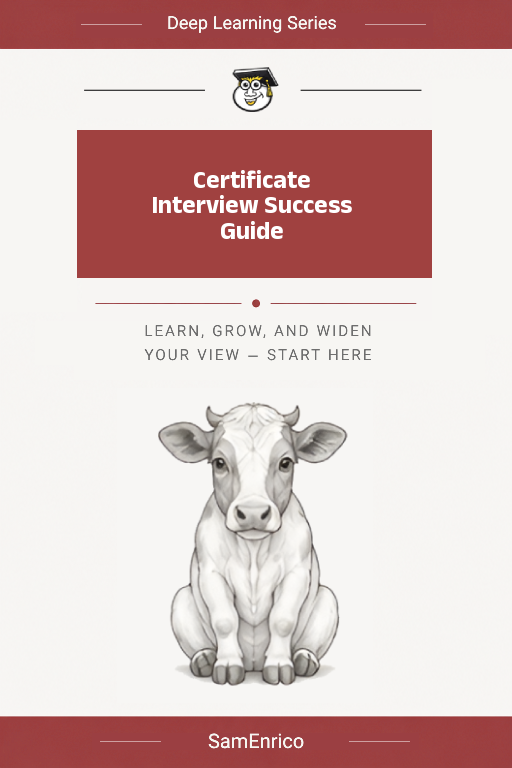
Certificate Interview Success Guide eBook
Explain your certification projects during intervi
Explain your certification projects during interviews and demonstrate skills through portfolio walkthrough.
Formats
Free sample
Chapter 1: The Certification Lie--The certificate arrived in a crisp PDF, your name centered in bold, a golden seal gleaming in the corner. You posted it on Linked In. Your mom commented with three emojis. For exactly forty-eight hours, you felt invincible.Then you applied for a job. And another.
And another. The callbacks came—your resume was fine, your certification was current, your keywords matched the job description. You walked into the first interview with confidence. You had memorized the five pillars, the four stages, the three types of authentication. You could recite the OSI model in your sleep.The interviewer smiled.
Shook your hand. Looked at your resume. Then asked a question that made your stomach drop:"Tell me about a time you actually used this. Not a lab. Not a practice exam.
Something you built that broke, and you fixed it."Silence.You fumbled. You described a multiple-choice scenario you aced. The interviewer's smile froze. They nodded, wrote something down, and moved on. You felt the shift—the invisible door closing.
Three days later, the rejection email arrived. "Strong credential, but we're looking for someone with more hands-on experience."This chapter is about why that happened and how you will never let it happen again.The Paper Certification Trap Let's name the enemy. The Paper Certification Trap is the gap between what a certificate proves and what a job requires. A certificate proves you can study, memorize, and recall information under exam conditions. It proves you can sit still for ninety minutes, manage your time, and select the least-wrong answer from four options.
These are not trivial skills. They require discipline, focus, and domain knowledge.But they are not the skills that keep a system running at 2 AM when the database crashes.Hiring managers have stories. Ask any engineering director for their "paper certification" horror story, and you will hear one within sixty seconds. The certified cloud architect who could not launch an EC2 instance without a wizard. The security-certified candidate who committed an API key to a public Git Hub repo during the technical screen.
The network-certified engineer who could not explain why a packet was dropping between two subnets.These stories spread. They become lore. And they create the single most dangerous force working against you in every interview: institutional skepticism.The interviewer is not skeptical of your effort. They are not skeptical of your intelligence. They are skeptical of the gap between your certificate and your ability to do the actual job.
They have been burned before. They hired someone with the same certification you have, and that person cost the team three weeks of cleanup. That person made the team miss a deadline. That person asked basic questions that the certification supposedly covered.You are not that person. But you have to prove it.The Interviewer's Real Fear (Consolidated Here Once)Let me name what the interviewer is thinking but will never say out loud:"I have a deadline.
My team is overworked. My manager is pressuring me to fill this role. I need someone who can start contributing within weeks, not months. If I hire the wrong person, I will be the one explaining why we missed the quarterly goal. I am afraid of making a mistake."That fear manifests in specific behaviors.
The hostile question. The sudden technical deep-dive. The silence after you finish speaking. The way they glance at their colleague during your answer. None of this is personal.
All of it is fear.Your job in this interview—and in every interview after reading this book—is not to recite what you know. Your job is to replace their fear with relief. You do that by showing them evidence of applied competence, not by listing the domains you studied.This is the central shift this book demands of you. Stop thinking like a student who passed a test. Start thinking like an engineer who solved a problem.The Behavioral Interviewing Logic That Changes Everything There is a reason interviewers ask about your past projects.
It is not because they enjoy hearing stories. It is because decades of industrial-organizational psychology have proven one thing: past specific behavior is the strongest predictor of future performance.Not IQ tests. Not personality assessments. Not multiple-choice exams. Specific, documented, verifiable behavior in a situation similar to the one they are hiring for.When you say "I understand load balancing," you have given them an opinion.
Opinions are cheap. When you say "In my project, I configured an Application Load Balancer with three target groups. The first configuration failed because I misconfigured the health check path. I found the error by reviewing the access logs, fixed the path, and reduced 502 errors by 94%," you have given them evidence.Evidence replaces fear. Evidence creates trust.
Evidence gets you hired.This is why certification alone is a weak signal. It tells the interviewer you are capable of learning. It does not tell them you are capable of doing. The gap between learning and doing is where careers stall and interviews fail.Introducing the P.E.E.L. Method This book is built on a single framework.
Learn it. Practice it. Internalize it until you cannot tell a project story any other way.P.E.E.L. stands for Problem, Experiment, Evidence, Lesson.Let me break down each component.Problem Every project starts with a problem. Not a task.
Not an assignment. A real or simulated business pain point that needed solving. The problem is what makes your story relevant. Without a clear problem, you are just describing activity, not impact.Good problems sound like this:"Manual log analysis took four hours every morning.""The website became unresponsive during peak traffic.""We had no visibility into who accessed sensitive customer data."Bad problems sound like this:"The lab instructions told me to configure an S3 bucket.""I needed to complete the module to get the certificate.""It was the next chapter in the course."If you cannot articulate a problem that a business would pay to solve, you have not built an interview-ready project. You have completed homework.
Homework gets graded. Projects get hired.Experiment The experiment is what you actually did. Your configuration. Your code. Your architecture decision.
This is where most candidates stop. They describe the experiment in loving detail—the commands they ran, the services they used, the settings they adjusted—and assume that is enough.It is not enough. The experiment without context is just noise.Your experiment must be framed as a response to the problem. "I wrote a Python script" is meaningless. "I wrote a Python script to automate log parsing because manual analysis was costing four hours daily" connects experiment to problem.Evidence This is where certified candidates fail most often.
They describe what they did. They do not describe what happened as a result.Evidence is measurable. It is specific. It answers the question "How do you know it worked?" Evidence can be metrics (latency dropped from 200ms to 45ms). Evidence can be logs (zero errors after the fix).
Evidence can be before-and-after comparisons (twelve manual steps reduced to one automated command).If you cannot provide evidence, your experiment might as well have…
This is the end of the free sample. Get the eBook to keep going. Buy now
About this book
Details
- Author
- Runyon Coletta
- Publisher
- SamEnrico
- Language
- English
- Genre
- Non-Fiction, Student's Shortcut
- Released
- 2026-05-30
- Pages (approx.)
- 125
- Available as
- eBook, Audiobook

Read better in the ZLOADR app
Your eBooks on your phone or tablet. Sign in with your SamEnrico account and start reading.
More by Runyon Coletta
 Benzo Information for FamiliesRunyon Coletta$11.99
 Candle Flame Focus GuideRunyon Coletta$11.99
 Sibling Loss Prolonged GriefRunyon Coletta$11.99
 Potassium Heart GuideRunyon Coletta$11.99
 Metta for a Partner's ExRunyon Coletta$11.99
 Immigrant Wellness Studio FounderRunyon Coletta$11.99
 Procrastination Override BlockRunyon Coletta$11.99
 Episodic Buffer TrainingRunyon Coletta$11.99
 Whispers in the Wind: The Enigmatic Ballads of the DjinnRunyon Coletta$11.99
 NVC For Therapy SessionsRunyon Coletta$11.99
 The Day the Internet Broke: How a Single Glitch Reshaped the Digital WorldRunyon Coletta$11.99
 Baba Yaga's Iron Tower: The Witch Who Built the SkyRunyon Coletta$11.99
You may also like
 Hong Kong Handover 1997Dunn Johnnie$11.99
 Zumba For Postnatal Recovery CourseNeal Christian$11.99
 Zumba for BeginnersLadner Nikia$11.99
 YouTube Comment Mining GuideHumes Pandora$12.99
 Worry Box MeditationCarlin Rudy$11.99
 Workplace Stress MeditationNguyen Lynn$11.99
 Workplace Stress and Sleep RepairHawley Ivory$11.99
 Workplace Perfectionism CureDelaney Jeffry$11.99
 Workplace Injustice Anger GuideWallen Isabelle$11.99
 Work Addiction and Burnout LinkGreenwood Ester$11.99
 Women in Yoga and WellnessBeattie Galina$11.99
 Women in Stand Up ComedyChun Evangeline$11.99