
Non-FictionSelf-HelpExecutive Leadership
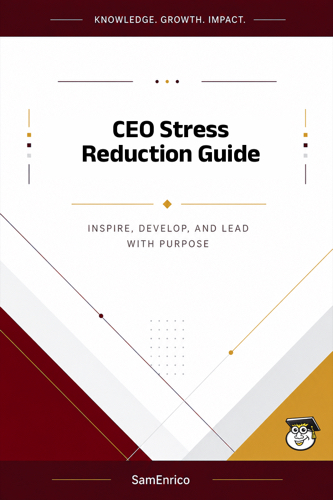
CEO Stress Reduction Guide eBook
Manage board pressure, shareholder expectations, a
Manage board pressure, shareholder expectations, and strategic decisions.
Formats
Free sample
Chapter 1: The Information Bubble--The conference room on the forty-seventh floor had mahogany walls, a table that cost more than most people’s homes, and a silence that should have terrified everyone in it. It was a Tuesday morning in March, and the CEO of a publicly traded logistics company—let us call him David—had just announced a quarterly earnings beat. The board had nodded. The CFO had smiled. The head of investor relations had patted him on the back.
Champagne was poured.Eight weeks later, David was fired.Not for poor performance. Not for scandal. He was fired because a $200 million compliance problem that six people in that room knew about had never reached his ears. The board’s audit committee had been quietly tracking the issue for two quarters. The general counsel had flagged it in a report that somehow never made it to David’s weekly briefing.
The CFO had assumed “someone else” would tell him. And David, sitting in the loneliest room in the world, had no idea.When the board chair finally broke the news in a private call, David’s first reaction was not anger at the problem. It was disbelief. “How could I not have known?” he asked. The chair paused and said something David would later describe as the most honest words ever spoken to him in his career: “Because no one wanted to be the one to tell you.”That is the CEO’s curse.
The more powerful you become, the less truth you hear. Not because people are malicious. Because they are human. They protect themselves. They protect you.
They protect their careers. And in that protection, they build a bubble around you that is impermeable, invisible, and potentially lethal to your company and your sanity.This chapter is about that bubble. It is about why it forms, how it distorts reality, and what you can do today—not next month, not after the next board meeting—to pop it. Because the single greatest source of chronic CEO stress is not the weight of your decisions. It is the weight of the decisions you do not know you are supposed to make.The Loneliest Room in the World The CEO role is unique in organizational life for one reason above all others: everyone filters for you.
Your executive assistant filters your calendar. Your communications team filters your external feedback. Your direct reports filter the information that flows up from their departments. Your board filters its own concerns through layers of politeness and liability avoidance. By the time information reaches you, it has passed through more filters than a NASA clean room.This is not conspiracy.
It is biology. Humans are hardwired to avoid delivering bad news to those with power over their survival. In prehistoric terms, telling the alpha that the hunting grounds were barren was a good way to get exiled from the tribe. In corporate terms, telling the CEO that their pet project is failing or that a compliance issue has been festering for six months feels like a career-limiting move. So the news gets softened.
Or delayed. Or buried entirely.Organizational behavior scholars call this the “mum effect”—the tendency for people to withhold bad news from superiors. The effect is so powerful that studies have shown that when a problem is detected at the middle management level, it takes an average of six weeks and four layers of escalation before the CEO becomes aware. Six weeks. During which time the problem grows, the options shrink, and the CEO continues making strategic decisions based on an increasingly fictional version of reality.David’s story is not an outlier.
It is the norm. For every CEO who gets fired in a public scandal, there are a dozen who are quietly removed because the board lost confidence in their ability to see what was coming. And in almost every case, the CEO did not lack intelligence or effort. They lacked a system for piercing their own information bubble.Consider the anatomy of a typical information bubble. At the bottom of the organization, raw data flows in all directions—customer complaints, operational hiccups, compliance exceptions, competitive threats.
As that information moves upward, it passes through managers whose incentives are to present their domains in the best possible light. A missed delivery becomes a “logistical adjustment.” A customer defection becomes a “strategic realignment.” A compliance warning becomes a “routine inquiry.”By the time the information reaches the executive suite, the sharp edges have been sanded off. The uncertainty has been replaced by confidence intervals that are far too narrow. The problems have been transformed into opportunities. And the CEO sits in a beautifully furnished room, surrounded by nodding heads, believing they have their finger on the pulse of the organization.They do not.
They have their finger on the pulse of a carefully curated performance.Strategic Narcissism: When Silence Feels Like Agreement There is a second force that inflates the information bubble, and it comes from inside the CEO themselves. It is called strategic narcissism, and it is the tendency of leaders to mistake the respectful silence of a boardroom for genuine agreement.The term was coined by a team of organizational psychologists who studied the communication patterns of fifty CEOs over three years. They found a consistent pattern: the longer a CEO served, the less they were challenged in meetings. Directors learned that certain topics triggered defensive reactions. Subordinates learned that certain words led to being shouted at.
Over time, the group adapted by staying silent on difficult topics and nodding along on easy ones.The CEO, noticing no overt disagreement, concluded that everyone was aligned. This was strategic narcissism in action—the belief that your charisma, your logic, or your authority has produced consensus when in reality, you have produced silence.Strategic narcissism is seductive because it feels good. Silence in a boardroom feels like respect. Nodding heads feel like agreement. A lack of open conflict feels like healthy alignment.
But these are not signals of consensus. They are signals of fear. And fear-based silence is the single most dangerous condition in corporate governance because it allows problems to metastasize while everyone smiles and nods.Here is the critical distinction that most CEOs never learn: the opposite of disagreement is not silence. The opposite of disagreement is vocal, explicit, documented consent. If your board or your team is not actively saying “I agree and here is why,” assume they do not agree.
If they are not asking follow-up questions about risks, assume they see risks they are not voicing. If they are not pushing back on your assumptions, assume they have checked out.Silence is not alignment. Silence is a symptom of a broken feedback system.The Anxiety of the Unknown Unknown Why does the information bubble cause so much stress? The answer lies in a distinction first made by political scientist Donald Rumsfeld, who famously separated known knowns (things we know we know), known unknowns (things we know we don’t know), and unknown unknowns (things we don’t know we don’t know).CEOs are paid to manage known unknowns. That is the job: making strategic bets in the face of uncertainty.…
This is the end of the free sample. Get the eBook to keep going. Buy now
About this book
Details
- Author
- Berryman Cecila
- Publisher
- SamEnrico
- Language
- English
- Genre
- Non-Fiction, Self-Help, Executive Leadership
- Released
- 2026-06-09
- Pages (approx.)
- 147
- Available as
- eBook, Audiobook

Read better in the ZLOADR app
Your eBooks on your phone or tablet. Sign in with your SamEnrico account and start reading.
More by Berryman Cecila
 Diver's Deep Ocean WorkbookBerryman Cecila$11.99
 Self Esteem for Moms ReturningBerryman Cecila$11.99
 Peer Support Burnout GroupBerryman Cecila$11.99
 ABC PLEASE OverviewBerryman Cecila$11.99
 The Koresh BibleBerryman Cecila$11.99
 Buddhist Breath MeditationBerryman Cecila$11.99
 Abu Simbel TemplesBerryman Cecila$11.99
 Bible Verse Memory PalaceBerryman Cecila$11.99
 The Forge of Goibniu: Celtic Smith Who Crafted ImmortalityBerryman Cecila$11.99
 The Hammer and the Crown: The Rise of the Angevin EmpireBerryman Cecila$11.99
 Seams of Scandal: The Secret War of the Parisian Couture HousesBerryman Cecila$11.99
 How to Become a Artificial-flower MakerBerryman Cecila$11.99
You may also like
 Hong Kong Handover 1997Dunn Johnnie$11.99
 Zumba For Postnatal Recovery CourseNeal Christian$11.99
 Zumba for BeginnersLadner Nikia$11.99
 YouTube Comment Mining GuideHumes Pandora$12.99
 Worry Box MeditationCarlin Rudy$11.99
 Workplace Stress MeditationNguyen Lynn$11.99
 Workplace Stress and Sleep RepairHawley Ivory$11.99
 Workplace Perfectionism CureDelaney Jeffry$11.99
 Workplace Injustice Anger GuideWallen Isabelle$11.99
 Work Addiction and Burnout LinkGreenwood Ester$11.99
 Women in Yoga and WellnessBeattie Galina$11.99
 Women in Stand Up ComedyChun Evangeline$11.99