
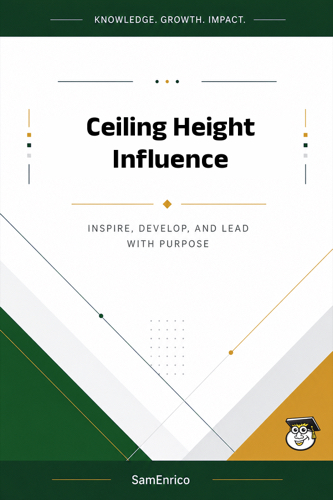
Ceiling Height Influence eBook
High ceilings encourage abstract thinking and crea
by Hong David
High ceilings encourage abstract thinking and creativity.
Formats
Free sample
Chapter 1: The Cathedral Effect--–- Jonas Salk was not supposed to discover the polio vaccine in a monastery. By all logical accounts, the breakthrough should have happened in his laboratory—a sterile, efficient, low-ceilinged basement in Pittsburgh, lined with beakers, microscopes, and the concentrated hum of fluorescent lights. That was where the work happened. That was where data was analyzed, experiments were run, and problems were solved methodically. And yet, when Salk later reflected on the moment the answer arrived—the moment when the fragmented pieces of a decade of research suddenly assembled themselves into a coherent whole—he did not point to his lab bench.
He pointed to a monastery in Assisi, Italy.Salk had traveled there to rest. The monastery, perched on a hillside overlooking the Umbrian valley, had none of the trappings of a scientific facility. There were no test tubes, no charts, no colleagues to debate with. What it had, instead, was space. Soaring, ancient, stone-vaulted ceilings that rose thirty feet above the floor.
Arched windows that flooded the room with soft, diffused light. A profound sense of openness that seemed to invite the mind to wander beyond its usual borders. Salk walked those cloisters for days, not working, not forcing solutions, just thinking in the company of volume. And then, in a way he could never fully explain in scientific terms, the answer arrived. The structure of the vaccine appeared in his mind as if it had been waiting there all along.When he returned to his cramped basement lab, he did not feel inspired.
He felt focused. He took the abstract blueprint his mind had constructed among the high ceilings and translated it, step by painstaking step, into a working vaccine. The monastery gave him the idea. The basement gave him the execution. He needed both.This story, often told in productivity circles as a quaint anecdote about the value of rest, is actually something much more important.
It is the first documented clue of a profound and largely ignored phenomenon: the ceiling above your head is quietly, constantly, and powerfully shaping the quality of your thoughts. You have been living under this influence your entire life without ever being told it exists. That ends now.The Invisible Thermostat of the Mind Think for a moment about the spaces where you do your most important work. Where do you sit when you need to solve a difficult problem? Where do you go when you need to focus intensely on a detailed task?
Where do you find yourself when ideas seem to flow effortlessly, and where do you retreat when you need to grind through something tedious and precise? Chances are, you have never asked yourself these questions. And yet, if you pause to consider them honestly, you will likely notice a pattern. There are rooms where you feel sharp, visionary, and quick to make unexpected connections. There are other rooms where you feel careful, methodical, and slightly constrained.
You have probably attributed these differences to your mood, your energy level, or the time of day. You have been wrong.The field of neuroarchitecture—the study of how built environments physically alter brain function—has demonstrated conclusively that the volume of space around you changes the way you think. Not metaphorically. Not psychologically in a loose, poetic sense. Neurologically.
Your brain is not a sealed, self-contained organ that processes information in a vacuum. It is a porous, responsive system that constantly takes cues from your surroundings, adjusting its processing priorities based on what the environment signals is important. A high ceiling signals one set of priorities. A low ceiling signals another. And you have been responding to these signals every moment of every day without ever being aware of the conversation.This phenomenon has a name.
It is called the Cathedral Effect, a term coined by researchers Joan Meyers-Levy and Rui (Juliet) Zhu in their landmark 2007 study published in the Journal of Consumer Research. The name is apt because it captures the intuitive experience of walking into a grand, vaulted space like a cathedral and feeling something shift inside you. That feeling is not awe alone—though awe is part of it. It is a cognitive shift, a reorientation of your mental processing from the specific to the abstract, from the local to the global, from the detailed to the relational. The cathedral does not just make you feel small in a humbling way.
It makes your thinking large.Divergent vs. Convergent: The Two Modes of Thought To understand the Cathedral Effect, you must first understand a fundamental distinction in cognitive science: the difference between divergent thinking and convergent thinking. These two modes of thought are not better or worse than one another. They are simply different tools for different jobs, and the ceiling above your head is the switch that determines which tool your brain reaches for.Divergent thinking is the mode of abstraction, association, and creativity. It is what happens when your mind is allowed to roam freely, making connections between seemingly unrelated ideas, generating multiple possible solutions to a problem, and seeing the forest rather than the individual trees.
Divergent thinking is what you use when you brainstorm, when you strategize, when you write the first draft of a novel, when you design a product from scratch, when you try to see the big picture. It thrives on possibility, ambiguity, and freedom. It is, to use a spatial metaphor, the thinking that happens when your mind has room to breathe.Convergent thinking is the opposite. It is the mode of analysis, precision, and focus. Convergent thinking narrows possibilities down to a single correct answer.
It evaluates, edits, calculates, and verifies. It is what you use when you proofread a contract, when you debug code, when you balance your checkbook, when you perform surgery, when you land an airplane. Convergent thinking thrives on clarity, rules, and constraints. It wants the world to be specific and knowable. It is the thinking that happens when your mind is zoomed in, examining the bark on a single tree rather than the shape of the forest.Here is the crucial insight that most people never stumble upon by themselves: your environment primes your brain for one mode or the other.
And ceiling height is one of the most powerful environmental primes ever discovered.A room with a high ceiling—generally accepted in the research as ten feet or above—signals freedom, possibility, and expansiveness. Your brain receives this signal unconsciously and shifts toward divergent thinking. You become better at abstract reasoning, at making novel connections, at generating multiple solutions to a single problem. You become more creative, not because you have suddenly gained new abilities, but because you have unlocked abilities that were already there, suppressed by the wrong environment.A room with a low ceiling—under nine feet—signals constraint, safety, and specificity. Your brain receives this signal and shifts toward convergent thinking.
You become better at detailed analysis, at catching errors, at focusing on a single task without distraction. You become more precise, more careful, more accurate. You do not become less intelligent. You become differently intelligent, optimized for a different kind of cognitive work.Neither…
This is the end of the free sample. Get the eBook to keep going. Buy now
About this book
Details
- Author
- Hong David
- Publisher
- SamEnrico
- Language
- English
- Genre
- Non-Fiction, Self-Help, Spatial Psychology
- Released
- 2026-06-06
- Pages (approx.)
- 154
- Available as
- eBook, Audiobook

Read better in the ZLOADR app
Your eBooks on your phone or tablet. Sign in with your SamEnrico account and start reading.
More by Hong David
 Disability Accommodation AngerHong David$11.99
 Professional Ethics and Addiction RecoveryHong David$11.99
 Portfolio Management InnovationHong David$11.99
 The Ransom of Fort Pillow: The Betrayal That Shook the NationHong David$11.99
 YC African Startup Tech StackHong David$12.99
 VAT and EducationHong David$12.99
 Understanding TularemiaHong David$17.99
 How to Become a Planimeter OperatorHong David$11.99
 Design CoordinatorHong David$11.99