
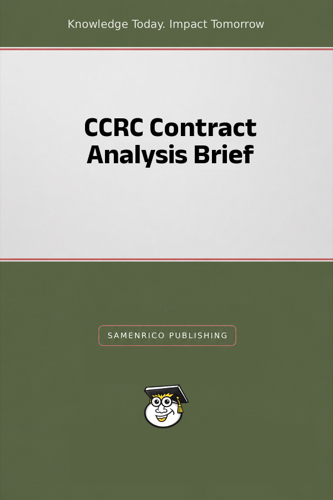
Non-FictionBusiness BriefSenior Living
CCRC Contract Analysis Brief eBook
Compares Type A, B, and C continuing care contract
Compares Type A, B, and C continuing care contracts actuarially.
Formats
Free sample
Chapter 1: The Great Masquerade--–- The brochure in your hands feels substantial, printed on heavy stock with a matte finish that suggests quality. On the cover, a silver-haired couple laughs while holding ceramic mugs on a sun-drenched patio. Inside, you find floor plans, sample menus featuring herb-crusted salmon, a schedule of water aerobics classes, and testimonials from residents who describe their move as "the best decision we ever made." What you will not find—what no CCRC marketing brochure has ever contained—is an actuarial table. There will be no discussion of morbidity assumptions, no disclosure of funded ratios, no explanation of how the community plans to cover the $150,000 per year it costs to keep a resident with advanced dementia in its skilled nursing wing.This omission is not accidental. The entire consumer experience of shopping for a CCRC is designed to masquerade as a real estate transaction precisely because the underlying financial reality is far more complex and far less reassuring.
You are not being deliberately deceived, but you are being artfully directed away from questions that might unsettle you. The industry knows that if prospective residents fully understood the insurance mechanics embedded in their contracts, they would ask harder questions, demand more transparency, and—in some cases—walk away entirely.This chapter pulls back the curtain on that masquerade. It reveals why a CCRC is fundamentally an insurance company disguised as a retirement community, why this distinction matters more than any other factor in your decision, and how failing to understand this distinction has led thousands of retirees to financial ruin. By the time you finish reading, you will never look at a CCRC brochure the same way again.The Real Estate Mirage Consider what you know about buying a house. You pay a price, receive a deed, and acquire a set of rights that include selling, renting, remodeling, and bequeathing.
The transaction is discrete; once completed, your obligations to the seller are zero. The seller's obligations to you are also zero, except for warranties that gradually expire. This clean, arms-length exchange is what generations of Americans have internalized as "buying a home."Now consider what happens when you "buy into" a Type A CCRC. You pay an entrance fee—often between $400,000 and $800,000, sometimes exceeding $1 million in high-cost metropolitan areas. In exchange, you receive the right to occupy a specific unit for the rest of your life.
That right, however, comes with a dense web of restrictions. You cannot sell the unit. You cannot rent it to your grandchildren. You cannot leave it to your heirs, except possibly a portion of the entrance fee if you selected a refundable option. You cannot remodel the kitchen or knock down a wall.
You cannot even choose your own contractor to fix a leaky faucet; maintenance is the community's domain.Worse, your continued occupancy depends on your continued payment of monthly fees, which typically start around $3,000 to $5,000 but can rise arbitrarily if the community faces financial pressure. Fail to pay, and you can be evicted—just like a tenant in an apartment building. The non-profit status of many CCRCs does not change this basic fact. The resident agreement is a lease, not a deed.So why does the industry call it an "entrance fee" rather than a "prepaid insurance premium with a lifetime lease attached"? Because real estate sells.
Real estate is tangible. You can touch the countertops, walk the grounds, and imagine yourself hosting Thanksgiving dinner in the dining room. Insurance is abstract. Insurance is paperwork and fine print and the nagging worry that the company might not be there when you need it. The masquerade serves a psychological purpose, making an intimidating financial product feel familiar and safe.But safety purchased through familiarity is an illusion.
The real safety of a CCRC contract depends entirely on factors invisible to the naked eye: the adequacy of reserves, the accuracy of actuarial assumptions, and the discipline of management. None of these can be assessed by admiring the landscaping.The Insurance Company You Did Not Know You Were Joining If a corporation approached you and offered to sell you a policy that covered unlimited skilled nursing care for the rest of your life in exchange for a large upfront payment and ongoing monthly premiums, you would immediately recognize that you were buying insurance. You would ask about the company's financial ratings, its claims-paying ability, and the regulatory oversight to which it was subject. You might consult an independent insurance broker. You would certainly not make a decision based on the quality of the company's cafeteria.Yet this is exactly what a Type A CCRC contract is: an insurance policy that covers long-term care costs, bundled with a lifetime lease on a residential unit.
The insurance component is not incidental or optional. It is the primary driver of both the contract's value and its risk. Remove the insurance promise—guaranteed access to assisted living and skilled nursing at predictable prices—and the entrance fee would drop by half or more. You would simply rent an apartment in a senior community, paying market rates for any future care needs.The insurance function of a CCRC becomes visible when you examine the flow of money. New residents pay entrance fees that are substantially higher than the market value of the residential units they occupy.
That premium does not disappear into executive bonuses or shareholder dividends (in non-profits, at least). It is deposited into reserves earmarked for future healthcare obligations. Actuaries calculate the present value of those obligations—the total cost of all assisted living and skilled nursing care that current residents are expected to consume over their remaining lifetimes. The entrance fees, together with a portion of monthly fees, are supposed to fund that present value.This is precisely how an insurance company operates. Policyholders pay premiums.
The insurer holds reserves equal to the present value of expected future claims. Claims are paid when policyholders need care. The insurer profits (or breaks even, in the case of non-profits) to the extent that actual claims are lower than projected or investment returns exceed expectations.The parallel is not merely conceptual; it is legal and regulatory. States that regulate CCRCs—California through AB 3088, for example—explicitly treat Type A contracts as insurance products, requiring actuarial studies, reserve requirements, and periodic financial examinations. The regulators understand what the marketing brochures obscure: a promise of future healthcare is a promise of future healthcare, regardless of whether it is packaged with a patio and a pool.The Promissory Note That Hangs Over Every CCRCEvery Type A CCRC carries on its books a liability called the "actuarial present value of future healthcare obligations." This number represents the total discounted cost of all assisted living and skilled nursing care that the community has promised to its current residents.
For a medium-sized CCRC with 300 independent living units, this liability can easily exceed $100 million. For a large community in an expensive market, $300 million or more is not unusual.This liability is a promissory note. It is a legally enforceable obligation to deliver care, regardless of how much that care costs at the time it is delivered. If healthcare inflation runs higher than…
This is the end of the free sample. Get the eBook to keep going. Buy now
About this book
Details
- Author
- Davenport Alecia
- Publisher
- SamEnrico
- Language
- English
- Genre
- Non-Fiction, Business Brief, Senior Living
- Released
- 2026-06-06
- Pages (approx.)
- 142
- Available as
- eBook, Audiobook

Read better in the ZLOADR app
Your eBooks on your phone or tablet. Sign in with your SamEnrico account and start reading.
More by Davenport Alecia
 Postpartum Extended Family BoundariesDavenport Alecia$11.99
 Nuclear Fusion InvestmentDavenport Alecia$11.99
 MBSR for TeensDavenport Alecia$11.99
 Ultrasound Skin Lifting CourseDavenport Alecia$11.99
 Safety Plan for TriggersDavenport Alecia$11.99
 IBS Hypnosis Script GuideDavenport Alecia$11.99
 Workplace Relationship AngerDavenport Alecia$11.99
 Schwarzenegger TerminatorDavenport Alecia$11.99
 The Golden Scalpel: The Royal Physicians of the Kingdom of KongoDavenport Alecia$11.99
 Quetzalcoatl’s Fire: The Feathered Serpent’s WisdomDavenport Alecia$11.99
 Ghosts in the Machine: The Hunt for the Higgs BosonDavenport Alecia$11.99
 Mastering CrowdfundingDavenport Alecia$11.99
You may also like
 Hong Kong Handover 1997Dunn Johnnie$11.99
 Zumba For Postnatal Recovery CourseNeal Christian$11.99
 Zumba for BeginnersLadner Nikia$11.99
 YouTube Comment Mining GuideHumes Pandora$12.99
 Worry Box MeditationCarlin Rudy$11.99
 Workplace Stress MeditationNguyen Lynn$11.99
 Workplace Stress and Sleep RepairHawley Ivory$11.99
 Workplace Perfectionism CureDelaney Jeffry$11.99
 Workplace Injustice Anger GuideWallen Isabelle$11.99
 Work Addiction and Burnout LinkGreenwood Ester$11.99
 Women in Yoga and WellnessBeattie Galina$11.99
 Women in Stand Up ComedyChun Evangeline$11.99