
Non-FictionSelf-HelpSanctuary Imagery
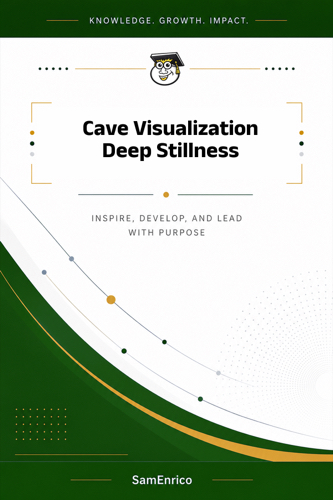
Cave Visualization Deep Stillness eBook
Enter an imagined crystal cave, feeling cool, safe
Enter an imagined crystal cave, feeling cool, safe, and profoundly quiet away from noise.
Formats
Free sample
Chapter 1: The Primal Enclosure...--You are reading this because somewhere beneath the surface of your busy life, you are tired. Not the ordinary tiredness that comes after a long day and disappears after a good night's sleep. A deeper exhaustion. The kind that settles into your bones when you have spent another week swimming through notifications, obligations, small talk, bad news, endless decisions, and the low-grade hum of a world that never seems to shut off. You have tried to relax.
You have tried meditation, perhaps, and found that sitting still only made your mind louder. You have tried vacations, only to return more drained than when you left. You have tried scrolling, eating, drinking, buying—all the small anesthetics of modern life—and each one works for about fifteen minutes before the noise returns, hungrier than before.What you are holding in your hands is not another relaxation technique. It is not a set of affirmations to repeat until you believe them, nor a collection of inspirational quotes to pin on your wall. This book is a door.
Behind that door is a place your brain already knows how to enter, though you may have forgotten the way. It is a cave. Not a dark, threatening cave from childhood nightmares, but a crystal cave—cool, safe, profoundly quiet, and waiting for you to step inside.Before you read another word, take a single breath. Not a special breath. Not a meditative breath.
Just the breath you are already breathing. Notice that for this one moment, you are not doing anything wrong. You have not failed at calm. You have simply never been shown a sanctuary that actually fits the way your mind works.This chapter will explain why a cave—specifically a crystal cave—is the most powerful visualization sanctuary for the overstimulated, overconnected, overwhelmed human brain. You will learn the evolutionary logic of enclosures, the two distinct ways coolness can serve you, and why forests and beaches have been letting you down.
By the end of this chapter, you will have taken your first guided journey to the cave's mouth, where cool air meets your skin and the boundary between noise and stillness becomes real.The Problem with Every Relaxation Method You Have Tried Let us be honest about what has not worked. You have likely been told to "quiet your mind" as if your mind were a radio with a volume knob you simply forgot existed. You have been told to picture a peaceful beach, but the beach came with imaginary seagulls, imaginary sunburn, and the uncomfortable awareness that you were supposed to be feeling peaceful and were not. You have been told to breathe deeply, which worked for exactly three breaths before your mind reminded you about the email you forgot to send.None of this is your fault. The problem is not your willpower, your discipline, or your capacity for peace.
The problem is that most relaxation methods were designed for people who lived in a different world. They were designed for monks in silent monasteries, for retreat participants who have already unplugged for ten days, for people whose nervous systems are not constantly being hammered by the equivalent of a thousand tiny alarms every hour.You live in an environment that your brain evolved to treat as a life-or-death emergency. Not because your life is actually in danger, but because your ancient nervous system cannot tell the difference between a notification from your boss and a rustle in the bushes that might signal a predator. Both trigger the same cascade of stress hormones. Both activate the same fight-or-flight response.
Both leave you slightly more depleted than you were before.This is not a metaphor. This is physiology. Each time your phone buzzes, your brain releases cortisol. Each time you switch tasks, your brain burns through glucose as if it were running from a tiger. Each time you walk into a room with fifteen competing stimuli—screens, voices, lights, colors, movements—your sympathetic nervous system stays partially activated, waiting for the threat that never quite arrives but never quite goes away.You are not broken.
You are responding exactly as you should to an environment that no human brain was designed to inhabit. The solution is not to try harder. The solution is to find a sanctuary that matches your biology.Why the Cave? Evolutionary Logic of the Enclosure Every animal seeks enclosure when threatened. Rabbits retreat to burrows.
Birds return to nests. Bears den in caves. This is not cowardice; it is survival. An enclosed space reduces the number of directions from which a threat can come. It contains warmth.
It muffles sound. It creates a boundary between the vulnerable self and the overwhelming world.Your brain carries this ancient logic with you, even now, even in a world without predators. When you pull the covers over your head, when you close your office door, when you sit in a closet during a panic attack—you are reaching for the enclosure response. Your brain knows, on a level deeper than thought, that an enclosure means safety.The cave is the original enclosure. It is the burrow of your species, the den of your ancestors.
For hundreds of thousands of years, caves provided the first true sanctuary from weather, from predators, from enemy tribes, from the raw chaos of the world outside. Your brain still remembers. When you imagine a cave, even a crystal cave you have never seen, something ancient in you exhales.But here is what most visualization methods get wrong. They ask you to imagine open spaces. A beach.
A forest clearing. A mountaintop. These places are beautiful, but they are not enclosures. They leave your brain's threat-detection system partially online because threats can come from any direction. A beach has the open sky above and the open sea before you.
A forest has sounds behind every tree. These are not sanctuaries for a tired nervous system. They are beautiful places to be alert.A cave, by contrast, offers three walls and a ceiling. There is no horizon to scan, no approach to monitor, no direction from which surprise can come except the single entrance you have already passed through. Once you are inside the cave, your brain can finally stop scanning.
There is nothing to watch for. You are enclosed. You are safe.This is not imagination. This is measurable physiology. Studies of enclosed versus open virtual environments show that enclosed spaces consistently lower heart rate, reduce skin conductance (a measure of sympathetic arousal), and increase subjective reports of safety and calm.
The effect is strongest in people who report high baseline stress—exactly the readers for whom this book is written.The Two Faces of Cool: Alert-Calm and Deep Rest One of the most common misunderstandings about relaxation is that all calm feels the same. It does not. There is a profound difference between the calm you need before a difficult meeting and the calm you need before sleep. Most relaxation methods try to force both into the same shape, and as a result, they work for neither.Temperature is the missing link. Throughout this book, we will work with a simple, powerful…
This is the end of the free sample. Get the eBook to keep going. Buy now
About this book
Details
- Author
- Billings Bethel
- Publisher
- SamEnrico
- Language
- English
- Genre
- Non-Fiction, Self-Help, Sanctuary Imagery
- Released
- 2026-06-08
- Pages (approx.)
- 145
- Available as
- eBook, Audiobook

Read better in the ZLOADR app
Your eBooks on your phone or tablet. Sign in with your SamEnrico account and start reading.
More by Billings Bethel
 MBSR For Substance Abuse Recovery WorkbookBillings Bethel$11.99
 PCOS Vitamin D ImportanceBillings Bethel$11.99
 The Francoise Barre Sinoussi HIV StoryBillings Bethel$11.99
 Sunday Scare Prevention GuideBillings Bethel$11.99
 The Last Emperor of Ice: The Obsessive Quest to Save the ArcticBillings Bethel$11.99
 Shop CustodianBillings Bethel$11.99
 A Beginners Guide to Freestyle swimming (Volume 1)Billings Bethel$11.99
 Canadian Graduate Medical ExamBillings Bethel$12.99
 PayPal SWOT GuideBillings Bethel$12.99
 Understanding Osteochondritis DissecansBillings Bethel$17.99
You may also like
 Hong Kong Handover 1997Dunn Johnnie$11.99
 Zumba For Postnatal Recovery CourseNeal Christian$11.99
 Zumba for BeginnersLadner Nikia$11.99
 YouTube Comment Mining GuideHumes Pandora$12.99
 Worry Box MeditationCarlin Rudy$11.99
 Workplace Stress MeditationNguyen Lynn$11.99
 Workplace Stress and Sleep RepairHawley Ivory$11.99
 Workplace Perfectionism CureDelaney Jeffry$11.99
 Workplace Injustice Anger GuideWallen Isabelle$11.99
 Work Addiction and Burnout LinkGreenwood Ester$11.99
 Women in Yoga and WellnessBeattie Galina$11.99
 Women in Stand Up ComedyChun Evangeline$11.99